
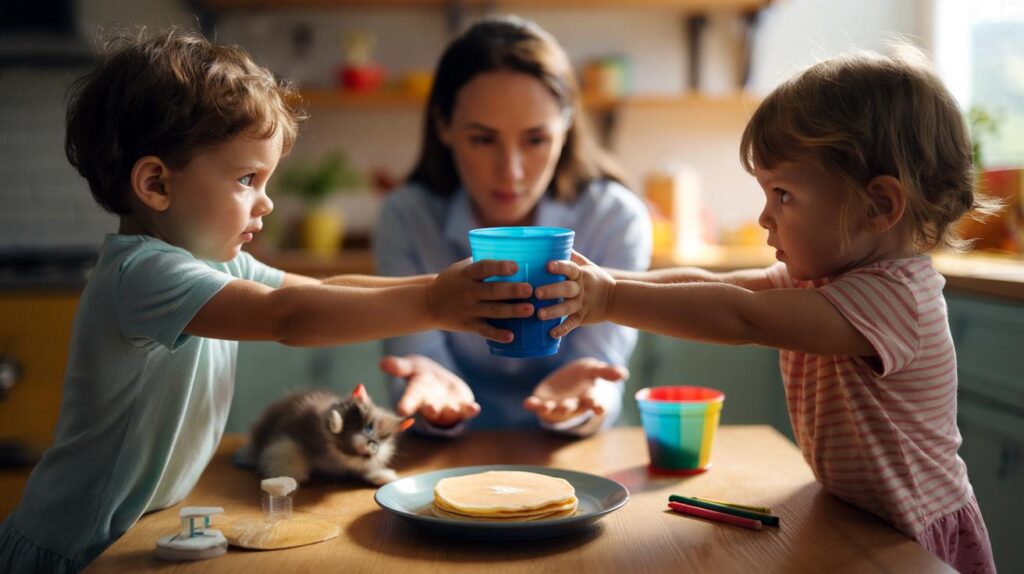
The row starts over a battered blue cup. Two children, both sure they saw it first, both certain the other one is cheating the universe. Someone wails, someone shouts “Mum!” like it’s a courtroom summons, and the cat shoots under the table as if there’s been a small explosion of toast. You feel the familiar pull: referee, judge, peacekeeper, vending machine for fairness. In the space of a breath, you’re already picking sides in your head. Then you notice something else.
Sibling rivalry explained: why jealousy between kids is normal
Jealousy isn’t a flaw in children; it’s a signal that something they value feels scarce. Attention, status, a toy, the last pancake — the currency shifts by the hour, yet the feeling is the same. In family life, your living room is the training ground where they learn what to do with that surge of “not fair”, and how to bring it down to a level they can live with.
When a baby arrives, a four-year-old who once sprawled starfish-wide on your lap has to fold themselves into a corner of it. They don’t have the language to say “I miss the old ratio”, so the message comes out sideways: grabbing, boasting, eye-rolling, tattling. We’ve all been there, watching one child stunt-double the other’s tricks or exaggerate tiny slights, because matching a sibling isn’t just about toys — it’s about place.
Under the bonnet, their brains are still fitting the brakes. The prefrontal cortex — the bit that plans and waits — matures slow, while the emotional engine is already revving. The gap between “I want” and “I can wait” is a developmental canyon, not bad behaviour. Social comparison is wired into us, so kids scan for rank all day; it’s why “fair” to them often means identical, even though **fair doesn’t mean equal**.
How children can learn to resolve it themselves
Start with a pause that buys everyone a tiny window. Walk in and narrate what you see like a sports commentator: “Two people want the blue cup; hands are on it; faces look tight.” Then invite them to lead: “What’s the plan? Two minutes each, different cups, or a swap for something else?” You’re lending them structure, not verdicts.
Skip the courtroom. When you rush to decide who’s right, kids learn to perform for the judge instead of thinking. Swap “Who started it?” for “What do you both need?” Model neutral language, keep your voice low, and get curious. Let’s be honest: nobody really does that every day. Aim for more of it than yesterday, not perfection, and notice even tiny steps, because momentum is everything.
Teach a simple conflict script they can remember at five and still use at fifteen: “Say what you need; suggest two solutions; pick one you both can live with.” Separate the kids from the problem, not from each other, so the issue stays the enemy, not the sibling. Sibling rivalry isn’t a bug in family life; it’s a rehearsal for the world outside your front door.
“Jealousy is information, not accusation. When children learn to read it, they learn to steer it.” — Family therapist, London
- Use “two yeses” choices (“What’s a plan you both can say yes to?”)
- Swap forced apologies for repairs (“How will you make it feel better?”)
- Create “ownership zones” and “share zones” to reduce friction
- Bank daily one-to-one time tokens to soften spikes of envy
What this phase can teach a family
Jealousy becomes less scary when it’s named and handled, not shushed. Kids learn that big feelings can shrink with words, that solutions can be built, and that power doesn’t always come from being louder. The real win isn’t silence; it’s two children who can look at each other and try a different move.
There’s a quiet shift when you stop asking “Who deserves the blue cup?” and start asking “What will get us moving again?” Suddenly, the house isn’t a court, it’s a workshop. The skill you’re building is portable: they’ll use it with friends, in teams, and later at work when the blue cup becomes a deadline, a promotion, or a seat at a table.
On some days, you’ll still hear the siren of “Muuum!” cut the air and feel your shoulders climb your ears. On those days, the aim is smaller: one less verdict, one extra question, one moment of spotting the need underneath the noise. **Jealousy is information**; your home is where they learn to read it out loud.
| Key points | Details | Interest for reader |
|---|---|---|
| Jealousy is normal | Signals perceived scarcity of attention, status or stuff | Reframes rivalry as teachable, not shameful |
| Coach, don’t judge | Use narration and “two yeses” to guide solutions | Practical scripts parents can try tonight |
| Build repair habits | Swap blame and forced apologies for meaningful fixes | Reduces repeat fights and grows empathy |
FAQ :
- What if one child always seems to “win” arguments?Shift from outcomes to process. Rotate “first choice” roles outside the conflict, and during disputes use a timer or swap rule so neither child’s default strategy is domination.
- Is rivalry worse with small age gaps?Sometimes the closer the ages, the closer the interests — which can mean more friction. Counter it with clear zones, duplicated high-demand items where possible, and regular separate “special time” to lower the stakes.
- How do I handle physical fights safely?Step in early if bodies or belongings are at risk. Block, separate to cool off, and revisit with a simple repair script when calm. Teach “tap out” phrases for breaks before hands get involved.
- Won’t they become soft if I don’t assign blame?Accountability stays; humiliation goes. You’re still naming harm and guiding reparations, you’re just avoiding labels like “bully” and “victim” that lock kids into roles.
- What about neurodivergent siblings with different needs?Use visual cues, predictable routines, and more explicit scripts. Keep “fair isn’t equal” language in play, and agree on sensory-friendly exits so both children have a path back to calm.



This is gold. The “two yeses” idea — tried it at breakfast and my kitchen was suddenly less of a courtroom 🙂