
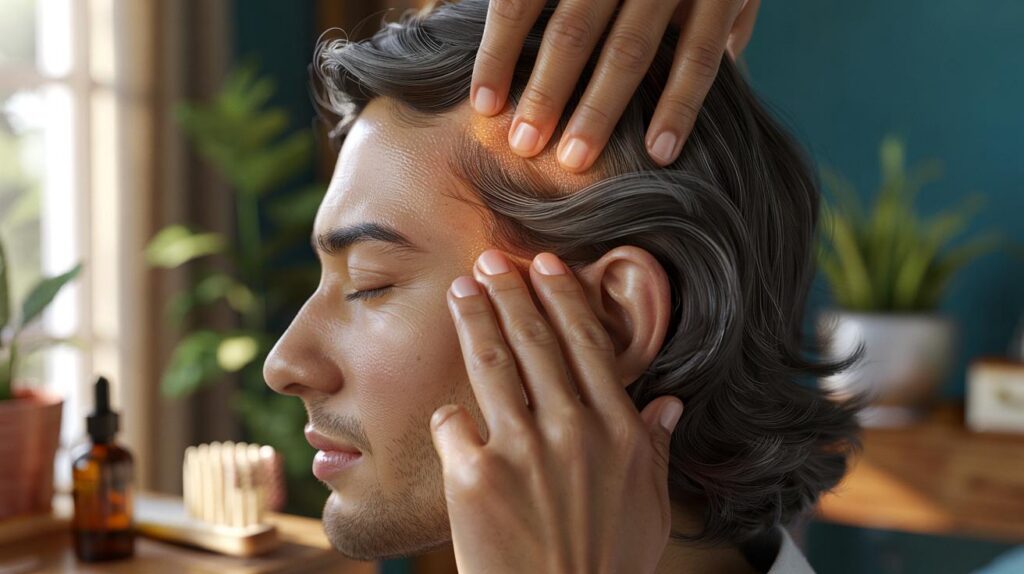
Between headphones, high buns and long days at a desk, the scalp gets quietly starved of movement. Blood flow slows, roots sulk, tension builds behind the ears. The fix isn’t a miracle lotion. It’s a daily, two‑minute ritual your fingers already know.
I first noticed it on the 7.42 to Victoria: a woman in a navy coat kneading her temples as the train rattled, thumbs sinking, breathing soft. Her shoulders dropped a centimetre, maybe two. By Clapham Junction, the skin above her ear had turned a shade warmer, almost pink. It looked like something small switching back on.
Later a barber in Brixton told me he could tell who massaged by the way their scalp “moved like fabric, not board.” He said it with a grin, like a secret. I went home and tried it while the kettle boiled, and the whole crown felt alive by the time the water whistled.
What if your scalp could learn to breathe again?
Why circulation makes your scalp happier
Hair roots sit in tiny, hungry bulbs called follicles. They live off oxygen, glucose and micronutrients delivered by blood. When your scalp is tight from stress or stiff from static posture, those microscopic roads get sluggish.
Warmth is the first sign that blood is moving. You feel it as a gentle flush under your fingertips. That warmth isn’t magic; it’s circulation delivering what the roots need and carrying away waste that can make skin grumpy.
There’s a small but telling body of research. A Japanese pilot study found four minutes of daily scalp massage increased hair thickness after 24 weeks. Another survey of people doing self-massage reported less shedding anxiety and better “hair feel” within a month. Real life echoes it: barbers and trichologists see calmer scalps and livelier roots in clients who touch their heads with purpose.
The mechanism is simple biology. Massage creates mechanical pressure that signals blood vessels to widen. More flow means better nutrient delivery and a fresher environment around the follicle. Gentle stretching of the skin also seems to reduce stiffness in the tissue layers, so the scalp glides instead of clamping down.
There’s also the stress circuit. When you slow your hands, your breath follows. That nudge to your nervous system drops cortisol, which helps calm inflammation. A relaxed scalp isn’t just a feeling; it’s chemistry shifting in your favour. **Warmth means blood flow.**
How to do simple daily scalp massages—step by step
Start with clean hands and dry or lightly oiled hair. Place the pads of your fingers on your hairline, not the nails. Press to a “3 out of 10”, then make slow circles the size of a 10p coin. Move in sections: hairline to crown, crown to nape, ears to centre.
Use a rhythm: press, glide, lift. Each spot gets five slow circles before you travel. Aim for 60 to 120 seconds in total. Morning in the mirror or night on the sofa both work. **Light, steady pressure is king.**
For extra glide, warm a drop of lightweight oil between your hands and sweep it over the scalp before you start. *You don’t need a spa budget to feel better.* If you prefer a tool, a soft silicone scalp brush is fine—short strokes, no sawing.
Common slip-ups are easy to fix. Don’t scratch with nails or drag hair; that irritates skin and snaps strands. Keep the pace slow. If you’re pressing so hard your face tightens, you’re overdoing it.
Skip very hot showers beforehand, as flushed skin can mislead you on pressure. If your scalp is flaky or sore, go lighter and shorter while it settles. Let product build-up be a cue: wash, then massage, not the other way around. We’ve all had that moment when we realise we’ve been clenching our jaw for hours—your scalp does the same.
Let’s be honest: nobody really does this every single day. Aim for “most days” and forgive the rest. **Two minutes beats zero.**
Pros will tell you it’s less about fancy moves and more about consistency. A small routine, repeated often, gets results you can feel in a week.
“Think of the scalp like a lawn on compacted soil,” says a London trichologist. “Loosen the ground a fraction each day and the roots do the rest.”
- Pressure target: gentle to firm, never painful
- Motion: tiny circles, then short lifts
- Route: hairline to crown, crown to nape, around ears
- Time: 60–120 seconds, most days
- Boosters: warm hands, a drop of light oil, slow breathing
Make it a tiny ritual you actually keep
Pair the massage with anchors you already have. While the kettle warms. After your face cream. During the “skip ad” count. Tiny repeats stack faster than heroic bursts.
Set the mood on low effort days: shoulders down, jaw unclenched, breath through your nose. If your scalp feels wired, drop pressure and lengthen the circles. If it feels sleepy, trade circles for short, rhythmic lifts.
Share the habit with someone at home. Teach a partner the hairline-to-crown route and swap two minutes each. Notice how your focus shifts when your head stops buzzing. The world doesn’t get quieter, you do.
| Key points | Details | Interest for reader |
|---|---|---|
| Circulation first | Gentle, regular pressure warms tissue and widens tiny vessels | Better-fed follicles, calmer scalp feel |
| Technique matters | Pads of fingers, small circles, section-by-section route | Easy to learn, low risk of irritation or breakage |
| Consistency over time | 60–120 seconds most days outperforms long, rare sessions | Results you can feel quickly, habit you’ll keep |
FAQ :
- How hard should I press?Think “firm handshake”, not “door slam”. The skin should move under your fingers without pain.
- When will I notice a difference?Many people feel warmth and release straight away. Texture and comfort shifts usually happen within 7–14 days.
- Can scalp massage help with hair growth?It supports the environment by improving blood flow and easing tension. It’s not a cure-all, but it can complement a broader routine.
- Should I use oil?Optional. A drop of lightweight oil can add glide on dry hair. Fine or oily scalps may prefer clean, dry hands.
- What if I have dandruff or a sensitive scalp?Go softer and shorter, and keep nails off the skin. If irritation persists or you have a condition, speak with a professional.



Tried the ‘press, glide, lift’ while the kettle boiled and wow—felt that gentle flush within 90s. Bookmarked for ‘most days’ reality. Thanks for the no‑nonsense tips! 😊
Any chance you can link the Japanese pilot study and the survey? Curious about sample size and effect magnitute; hair thickness changes can be tiny and within error bars.