
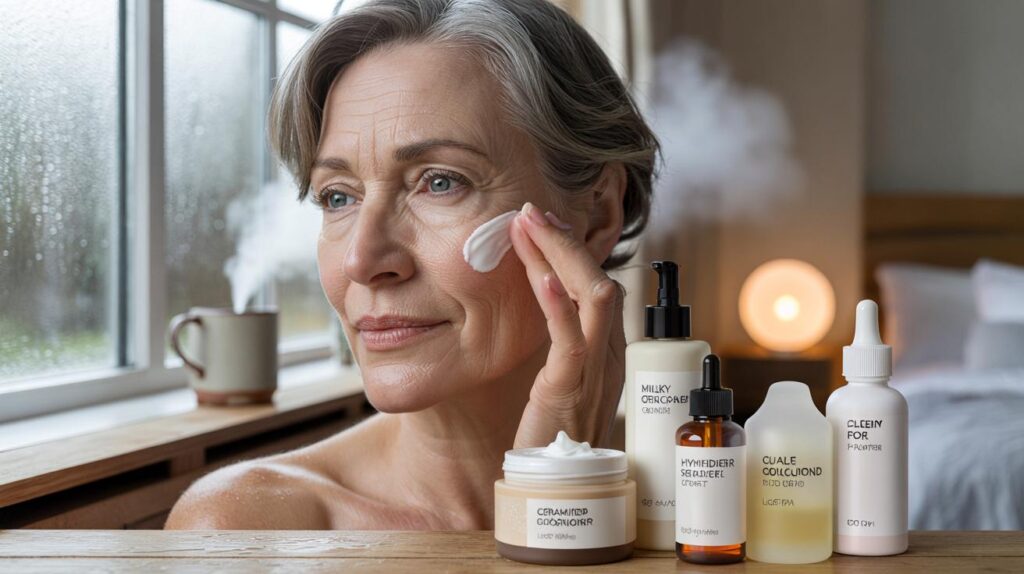
Your face isn’t “suddenly dry.” Skin over 50 is doing hard work. Oestrogen dips, heating goes on, wind bites, and the old tricks stop landing. Barrier repair becomes the main plot, not a side note. It’s less about chasing a glow stick and more about keeping what you already have — water, lipids, and calm.
The first cold Tuesday of the year, I watched a woman in a café warm her hands around a mug and pat moisturiser over lipstick smudges. *The radiator hissed and the mirror fogged.* She checked her reflection anyway, a quick glance we all recognise after a certain birthday. Her skin looked thirsty, not tired, and the foundation had gathered in little flakes along her smile. We made eye contact and exchanged that micro-nod that says, “Same.”
On the walk home I kept thinking about the thinness of winter air and the thinness of skin that’s seen five, six decades. The face doesn’t bounce back in the same way. The fix isn’t another acid.
Why the barrier becomes the story after 50
Over 50, the skin’s lipid matrix doesn’t just slow — it edits itself down. Ceramides fall, cholesterol shifts, and transepidermal water loss quietly climbs. The barrier is brick-and-mortar biology: corneocytes as bricks, lipids as mortar. When the mortar thins, water escapes. The result isn’t drama; it’s that nagging tightness after cleansing and the afternoon crêpe that make-up won’t hide. **Barrier first, trends second.**
Moira, 58, told me she thought she needed more exfoliation because her skin felt rough. Two weeks after swapping a foaming wash for a milky cleanser and adding a ceramide + cholesterol cream at night, the roughness softened without a single scrub. She hadn’t changed her foundation. She changed her barrier. Dermatology clinics have noted a jump in dryness through the peri- and post-menopause years, as lipid production declines and the acid mantle drifts. The skin isn’t misbehaving. It’s signalling.
Here’s the logic. A sturdy barrier locks in water and keeps irritants, pollution and overzealous actives at the door. A fragile barrier lets everything in and everything out, which is why strong acids feel fiery and fragrance suddenly stings. Replenishing the mortar — ceramides, fatty acids, cholesterol — in ratios the skin understands (often cited as around 3:1:1) helps restore that fence. Humectants like glycerin and hyaluronic acid draw in water; occlusives and emollients keep it from evaporating. Moisture stays only if the door is shut.
Gentle actives that play nicely with a fragile barrier
Think like a builder, not a decorator. Start with a soft cleanser, lukewarm water, and 30 seconds of unhurried hands. While skin is still damp, use a hydrating serum with glycerin, panthenol, or low-molecular hyaluronic acid. Seal with a moisturiser rich in ceramides, squalane and shea. At night, try the “retinoid sandwich”: moisturiser, pea of low-strength retinol or retinal, then moisturiser again. Twice a week, a lactic acid or PHA toner can nudge dullness without shredding the fence. Patch-test new love affairs on the jawline first.
Now the pitfalls. Big-deal percentages can backfire. A 10% niacinamide serum can flush a reactive face; 2–5% often gives the smoothing and pore-trimming you actually want. Vitamin C as pure ascorbic acid can tingle on thinner skin, so gentler derivatives like sodium ascorbyl phosphate or THD ascorbate may sit better. Over-50 skin likes rhythm — not a new act every night. Let’s be honest: nobody really does that every day. Consistency beats fireworks.
You can still use actives — just choose allies, not adversaries. **Moisture needs lipids and water.** Pair humectants with emollients, retinoids with comfort, and exfoliation with a timer rather than a mood.
“Repair the barrier first, then tread in with actives that whisper, not shout. Hydration that lasts is a composition: water pulled in, lipids replenished, evaporation slowed.”
- Cleansers: cream or gel-cream, fragrance-free, pH-balanced.
- Hydration: glycerin, panthenol, hyaluronic acid, beta-glucan.
- Barrier: ceramides, cholesterol, fatty acids, squalane.
- Retinoid: 0.1% retinal or 0.2–0.3% retinol, two to three nights weekly.
- Exfoliant: lactic acid 5% or PHA once weekly to start.
- Day shield: broad-spectrum SPF 30–50, UVA rating high for UK light.
Hydration that lasts, day after day
We’ve all had that moment when the mirror feels a bit harsher than usual. Lasting hydration begins with tiny, almost boring habits that stack. Shorter showers. Lukewarm, not hot. Face left slightly damp before serum. Hands pressing, not rubbing. A balm on cheekbones before a long walk. A bedside humidifier when the radiators are on and the windows are shut. None of this is flashy. It is oddly soothing.
Oil and water share the work. Humectants draw; lipids defend; occlusives slow the escape. In winter, try a light occlusive step — a pea of petrolatum-based balm or lanolin-rich cream — only where you crease and crinkle. If you’re breakout-prone, pick dimethicone or squalane instead. **SPF is your daily insurance.** UVA is present even on grey British mornings and speeds up collagen loss and dryness signals. It’s not about avoiding the sun. It’s about editing its script on your skin.
There’s room for joy, too. A gentle face massage when moisturiser goes on. A splash, not a scrub. A retinoid night followed by a “boring” buffer night. The skin doesn’t thrive on punishment; it thrives on kindness repeated. You may notice the change first not in the mirror, but in how foundation sits, or how your cheeks don’t complain on the bus home. That’s the quiet win worth sharing.
| Point clé | Détail | Intérêt pour le lecteur |
|---|---|---|
| Rebuild the barrier | Ceramides, cholesterol, fatty acids in skin-friendly ratios | Fewer dryness flares, calmer skin day to day |
| Choose gentle actives | Low-dose retinoid, lactic acid or PHA, 2–3 nights weekly | Smoother texture without the sting |
| Layer for lasting hydration | Humectant on damp skin, emollient to seal, optional light occlusive | Hydration that actually stays put |
FAQ :
- Can I still use retinoids after 50?Yes. Start low, go slow, and “sandwich” between moisturiser. Two to three nights a week is a sweet spot for many faces.
- What ingredients help most with dryness?Glycerin, urea (2–5%), hyaluronic acid for water; ceramides, squalane, cholesterol, shea for lipids. Panthenol and beta-glucan add calm.
- How often should I exfoliate now?Once weekly with lactic acid or PHA is plenty for most. If skin stays calm, step to twice weekly. No scrubs, no “tingle chasing.”
- Do I need a face oil?Useful for comfort, not mandatory. A few drops of squalane or meadowfoam can soften edges. If congestion is a guest, keep oils light and occasional.
- What’s the right order in the morning and at night?AM: gentle cleanse, hydrating serum, moisturiser, SPF. PM: cleanse, hydrating serum, retinoid on alternate nights, barrier cream. On “buffer nights,” skip actives and lean into repair.



Definitley barrier-first resonates. Swapped my foaming cleanser for a cream and the 3pm tightness vanished. Thanks for making it feel sane rather than “anti-age” hype.
Re the 3:1:1 ceramide:cholesterol:fatty acid ratio—do you have a paper or derm guideline to link? I see it everywhere but it feels a bit hand-wavy without a citation. Pls share.