
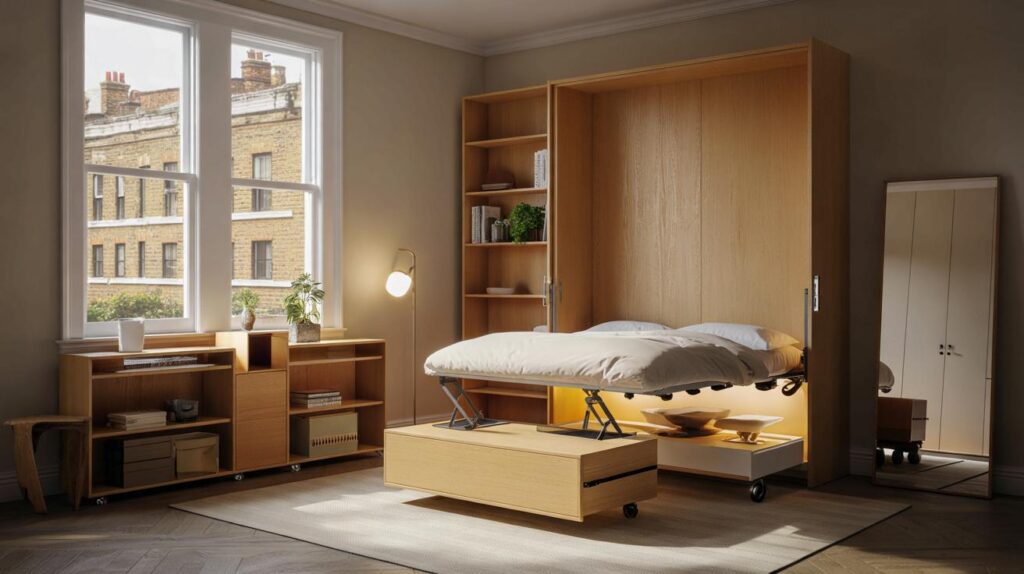
London studios the size of a parking space. Rents that gobble two paycheques. Tiny UK flats are not a vibe, they’re a reality — and they demand furniture that can shapeshift by the hour. The trick isn’t to cram in more stuff. It’s to make every piece earn its keep.
I’m standing in a fourth-floor walk-up in Hackney where the coffee table is also a dining table and, on Tuesdays, a piano bench. The owner, Priya, flips a latch and the lid rises, smooth as a wink. Two stools appear from under the sofa like a magic trick you can actually live with. There’s the soft clack of a wall bed re-holstering itself. Sun hits a mirrored wardrobe and the room doubles, just for a second. Morning is a choreography: kettle boils, desk folds down, laptop opens, toast pops. The entire home shifts between breakfast, office, yoga, and movie night in under four minutes. **Space doesn’t grow; it cooperates.** And when it does, life stops bumping into itself. One question keeps hanging in the air.
Multifunction is the new square footage
Small flats don’t just need smaller furniture; they need furniture with a second life hidden inside. A sofa that’s also storage. A bookshelf that becomes a door. A table that telescopes from solo plate to dinner for six. The old rule was “measure twice.” In a tiny UK flat, the rule is measure, then ask what else this thing can be. The best pieces change role without drama. The room breathes again.
Around the country, people are quietly hacking the housing crunch. A Bristol renter turned a 29 m² studio into three “rooms” using one modular shelf: day side for books, night side for clothes, with a pivot section that hides a fold-down desk. In Manchester, a couple share a 34 m² new-build; their bed rides up on gas struts to reveal winter wardrobes and a hoard of board games. London’s space standards set a 37 m² minimum for a one-bed, yet thousands live inside less. The solution isn’t martyrdom. It’s ingenuity you can buy.
Here’s the logic. Your flat is not a plan view; it’s a time machine. Morning needs a counter, afternoon wants a desk, evening asks for a lounge. Each piece should respond to a moment, not just a spot on the floor. That’s why wheels, hinges, risers and fold lines matter. They reduce friction. They turn a 10-minute faff into a 10-second move. And the moment setup stress falls, you’ll actually use every function you paid for.
Real-world tactics that punch above their size
Pick pieces with at least two jobs, then upgrade the motion. A lifting coffee table that clicks to dining height. A drop-leaf wall table with a slim drawer for cutlery. Sofa beds with bench-firm seat foam and quick-lift storage under the chaise. Put casters on the things you move weekly: island, ottomans, printer shelf. Mount a pegboard inside a wardrobe door for the “desk” that packs to nothing. Small spaces aren’t a punishment; they’re an invitation.
We’ve all had that moment when the ironing board is also the dining table and you eat standing up. So pick fewer transformations, done beautifully. Avoid 7-in-1 gimmicks that squeak by month three. Choose a wall bed with gas pistons rated for daily use, not just guests. Go light: aluminium frames, slender oak legs, slimline mattresses. Let’s be honest: nobody does that every day. You’ll reset a room nightly if the move is under 30 seconds and doesn’t wake the neighbours.
Think zones you can redraw without a plan. A rug marks “living room” by day. At night, the same rug becomes the border of a bedroom when the Murphy bed drops. **Lighting seals the disguise.** A floor lamp on a smart plug goes warm for chill mode; under-shelf LEDs go bright for work. Then add one hero piece that steals the show but earns it in storage.
“If your furniture doesn’t move, your life gets stuck,” says Abi Oliver, a London designer who outfits micro-flats. “Design is a permission slip to change your mind at 7pm.”
- Flip-up coffee-to-dining table: eats the big meals, hides the placemats.
- Storage ottomans: seat friends, swallow the throws, live on wheels.
- Loft bed with wardrobe stairs: no dead air above your head.
- Room divider bookcase: zones space, holds life, lets light through.
- Drop-front wall desk: closes to silence the to-do list.
From square metres to square moments
Homes work when they answer to time, not ego. The flat that feels generous is the one where breakfast and bedtime don’t argue. **Multifunctional furniture is less about tricks and more about rhythm.** You’re buying back minutes, attention, calm. The last square metre you need might already be in the room, trapped inside a rigid sofa or a table set to the wrong height since 2019.
Ask your furniture to perform. Ask it to roll, lift, fold, and hide. Ask it to give back the corner where you used to trip. When a wall bed glides down and the duvet lands like a sigh, that’s not just a mechanism working. That’s a home saying yes to your next hour. Share the hacks that freed your floor. Someone else is measuring theirs tonight.
| Point clé | Détail | Intérêt pour le lecteur |
|---|---|---|
| Choisir 2-in-1 utiles | Coffee table that lifts; sofa with storage; drop-leaf dining | Fewer pieces, more functions without clutter |
| Reduce friction | Casters, gas pistons, quick-lift hinges, lightweight frames | Daily transformations take seconds, so you use them |
| Zone with light and rugs | Warm lamps for lounge, bright task LEDs for work, one rug to define | Flat feels bigger and calmer, no walls needed |
FAQ :
- What’s the best sofa bed for tiny UK flats?Look for a tri-fold or click-clack with a bench-firm seat, under-chaise storage, and a 140 cm sleeping width. Metal frames stay lighter, and removable covers survive rental life.
- Are wall beds safe in rental properties?Freestanding Murphy systems exist that anchor to a base, not the wall. For wall-fixing, add landlord permission and use proper anchors into studs or masonry. A certified installer is worth it.
- How can I fit a dining table without losing floor?Use a drop-leaf against a wall, or a lift-top coffee table that hits 65–70 cm. Pair with stackable stools that nest under 30 cm deep shelving. Dinner appears, then vanishes.
- What mistakes make small spaces feel smaller?Overstuffed low cabinets, heavy skirting on sofas, dark bulky storage. Choose legs you can see under, mirrored or ribbed fronts, and one tall piece instead of three short ones.
- How do I make a studio feel like two rooms?Divide by function, not walls. A bookcase on wheels, a ceiling track curtain, and two lighting scenes create a “bedroom” at night and a “lounge” by day, no builder required.



Brilliant piece—’Multifunction is the new square footage’ nails it. I’m in a 30 m² flat in Leeds and the flip-up coffee-to-dining table is exactly what I need. Any recommendations for models that don’t wobble when fully raised? Also curious about sofa beds with bench-firm foam that actually feel like a couch, not a trampoline. Bonus points if the covers are removable (rental life is… messy). Links to UK suppliers would be amazing, especially anything under 500 quid that still uses gas pistons rated for daily use.