
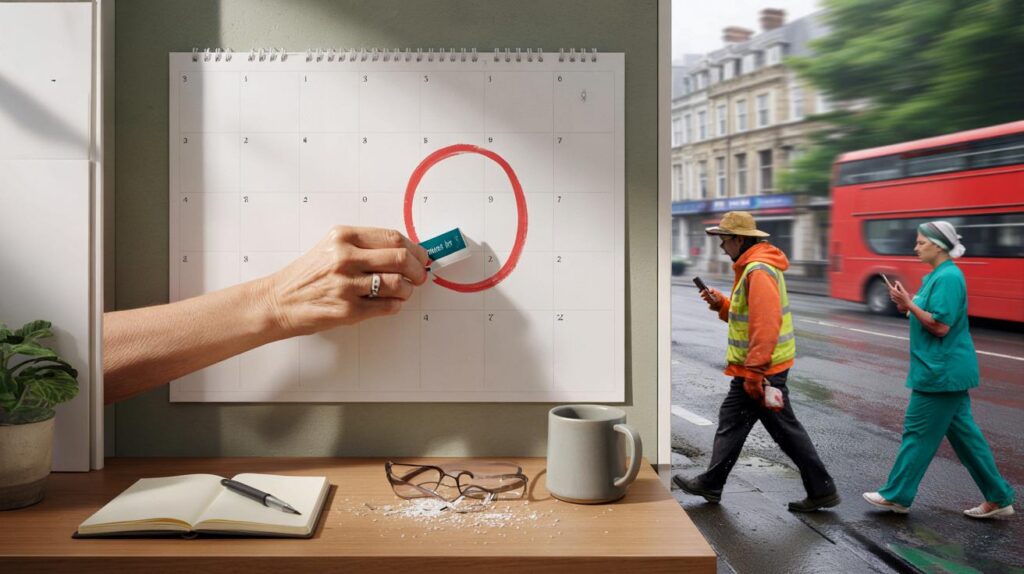
Millions who pencilled “67” into the calendar now face an eraser moment. The State Pension age is shifting terrain, not a single number carved in stone. The goalposts haven’t just moved; they feel mobile.
The woman at the bus stop had a laminated card with “66” inked on the back, a private reminder of when she’d finally lift her foot off the work pedal. Next to her, a builder in a paint-splashed hoodie scrolled a headline that made his jaw set: “State pension age bombshell – retirement age no longer 67.” The air was damp; the chatter was real. Numbers travel fast when they hit your pocket and your plans.
On the 8:12 to town, a man in his fifties muttered to his partner, “I thought it was 67 for us.” She raised a brow and said, “For who?” A beat passed, in that small silence where futures rearrange themselves. The number has slipped.
Why ‘67’ isn’t the whole story anymore
If you were born after April 1960, the State Pension age you actually reach isn’t a simple, static 67. It’s currently 66, and it rises gradually to 67 between 2026 and 2028, depending on your exact birthday. For younger workers, legislation points to a climb to 68 between 2044 and 2046, with the timing subject to future reviews.
This is where the “bombshell” feeling comes from: the age is on a schedule, but the schedule itself is under review pressures. A formal review in 2023 decided not to accelerate the jump to 68, keeping the next big call for the next review window. Yet the message is clear enough for millions planning their lives: 67 isn’t a fixed wall. It’s a moving gate.
Look at the drivers. The Treasury stares at an ageing population and a stubborn bill. Life expectancy plateaued after decades of growth, but healthy life expectancy still varies sharply by region and job. A care worker on their feet for 30 years doesn’t age like an office analyst. Policymakers have to juggle fairness, maths and politics. That’s why your “retirement age” now looks more like a range than a single date.
What it looks like on the ground
Paul, 52, from Leeds, planned around “67”, with a spreadsheet that involved mortgage clearance at 64 and a phased wind-down at work. He phoned his sister last week, voice tight: “If they push for 68, that’s another year on site for me.” She reminded him he can still aim to step back earlier using his private pot, and that the State Pension age hasn’t officially shifted sooner. They paused. He redrew the plan anyway, not out of panic, but prudence.
Then there’s Farah, a nurse in Birmingham, who assumed the State Pension would be the main pillar. She checked her State Pension forecast and discovered she had 29 qualifying National Insurance years, not the 35 typically needed for the full new State Pension. One phone call later, she knew she could plug gaps with voluntary contributions, potentially turning a few hundred pounds into thousands of extra lifetime income. Not a headline, just a quiet fix.
The data behind these stories complicates the simple “67” headline. The full new State Pension is currently around £221 a week, and it’s uprated annually by the **triple lock**. Yet the age you hit it at is tied to birth date, not a round number on a poster. Under the new rules, deferring beyond your State Pension age increases your weekly amount by about 1% for every 9 weeks you delay (around 5.8% a year). That’s not a command. It’s a lever you can pull, if work, health and cashflow let you.
What you can do now, not later
Start with facts, not fear. Use the Government’s tools: “Check your State Pension forecast” to see your projected weekly amount and State Pension age, and “Check your National Insurance record” to spot any gaps. If you see missing years, get guidance on whether voluntary Class 3 contributions would pay back for you. For many, a top-up can deliver a strong return over a typical retirement.
Mind the common trip-ups. Not everyone needs 35 years to hit the full rate, and some who were contracted-out may need more. If you’re short on cash now, think about pacing top-ups across tax years or focusing on the years that add the most. Use your workplace or personal pension to bridge if you hope to step down before the State Pension starts — you can usually touch defined contribution pots from 55, rising to 57 in 2028. We’ve all had that moment when a plan feels too big to touch. Let’s be honest: nobody really does that every day.
Big picture, keep your options open and your expectations flexible. The **State Pension age review** could shift the timeline to 68 sooner, or hold the line, or tweak the gradient in between.
“Plan for what’s legislated, stress-test for what’s plausible,” says independent pensions actuary Ruth Alexander. “If 67 still works after you move the slider to 68 in your spreadsheet, you’ve probably cracked it.”
- Check your forecast and State Pension age on gov.uk.
- Audit your NI record; consider topping up missing years that actually boost your final amount.
- Model two scenarios: State Pension at 67 and at 68. See the gap. Fill it on paper first.
- Explore deferral only if you can afford the waiting period and you expect a longer retirement.
- Look into **Pension Credit** if money is tight at State Pension age; it can unlock other help too.
The bigger picture — and the conversation we need
The headline “retirement age no longer 67” reads like a jolt, but the deeper truth is more human and more complicated. Your retirement is a timeline with sliders: State Pension age, private savings age, health, caring responsibilities, the job you can or can’t keep doing at 66. Politicians will argue about decades. You live month by month.
For some, flexible work and a private pot create levers: step down at 64, start the State Pension at 67, defer to boost. For others, the key lever is income support from Pension Credit at State Pension age, which can draw in housing help and even a TV licence. *One system, many routes through.* The State Pension age moves because the country is changing. The question is how we share that change fairly — between places, professions, and generations. That’s a conversation best had now, while the numbers on your calendar can still be moved by your hand.
| Key points | Details | Interest for reader |
|---|---|---|
| ‘67’ isn’t a single-age promise | State Pension age is 66 now, rises to 67 by 2028; 68 is legislated for 2044–46 but subject to review | Know your actual date, not a headline number |
| Levers you can pull | Top up NI gaps, adjust private pension timing, consider deferral (~5.8% per year uplift) | Practical steps to replace worry with a plan |
| Safety nets and support | Pension Credit for low incomes at State Pension age; can trigger other help | Potentially worth thousands and extra entitlements |
FAQ :
- Is the State Pension age still 67 for my generation?It depends on your birth date. It’s currently 66 and rises gradually to 67 between 2026 and 2028. For younger people, the law points to 68 in the 2040s, with timing reviewed periodically.
- Can I take the State Pension early if I’m struggling?No. You can’t draw the State Pension before your State Pension age. You might use private pensions earlier, or look at benefits like Pension Credit once you reach State Pension age.
- Does deferring always pay?Deferral increases your weekly amount by roughly 5.8% a year under the new system. Whether it “pays” depends on your health, income needs, taxes, and how long you live to receive the uplift.
- How many NI years do I need?Typically 35 qualifying years for the full new State Pension and at least 10 years to get anything. Past contracting-out or transitional rules can change what you need in practice.
- What’s the weekly State Pension amount now?The full new State Pension is currently around £221 a week, and it rises annually via the triple lock. Check your personal forecast on gov.uk for the figure tailored to you.



So 67 was never a promise? Planning on quicksand.
My spreadhseet just sighed. Again. Guess I’ll rename the tab from “Retirement at 67” to “It depends”.