
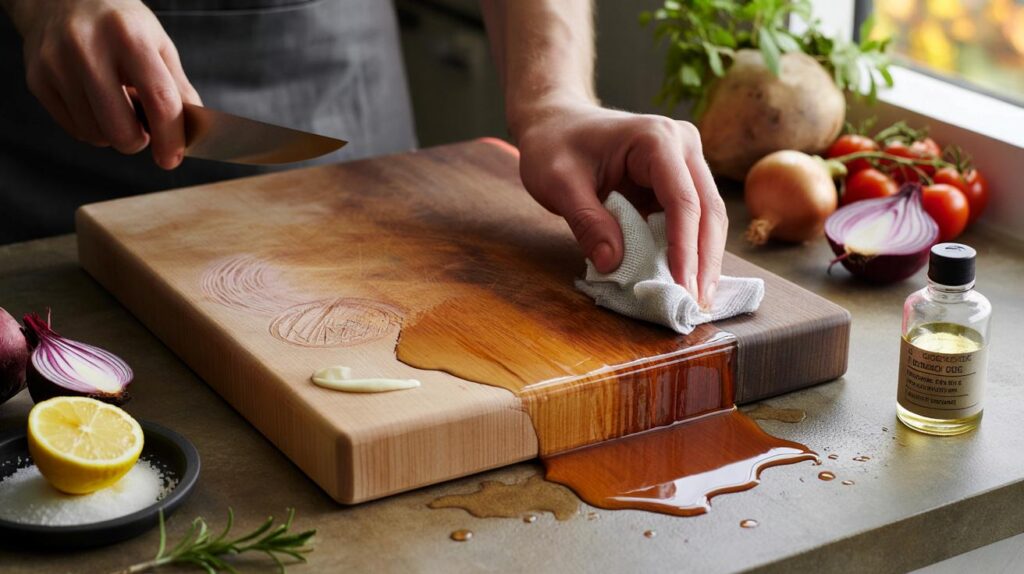
Your kitchen workhorse faces knives, juices and heat every day, and autumn’s hearty prep often turns small stresses into lasting damage.
The humble wooden board sits at the heart of home cooking. Yet repeated washing, splashes of acid, and sharp blades slowly strip its defences. A simple routine protects the grain, keeps odours at bay, and saves you money across the year.
Why your board fails faster than you think
Wood swells with water and shrinks as it dries. That movement opens tiny gaps around knife marks. Acids from onions, tomatoes and citrus etch the fibres. Heat from a radiator or a dishwasher bakes out moisture. Over weeks, the surface turns rough and more porous. Bacteria and stains settle deeper with every chop.
Autumn magnifies the problem. Warm kitchens meet cool, damp air. The moisture swing speeds up cracking. Thick soups and roasts also mean more chopping, more liquid, and more heat. Many cooks rinse and leave boards to air-dry flat. Water pools. Edges curl. Odours linger.
Water + heat + time equals split fibres. Control those three, and you extend your board’s life by years.
The one habit that seals out stains and germs
Regular oiling keeps wood stable. A food-safe, neutral oil fills the pores and slows water uptake. That barrier makes the board resist beetroot rings, onion odours and meat juices. Blades glide more smoothly. The surface stays supple and less prone to cracks.
Set a simple rule: oil every two to three months, or whenever the surface looks pale and dry. In heavy-use weeks, treat it sooner. Focus on the edges, as end grain drinks fastest.
Step-by-step: the 2-minute maintenance that pays back
- Wipe the board clean and let it dry completely, ideally overnight upright.
- Pour about 1 tablespoon of food-grade mineral oil or grapeseed oil onto the surface.
- Massage the oil across the grain with a lint-free cloth. Work it into knife marks and edges.
- Leave for 30 minutes. For very dry wood, leave overnight.
- Wipe off any excess until the surface feels dry to the touch, not greasy.
- Repeat once if the board absorbs everything immediately.
Prioritise the edges first. Saturated edges dramatically cut warping and stop cracks before they start.
Which oil to use
| Oil type | Notes |
|---|---|
| Food-grade mineral oil | Neutral, non-rancid, cheap (~£3–£6 per 250 ml). Widely used by butchers. |
| Grapeseed oil | Light, low odour, slower to turn. Store cool to extend life. |
| Walnut oil | Dries to a harder film but can trigger nut allergies. Check household needs. |
| Olive/sunflower oil | Prone to rancid odours over time. Best avoided for boards. |
| Boiled linseed oil | Often contains dryers not meant for food contact. Avoid. |
Daily habits that add years
Small choices every day prevent big repairs later. Keep water exposure short. Never soak. Rinse warm, scrub gently, then dry right away with a tea towel. Stand the board on its side so both faces breathe. Heat is the enemy; a dishwasher will twist and split the fibres in hours.
- Keep one face for sweet foods and bread, the other for savoury and strong flavours.
- For odours, rub a handful of coarse salt with half a lemon. Rinse, then dry.
- For stains, make a paste of bicarbonate of soda and water. Apply, wait 10 minutes, and wipe.
- Sanitise after raw meat with diluted white vinegar, then rinse and dry. Use a separate board for raw meat to be safe.
- Avoid bleach on wood. It damages fibres and leaves smells.
Skip the dishwasher. One 70°C cycle can undo a year of careful care.
When to sand, and when to replace
Sanding refreshes a tired board. If the surface feels furry or stained, start with 120-grit sandpaper, then move to 180–220-grit for smoothness. Vacuum dust, wipe with a damp cloth, dry fully, then oil. Deep knife grooves can vanish in 10 minutes.
Replace the board if cracks run through the thickness, or if a split stays open after oiling. A rule of thumb helps: if your fingernail fits into a gap deeper than 3 mm, bacteria can hide there. Severe warping that rocks on the counter also calls time.
The money argument: tiny cost, long payoff
A 250 ml bottle of mineral oil costs about £3–£6 and covers roughly 8–12 treatments. Each treatment uses around 20–30 ml. If your £25 board lasts five years instead of one, you avoid four replacements. That’s £100 saved, minus a fiver in oil. You also reduce waste and keep knives sharper, which saves sharpening fees or time.
The time cost is tiny. You spend two minutes applying, then let time do the rest. Fit it into your evening tidy-up, and it becomes automatic.
Wood, bamboo, plastic or glass
End-grain wood boards self-heal better and are gentler on knives. Edge-grain wood is cheaper and still durable. Bamboo is harder and more water-resistant but can be brittle at edges. Plastic tolerates dishwashers but scars deeply; old grooves trap grime. Glass looks smart but blunts knives fast and is slippery when wet.
Use a dedicated board for raw meat, whatever the material. Keep a wooden board for bread, fruit and veg for the best cutting feel and blade life.
Add protection with wax
A board cream of beeswax and mineral oil gives extra water resistance. Warm a teaspoon between your fingers and rub it in after oiling. Buff dry. Wax sits nearer the surface and slows swelling during long prep sessions.
Autumn routine you can start tonight
Do a quick check now. Is the surface dull, patchy or rough? If yes, clean, dry, and oil the board before bed. Pay attention to the edges. In the morning, wipe any residue and stand it upright. You have just lowered stain risk before the weekend roast.
Extra notes to go further
Want a tougher surface for pastry? Chill the board for 10 minutes near an open window before rolling dough. Less stick, easier cleanup. Need a fast odour reset before a fruit salad? Wipe with vinegar, rinse, then rub with a cut apple to lift savoury smells. Dry at once.
If you handle allergens at home, label one corner discreetly with a woodburner or permanent marker. Keep that board for gluten-free prep, or nut-free tasks. Oil does not remove allergens; separation does. For busy cooks, set a phone reminder every 10 weeks. Two minutes of oiling beats buying another board at Christmas.



Is mineral oil really food-safe? I keep seeing mixed advice—won’t it leach, and doesn’t grapeseed go rancid if you forget it in the cupbord?
Genuinely useful—“prioritise the edges” was the tip I never knew. Tried it tonite and the board stopped drinking like mad. Cheers for the £3 breakdown; simple and cheap.