
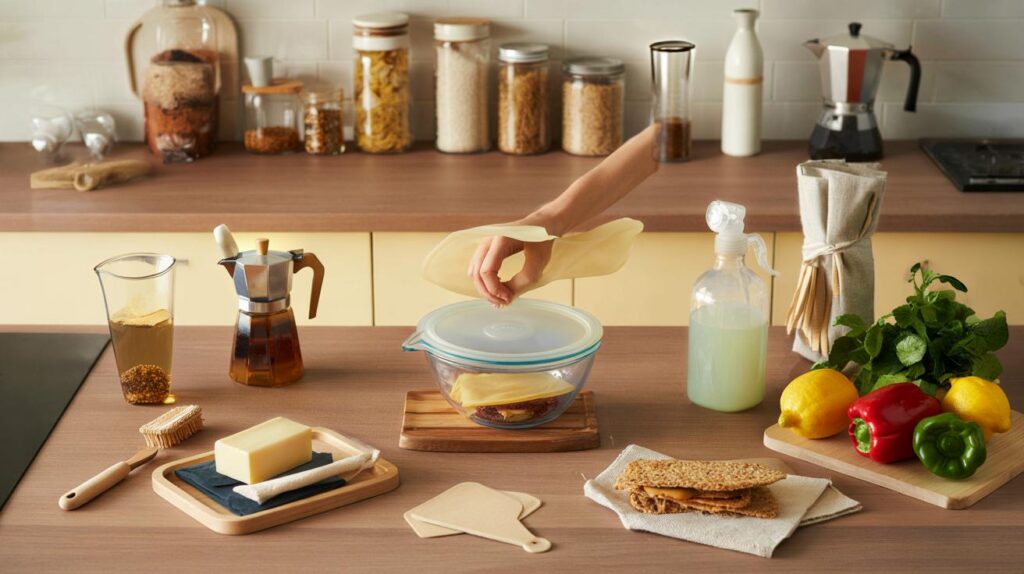
Plastic sneaks into our kitchens in a hundred quiet ways: the crinkly bag of salad, the cling film over leftovers, the glittery green sponge that sheds with every scrub. Bins fill, recycling boxes overflow, and still the drawer of “useful” bags bulges. The truth is less about guilt, more about habit. And habits can shift.
It’s a weekday morning in a small London flat. Kettle on, toast pops, and the first decision of the day is plastic or not: yoghurt pot, berry punnet, tea bag with that faintly waxy seam. The bin lid lifts with a soft thud, then sticks; there’s always one more packet fighting for space. Outside, the lorry growls past and gulls lift, triumphant. I watch the steam curl off my mug and wonder how much of this churn is baked in, and how much is just autopilot. The toast cools. The thought doesn’t.
What if the most powerful climate choice happens before you’ve finished your cuppa?
Why your kitchen holds the fastest wins
The kitchen is the stage where plastic performs daily. It’s where food arrives wrapped, where washing-up happens, where leftovers either get loved or quietly ignored. Because we’re at the sink, stove and fridge several times a day, tiny changes stick. A different lid here, a new habit there. You see the result every time you cook or clean, which nudges you forward.
There’s also scale. UK households churn through an astonishing volume of single-use packaging, much of it touched in kitchens within hours. Think carrier bags for loose veg, film on meat trays, pouches for sauces, sachets for spices, plastic-coated tea bags. **Only a sliver of global plastic has ever been recycled, and an even smaller share is recycled more than once.** When you cut plastic at the kitchen source, you side-step that lottery entirely and reduce the stream at its head.
Behavioural science calls it “friction”: the easier the choice, the likelier you’ll repeat it. If your stretch lids sit next to the fridge, you’ll reach for them. If a jar of washing-up tabs lives by the sink, refilling becomes routine. Small design wins compound. *Your kitchen sets the tone for the rest of the house.* It’s not about a perfect pantry; it’s about shaping the path so the low-waste option becomes your default without a pep talk.
15 easy eco-swaps for instant kitchen wins
Pick three swaps, not fifteen. Start with the place you touch most: the sink, the fridge door, the cupboard where wraps and foils live. Swap in a solid dish soap and a compostable brush. Fit silicone stretch lids over bowls that used to get smothered in cling film. Put a glass bottle of concentrated cleaner on the counter, and the plastic spray goes into retirement. Three quick moves, daily impact.
Keep it friendly. Let the pretty jar, the tactile lid, the hand-stitched produce bag earn its spot with pleasure, not pressure. We’ve all had that moment when you buy a “sustainable” gadget and never quite use it. If a swap adds faff, tweak the setup until it’s faster than the disposable option. Let’s be honest: no one does this every day. Give yourself two weeks for each switch to become muscle memory before stacking the next one.
The trick isn’t buying a different kind of stuff; it’s creating a different flow of stuff. Caddy for veg bags near the door, jars for bulk goods at eye level, a “refill day” that piggybacks on your shop. **Progress beats perfection.** Place reminders where your hand naturally moves, not where your conscience thinks it should.
“I used to buy cling film on autopilot,” says Priya, a Brixton home cook. “Once the stretch lids lived with the bowls, I just stopped. No drama, no sermon.”
- Swap cling film for reusable beeswax or plant-wax wraps for sandwiches, herbs and cheese.
- Use silicone stretch lids over bowls, tins and half-cut fruit instead of plastic covers.
- Switch to solid dish soap with a wooden or metal-handled brush; ditch plastic bottles.
- Refill washing-up liquid, surface spray and hand soap at a local zero-waste or high-street refill point.
- Choose compostable loofah or cellulose sponges; avoid plastic microfibre pads that shed.
- Buy dry goods (rice, oats, pasta, lentils) in bulk and decant into glass jars or sturdy tubs.
- Carry cotton mesh bags for loose produce; skip the thin produce sleeves entirely.
- Go loose-leaf for tea with a stainless infuser; many tea bags are sealed with plastic.
- Use a French press, moka pot or refillable coffee pod; skip single-use pods.
- Keep a reusable spray bottle and use concentrated tablets; cut out new plastic triggers.
- Line your food caddy with paper or go liner-free; if needed, choose certified compostable bags.
- Swap baking paper for a silicone baking mat; it pays for itself quickly.
- Get milk in returnable glass if available, or switch to larger containers over small bottles.
- Filter tap water or use a soda maker for fizz; end the endless stream of plastic bottles.
- Bring containers to the deli, fishmonger or takeaway that welcomes reusables; reward the ones that say yes.
When the plastic quiets down
Something subtle shifts. The bin gets lighter, the worktop clears, and your food feels calmer without the constant crackle and tear. You notice flavours more, perhaps because your fridge looks like a cook’s cupboard rather than a stash of parcels. One swap leads to another, not through guilt, but because life got easier.
It spills outward. Kids learn the rhythm of jar-top lids and wax wraps like a game. Housemates swap tips, not lectures. The weekly shop changes shape, which nudges budgets towards staples that stretch and packaging that lasts. **Small domestic rituals become a quiet vote for a different supply chain.** The chain listens when we do it often enough.
There’s no medal for a perfect pantry and no shame for the odd emergency packet. A soft plastic drop-off might still be part of your route. That’s fine. The goal is simple: make less rubbish, make more room for food you enjoy, and keep your kitchen kind. The rest follows, slowly and surely, like a kettle coming to the boil.
| Point clé | Détail | Intérêt pour le lecteur |
|---|---|---|
| Start small | Pick three swaps that touch your daily routine | Fast wins build confidence and momentum |
| Design the path | Place reusables where your hand naturally goes | Reduces friction and “forgetting” at busy moments |
| Buy less, better | Refill, bulk-buy staples, skip gimmicks | Saves money over time and cuts bin volume |
FAQ :
- Do eco-swaps actually save money?Often yes over a few months. Reusable lids, mats and refills outlast disposables, and bulk staples undercut small packets.
- What if I don’t have a refill shop nearby?Use supermarket refills and concentrates, buy larger formats, choose glass or aluminium where possible, and focus on reusables you can order once.
- Are compostable bags a good idea?They help for food caddies, but paper or no liner works too. Home-compostable certification matters more than buzzwords.
- How do I handle fussy family habits?Swap one item per person that feels like an upgrade. Make it easy, visible and nice to use. Incentives work better than rules.
- Is recycling a waste of time then?Recycling still matters for metals, glass and some plastics. Reducing and reusing cuts the stream before it becomes a sorting problem.



Loved the “start with three” advice. Moving my stretch lids next to the fridge door was the nudge I didn’t know I needed, and the solid dish soap actually made my sink feel calmer. Small design wins, big difference. Thanks for keeping it practical and not preachy.