
Rents are up, budgets are tight, and flat-pack furniture keeps wobbling after a year. Meanwhile, charity shops and local marketplaces are flooded with solid wood pieces going for the price of a takeaway. The tension sits right there: waste piling into landfill while we hunt for homes that feel like us. Why are we still buying new when second-hand has more soul and costs less?
I’m standing on a rainy Saturday outside a church hall jumble sale in Leeds, watching a line of strangers carry away small miracles. A scratched elm side table. A pine dresser with one missing knob. The smell is dust and polish, like a school corridor after hours. A woman in a green raincoat tells me she’s paying £15 for a chest of drawers older than her nan. She whispers as if revealing a secret: “I’m going to make it my own.” She means paint, handles, a weekend. She means life returning to something thrown away. She means more than furniture. One detail sticks.
Why upcycling old furniture makes sense right now
Buying brand-new promises convenience, but it also erases character. Upcycling flips that: you spend less, keep quality, and the end result doesn’t look like anyone else’s. Real wood takes a repair beautifully and wears age like a good leather jacket. The maths gets real when you need to furnish a room fast. A second-hand oak table at £30, plus sandpaper, primer and paint at £25, and you’ve got a centrepiece for under £60. Most multiples can’t match the weight or the warmth. Every nick you keep becomes part of the story you’re writing at home.
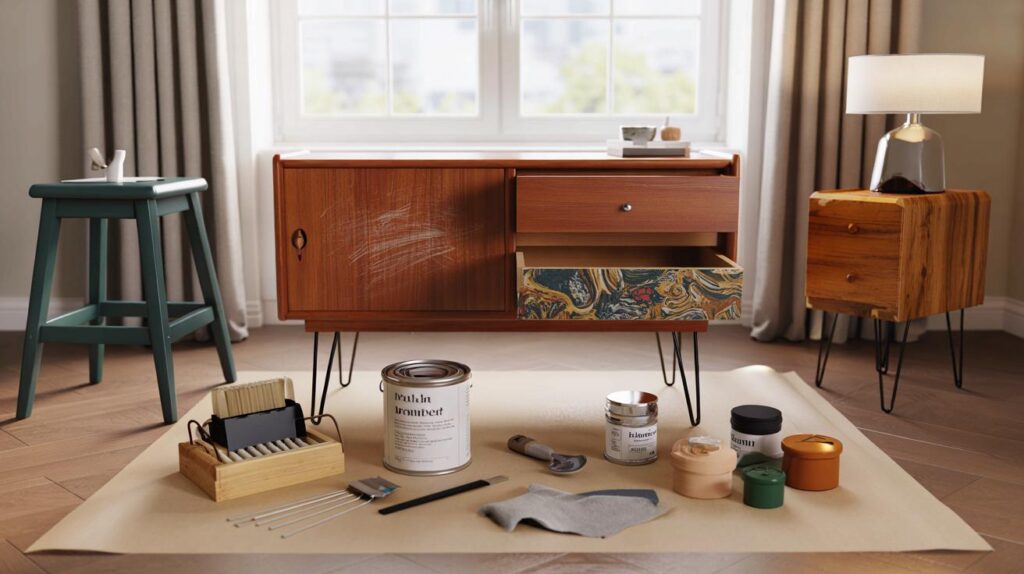
Here’s a picture I can’t shake. A graduate couple in Bristol pick up a battered mid-century sideboard off Facebook Marketplace for £40. Two evenings later, the old varnish is gone, the teak oiled, and the brutal handles swapped for slim brass pulls. Comparable new sideboards in the shop window down the street are tagged at £299. Research by WRAP points to roughly 1.6 million tonnes of bulky waste in the UK each year, much of it furniture, and a big chunk is still reusable. It isn’t just a bargain hunt. It’s a cultural rethink, happening piece by piece on kitchen floors.
There’s logic beneath the romance. When you invest time in an object, you value it more. Behavioural economists call it the IKEA effect, though the irony is clear: the deeper bond forms when the thing is built to last. Vintage joinery, dovetail joints, solid backs rather than paper-thin fibreboard—these respond to care. You change the colour, swap a leg, add a shelf, and your taste ends up baked into the piece. Longevity follows because your attachment is real. You’re less likely to throw out something you’ve fixed with your own hands.
How to start upcycling without the stress
Start small. A stool, a bedside table, a chair with good bones. Clean with sugar soap, then lightly key the surface with 120–180 grit so the primer can grip. If it’s shiny or varnished, reach for a shellac-based or bonding primer and give it time to dry properly. Two thin coats of paint beat one gloopy coat every time. Finish with a water-based polyurethane or wax for durability on tabletops. Work by a window if you can. Lay a dust sheet. Put on a playlist that makes an hour feel like twenty minutes.
Common missteps are easy to dodge. People rush the prep, use a random old brush, and then wonder why the finish looks streaky. Test your colour on the underside before committing, because lighting lies. Don’t fight the grain on beautiful wood—oil can be kinder than paint when the timber is singing. We’ve all had that moment when the first coat looks awful and you think you’ve ruined it. Keep going. Drying and sanding breathe out the panic. Let’s be honest: nobody waits the full curing time every single time, but longer really does mean tougher.
Start with intent rather than perfection. Take a photo before, pick one small change—handles, colour, or legs—and stop there. You can always return next month. The piece doesn’t need to look new; it needs to look like yours.
“Begin with the piece that already makes you smile,” says a London furniture restorer I met in a charity warehouse. “You’re not fixing a car. You’re giving a story a second chapter.”
- Tools that help: a decent sanding block, bonding primer, a 1.5-inch angled brush, microfibre cloth, furniture wax or water-based clear coat.
- Quick wins: change knobs, swap legs to hairpins, line drawers with wallpaper offcuts.
- Materials to favour: solid wood, veneer in good condition, sturdy frames with minimal wobble.
- Red flags: swollen chipboard, rot, strong musty smell that survives a day outdoors.
From stuff to story: the joy that money alone can’t buy
Your home is the one place you edit daily without permission. Upcycling leans into that freedom and makes it visible. When friends sit at a table you rescued for £20 and sanded at midnight, the conversation includes the table even when you’re talking about holidays. Colours you chose change with the light, and each mark you kept becomes a place your eye rests. The savings are real, yes, but something richer sneaks in: pride, patience, a calmer pace. Next time you pass a skip or scroll past a wonky listing, imagine how it could look in your corner, after two evenings and a cup of tea. Share the before-and-after. Teach your neighbour. What would your home say if you let it speak in your voice?
| Key points | Details | Interest for reader |
|---|---|---|
| Spend less, keep quality | Second-hand solid wood plus £20–£40 in materials often undercuts new flat-pack by hundreds | Immediate budget relief without sacrificing durability |
| Create a one-off look | Colour, hardware and small repairs turn standard pieces into personal statements | A home that doesn’t resemble a catalogue |
| Cut waste dramatically | UK bulky waste includes vast amounts of reusable furniture each year | Feel-good impact: less landfill, more longevity |
FAQ :
- What’s the best first project for a beginner?A small side table or stool. Flat surfaces are kinder, and you’ll see a quick win by the end of the weekend.
- How do I tell if a piece is solid wood or veneer?Check the end grain. Continuous grain around edges suggests solid wood; a repeating pattern or edging strip often means veneer.
- Do I need expensive paint?No. Mid-range paints with a proper bonding primer give excellent results. Spend more on a good brush and prep.
- Is sanding always necessary?Light scuff sanding improves adhesion on most finishes. For glossy or melamine surfaces, use a bonding primer and keep sanding gentle.
- What about safety with old finishes?Work in ventilation, wear a dust mask, and avoid dry sanding suspected lead paint. If in doubt, use a chemical stripper designed for safer indoor use.



Loved the Bristol sideboard story—proof that £40 + elbow grease beats £299 any day. The IKEA effect bit really resonated; I care more when I’ve sanded and oiled it myself. Thanks for the practical steps (120–180 grit and bonding primer!).
Quick Q: for a shiny veneer that might be melamine, would a shellac-based primer still be your go-to, or is there a better bonding option if I skip heavy sanding?