
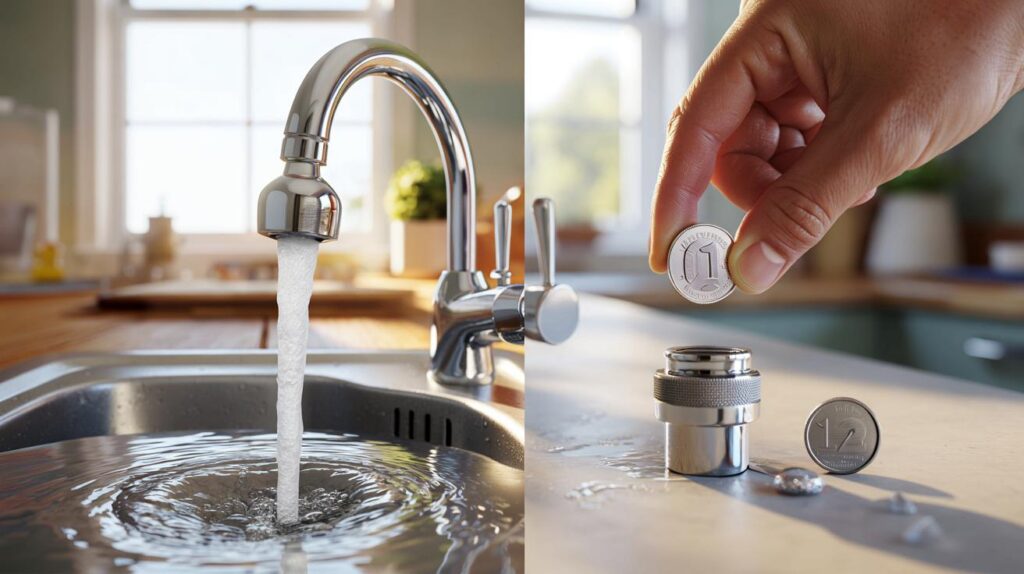
Water is getting pricier, summers drier, and most of us still let litres rush straight down the drain while we wash our hands or rinse a mug. There’s a tiny part on the end of your tap that could change that today. It costs about a fiver. It takes two minutes. And it can cut your water use by up to half.
The kitchen was loud in that morning way. Kettle sighing, radio whispering headlines, someone hunting for clean spoons. I turned the cold tap and it came out in a thick, impatient column, smashing into the sink like it had a point to prove.
A friend pulled out a tiny chrome ring from his pocket. “Watch,” he said, slotting a coin into the end of the spout and twisting. Off popped the old aerator. On went a new one the size of a two-pound coin. The flow dropped, softened, and suddenly the sink wasn’t roaring any more. Soap rinsed off just the same. The bill wouldn’t.
So why don’t we all do it?
The £5 part hiding in plain sight
Tap aerators aren’t sexy, but they’re everywhere. They screw into the tip of most modern taps, shaping the water into a soft, airy stream that rinses well without the waste. Swap a standard aerator for a low-flow, pressure‑compensating one and the difference is immediate.
Typical basin taps shout along at 10–12 litres per minute. A good low‑flow aerator brings that to 3–5 L/min on a bathroom sink and 6–8 L/min in a kitchen, often without you noticing a thing. Less water, same clean hands.
In Salford, the Martins tried it on a whim. One coin, one swap, then a quiet experiment with the meter. Over a week they saved roughly 60 litres a day for a family of three, just from the bathroom and kitchen taps.
That’s about 22,000 litres a year. On water and sewerage charges alone, it’s real money. Heat a chunk of that hot water less and you’re double‑saving on energy. **Hot water saved equals energy saved.** A softer stream that trims both bills is a rare kind of win.
How does a metal ring pull off that trick? Inside is a tiny mesh and a rubber regulator that responds to pressure. As mains pressure rises and falls, the insert keeps flow roughly steady. Air gets mixed in, turning the stream silky instead of splashy. The water feels abundant because it’s structured.
Laminar models give a clear, glass‑rod flow for deep sinks. Spray models add micro‑bubbles that feel plush on skin. Either way, the physics is simple: reduce volume, keep velocity, improve the rinse. The effect on your usage graph is not subtle.
How to swap a tap aerator in five minutes
Look at the end of your spout. If you see a little ring with a coin slot or flats for a spanner, you’ve got a removable aerator. Wrap it in a cloth, turn anticlockwise, and off it comes. Note the type: most UK taps are M24 male or M22 female.
Pick the right flow rate. For bathroom basins, 3–4 L/min feels generous for handwashing. For kitchens, 6–8 L/min is a sweet spot for rinsing pans. Go for a pressure‑compensating insert that lists a flow at 3 bar. Pop in the new washer, twist on finger‑tight, then give it a gentle snug with a coin. Run the tap and smile.
Common hiccups are boring and fixable. Buy the wrong thread and the part won’t seat, so check the size stamped on the old insert or measure the diameter lightly with a ruler. If you’re on a low‑pressure gravity system, avoid ultra‑low 2–3 L/min models on kitchen taps; try 4–6 L/min so you still get a good rinse.
Combi boilers like a minimum flow to fire for hot water. If a bathroom tap ends up too stingy, your boiler may sulk and not ignite. Nudge the flow rate up a notch and it behaves. Clean limescale off the new nozzle every month with a quick wipe or a vinegar dip. Let’s be honest: nobody actually does that every day.
“A tenner for two inserts is the fastest water‑saving job I do,” says Mark Patel, a London plumber. “Half the taps I meet are blasting 12 litres a minute and nobody realises. Drop them to five and people only notice it’s quieter.”
- Choose 3–4 L/min for basins, 6–8 L/min for kitchens.
- Match thread: M24 male and M22 female are most common.
- Pressure‑compensating models keep the feel steady.
- Low pressure or combi boiler? Avoid ultra‑low flows.
- Silicone nozzles shrug off limescale; a rinse brings them back.
Why this tiny hack lands big in 2025
Household water use in England sits around the 145‑litre‑per‑person‑per‑day mark. Targets lean lower. Reservoir maps go blotchy every summer and hosepipe bans creep in. An aerator isn’t a policy. It’s a micro‑habit that just quietly works, day after day, with zero willpower.
We’ve all had that moment when the bill lands and you promise grand changes. Shorter showers, timers, a new routine. *Tiny change, big difference.* Swap a part, keep your habits, cut the waste. It plays nicely in family homes, rented flats and student kitchens where you can’t remodel anything yet still want to leave the place better than you found it.
There’s a human bit here too. A softer, quieter stream calms a room. Soap lathers just as well, teeth‑brushing splatter drops, the sink doesn’t attack your glass. It’s small, tactile, satisfying. **You’ll feel the difference, not miss the water.** And once you’ve done one tap, you start eyeing the rest of the house.
| Key points | Details | Interest for reader |
|---|---|---|
| Swap a £5 aerator | Cuts tap flow from ~12 L/min to 3–8 L/min | Immediate savings on water and hot‑water energy |
| Pick the right spec | M22/M24 threads; pressure‑compensating; 3–4 L/min basin, 6–8 L/min kitchen | Good feel at the sink without faff or returns |
| Avoid common pitfalls | Low pressure and combi ignition need moderate flow; clean limescale | Keep comfort high and the boiler happy |
FAQ :
- Which taps actually take an aerator?Most mixer taps and many monoblocs have a removable insert at the spout. If you can see a ring with flats or a coin slot, you’re in. Older pillar taps sometimes lack them, but adaptors exist.
- Will a low‑flow aerator mess with my combi boiler?It can if the flow is ultra‑low. Combi boilers need a minimum flow to ignite hot water. Choose 4–6 L/min on basins if yours is sensitive, and 6–8 L/min in the kitchen.
- What flow rate should I choose?For handwashing, 3–4 L/min feels normal. For cooking and rinsing, 6–8 L/min keeps pace. Match the room and your pressure rather than chasing the lowest number.
- Does it change taste or hygiene?No. An aerator shapes flow; it doesn’t add chemicals. Hygiene is about good soap contact and a proper rinse, which you still get thanks to a structured stream.
- How do I clean or replace it?Unscrew with a coin or spanner, rinse debris from the screen, soak limescale in warm vinegar, and refit with the washer. If it’s tired or noisy, a new insert costs about £5.



Swapped ours last month after a plumber friend nagged me. Bathroom tap now feels softer and far less splashy; didn’t notice any difference washing or brushing. Meter suggests we’re ~50 L/day down versus before. For a £5 doodad, that’s bonkers value. One tip: pick pressure‑compensating inserts (I went 4 L/min basin, 7 L/min kitchen). Vinegar soak clears limescale fast. This is the kind of tiny fix I’ll definately gift to my parents.