
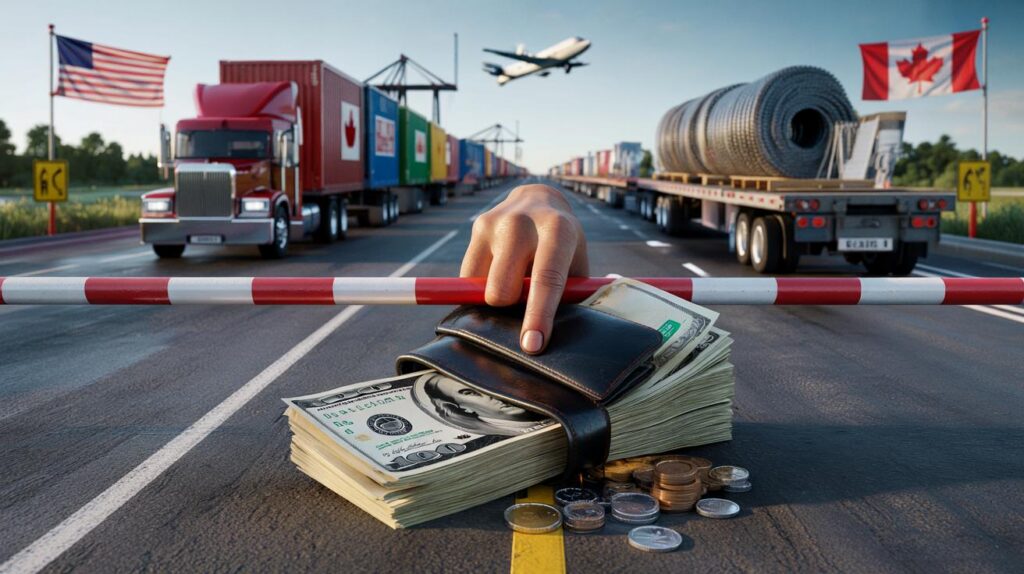
A baseball weekend, a vintage Reagan tape and an in-flight post combined to shake North America’s quiet trade routine.
The White House has signalled a fresh tariff rise on Canadian imports, triggered by a row over an Ontario advert that mined Ronald Reagan’s archive. As leaders criss-cross Asia for a regional summit, business groups, carmakers and steel buyers are racing to work out the new maths.
What changes with the latest tariff move
A 10% lift on top of existing levies
President Donald Trump said he would add 10 percentage points to the tariff rate currently applied to Canadian goods. Washington already runs a complex web of charges: a headline 35% levy that sits above a patchwork of exemptions under a free trade deal, plus sector-specific rates hitting metals and automobiles. The new uplift would bolt onto whatever rate an importer faces at the border.
Tariff liabilities fall on the importer of record. Firms pay at the border and usually pass costs down the supply chain to consumers.
| Category | Current headline rate | Announced uplift | Illustrative new rate | Notes |
|---|---|---|---|---|
| General Canadian goods | 35% | +10 points | 45% | Many items exempt under a free trade agreement |
| Metals (e.g., steel, aluminium) | 50% | +10 points | 60% | Applies to a broad set of HS codes |
| Automobiles | 25% | +10 points | 35% | Ontario hosts most Canadian auto manufacturing |
Three-quarters of Canadian exports head south to the United States, and Ontario’s factories anchor that flow. A 10-point jump, even if temporary, rewrites price lists, reshapes deliveries and risks denting margins across the border-spanning supply chains that stitch together engines, bodywork and electronics.
75% of Canadian exports go to the US. Ontario’s car plants and metal mills feel the front-line pressure first.
Why a Reagan advert lit the fuse
Ontario’s government funded a World Series advert built around Ronald Reagan’s late-1980s radio remarks on trade. The minute-long spot stitched together original audio to argue that tariffs harm American households. The Reagan Foundation accused the ad-makers of cherry-picking and said they had not sought permission to use the footage. After the US side froze talks, Ontario’s premier said he would pause the campaign, but allowed previously booked placements to run through the weekend.
Trump labelled the advert a fraud and demanded an immediate pull. He then announced the tariff uplift while flying to Malaysia, adding that he would not meet Canada’s prime minister at the summit. Ottawa said it remained ready to keep talking, while also accelerating trade diversification with Asian partners.
Positions harden as talks stall
Prime Minister Mark Carney used the ASEAN sidelines to reiterate Canada’s aim: deals that deliver for workers and families, with a budget on the way to invest at home. Trade minister Dominic LeBlanc stressed that progress tends to come through direct engagement with Washington. The cross-border tone swung between sharp words and light jabs: as the World Series rolled on, Ontario and California’s governors traded jokes and small wagers about tariffs and regional pride.
What it means for your wallet in the next 90 days
Importers typically absorb shocks first, then adjust prices or specifications. The timelines below reflect common lead times for North American supply chains.
- 0–30 days: Distributors accelerate existing shipments to beat duty changes; temporary stockpiles soften retail price moves.
- 30–60 days: New orders reflect higher landed costs; expect list price revisions for cars, appliances and construction inputs.
- 60–90 days: Contracts get rewritten; promotions shrink; some mixed-origin goods switch components to non-Canadian sources.
Who pays, and where costs land
- US importers pay the duty at customs. They often raise wholesale prices or cut specifications to compensate.
- Retail buyers face higher prices on tariffed goods or on substitutes if supply tightens.
- Canadian suppliers may trim margins or seek alternative markets in Asia and Europe to keep plants running.
Example: a mid-range saloon assembled in Ontario
Assume a US importer brings in a car valued at $25,000 before duty, freight and dealer fees. Under a 25% auto tariff, the duty equals $6,250. A 10-point uplift pushes the rate to 35%, raising the duty to $8,750. That $2,500 difference typically filters to the sticker price unless the manufacturer or dealer offsets it with discounts or lower-spec components.
A 10-point rise on a $25,000 import adds roughly $2,500 at the border before freight, finance charges and dealer costs.
Sectors on watch
- Cars and parts: Cross-border platforms are tightly integrated; a single vehicle can cross the frontier multiple times.
- Metals: Construction firms and equipment makers rely on Canadian steel and aluminium; project budgets may need rework.
- Consumer goods: Supermarket shelves carry Canadian packaged foods; price changes hinge on exemptions under the free trade deal.
- Agriculture inputs: Fertilisers and farm machinery parts face timing risks if brokers reclassify shipments to manage exposure.
Paths to de-escalation and the risks if talks fail
Ottawa wants direct dialogue to resume. Ontario has scaled back the advert placements that triggered the spat. The US Chamber’s Canadian counterpart urged a diplomatic fix, warning that higher duties eat into North American competitiveness. If negotiations restart quickly, Washington could grant targeted exclusions or staged implementation to limit disruption. If they don’t, legal challenges at the World Trade Organization and tit-for-tat measures remain possible, extending uncertainty into 2025 production calendars.
What businesses can do now
- Check tariff codes: Confirm HS classifications with your broker; small changes can swing the rate dramatically.
- Model landed costs: Reprice contracts with 10 points added to current tariff lines, then stress-test cash flow.
- Stagger orders: Split consignments to manage risk while you wait for policy clarity.
- Seek relief: Track any exclusion processes that open; industry associations often coordinate evidence packs.
- Hedge currency: USD/CAD moves can cushion or worsen the blow; talk to your bank about near-term cover.
What this means for readers in numbers
- 10 points: the announced additional tariff on Canadian goods.
- 35%, 50%, 25%: existing headline rates on general goods, metals and autos, respectively.
- 75%: share of Canadian exports sold into the US market.
- 2–3 months: typical window before most retail prices fully reflect a tariff jump.
Extra context that widens the picture
Tariffs act like a tax on imports, but the burden spreads: importers pay first, then workers, suppliers and customers share the cost through smaller pay rises, thinner margins or higher prices. In integrated sectors such as autos, duties can compound because components cross the border multiple times. That is why even a 10-point shift, layered on top of existing rates, can ripple far beyond a single factory gate.
For households weighing big-ticket purchases, timing matters. If you plan to buy a Canadian-assembled car or major appliance, ask dealers about current inventory that cleared customs before the change. Businesses should prepare contingency suppliers in ASEAN markets, as Canada courts new partners at the same summit where the tariff news broke. The combination of politics, sport and policy shows how quickly trade can swerve; a short, practical checklist and a fresh set of price calculations will help you stay upright while it does.



Clear explainer. A 10-point add-on to already high rates (35% general, 50% metals, 25% autos) is brutal when 75% of Canada’s exports head south. Importers eat it first, but it flows to consumers in 60–90 days as contracts reset. Cross-border platforms mean the duty compounds as parts ping-pong. This is basically a tax hike by another name.
So a World Series ad with Reagan audio “triggers” national trade policy? Sounds more like leverage than law. If the goal is helping U.S. households, why raise costs on cars, appliances, and rebar? Feels performativ, not strategic.