
As cooler nights set in, British households brace for unwelcome eight-legged visits and seek budget ways to stay calm.
A simple kitchen staple now tops that list, but location beats quantity. New guidance points to one spot to target.
Why autumn sends more spiders indoors
September and October mark peak sightings as mature males wander in search of mates and shelter. Damp weather pushes them towards warmth. Central heating, draughty thresholds and evening lights turn doorways into highways for house spiders.
Most species remain harmless to people, yet surprise appearances spark anxiety for many families. That’s why a low-cost, non-toxic deterrent attracts attention right now.
Why vinegar works, and why placement beats blanket spraying
White vinegar contains acetic acid. Its sharp odour disrupts how spiders navigate and assess safe territory. The scent fades in open rooms, so soaking walls achieves little. Direct it at chokepoints instead.
The chemistry behind acetic acid
- Acetic acid creates an odour barrier that spiders avoid rather than cross.
- It evaporates predictably, which lets you plan top-ups every few days.
- White vinegar dries clear and leaves fewer residues than malt or coloured vinegar.
Hit the threshold, not the whole room. A narrow, treated strip at the doorway does more than a mist everywhere.
The single location that changes outcomes
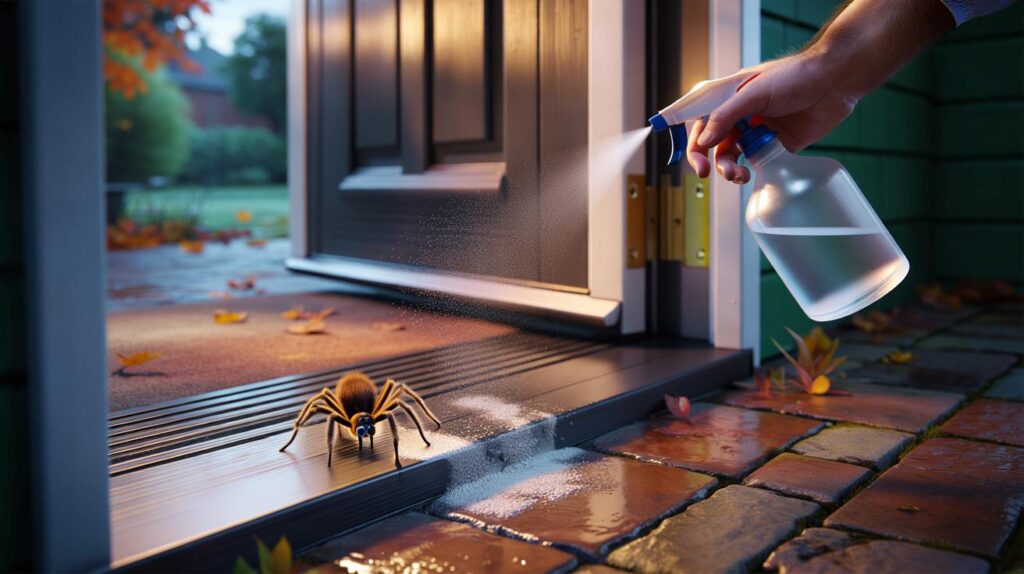
Door frames and the floor threshold form the most reliable interception point. Spiders cross here to reach warmth and food. Treat that perimeter and you make the home feel uninviting.
Extend the line to the lower hinge area, the bottom edge of the frame, and the skirt of the door. If you see activity at windows or vents, add short passes there, but keep the focus on the main entrance you use most.
How to set up the barrier in minutes
- Measure 250 ml white vinegar and 250 ml cold water into a clean spray bottle.
- Optional: add 15–20 drops of peppermint or lavender oil for a fresher scent.
- Shake for 10 seconds before use.
- Spray a 3–5 cm-wide band around the entire door frame, including the bottom threshold.
- Let it dry, then apply a second light pass on the lower corners where spiders test edges.
- Reapply every 2–3 days or after rain if the door opens straight to the outside.
Most households report fewer sightings within 48 hours when they maintain a visible band along the doorway.
What to expect over the first 7 days
Day 1: You’ll notice a tart smell for an hour. Keep the door open for a few minutes to ventilate if needed.
Day 2: Fewer webs near the lower jamb and doorstep. Spiders shift paths away from the treated strip.
Days 3–4: Sightings inside living areas often dip as new entrants turn back at the threshold.
Day 5: Top up the band; a light pass reinstates the odour line.
Days 6–7: Maintain the routine, especially at dusk when activity rises.
Results vary with weather and building type, yet consistent, targeted sprays beat occasional room-wide bursts.
Surfaces: where vinegar is safe, and where to be cautious
| Surface | Suitability | Notes |
|---|---|---|
| UPVC door frames | Safe | Wipe drips to avoid streaks. |
| Painted wood | Generally safe | Patch test if paint is old or flaking. |
| Varnished hardwood | Use with care | Spot test; acid can dull glossy finishes. |
| Tile and grout | Safe | Good adhesion; dries quickly. |
| Natural stone (marble, limestone) | Avoid | Acid can etch and leave pale marks. |
| Aluminium or stainless steel thresholds | Safe | Polish with a dry cloth after drying. |
Common mistakes that blunt the effect
- Using malt vinegar, which can stain and smells like a chip shop.
- Over-diluting. Below 50:50, the odour fades too fast for busy doorways.
- Spraying high up only. Spiders test the bottom corners first.
- Leaving a gap at the threshold. A broken line gives them a bridge.
- Forgetting top-ups after heavy use of the door or rainy conditions.
Costs and practicalities
A 700 ml bottle of supermarket white vinegar often sells for under £1. One 500 ml spray mix costs roughly 30–40p. Expect a family front door to use 100–150 ml per full pass, which makes weekly maintenance comfortably under 20p.
Essential oils add fragrance but also add cost. If you skip them, vinegar alone still works. If you keep pets, avoid heavy use of strong oils near their beds, especially with cats and birds, which can be sensitive to fragrances.
Complementary tactics under £5
- Fit a brush-strip draught excluder to the door bottom to block gaps.
- Seal cracks with clear silicone around frames and skirting boards.
- Reduce outdoor attractants by moving compost and log piles away from the door.
- Switch to warm-colour bulbs outdoors; cool white attracts more flying insects, which spiders hunt.
- Vacuum webs near entry points every few days to remove scent trails.
When to choose another method
If you have stone thresholds or high-gloss timber you want to protect, create a washable barrier line with mild soapy water instead, or lay a removable rubber threshold strip and spray that. People with fragrance sensitivities can wipe the frame with a vinegar-damp cloth rather than spray to keep odour lower.
What experts say about frequency and ethics
Pest professionals favour deterrence over killing, as spiders help reduce flies and midges. A door-focused spray every 2–3 days during the autumn peak achieves deterrence while limiting indoor chemicals. If a spider does wander in, trap it in a glass, slide a card under, and release it beyond the treated band outside.
Final pointers for a calmer season
Keep the barrier consistent for two weeks as temperatures drop. Combine the spray line with quick sealing jobs and tidier porch lighting. The goal is a simple habit: a 30-second pass around the frame after the evening post—small effort, steady payoff.



Tried it—worked within 2 days. Thanks!
How long does the vinegary smell actually linger? I don’t want my hallway smelling like a chip shop. Also, my front door is varnished oak—has anyone had gloss dulled even after a spot test?