
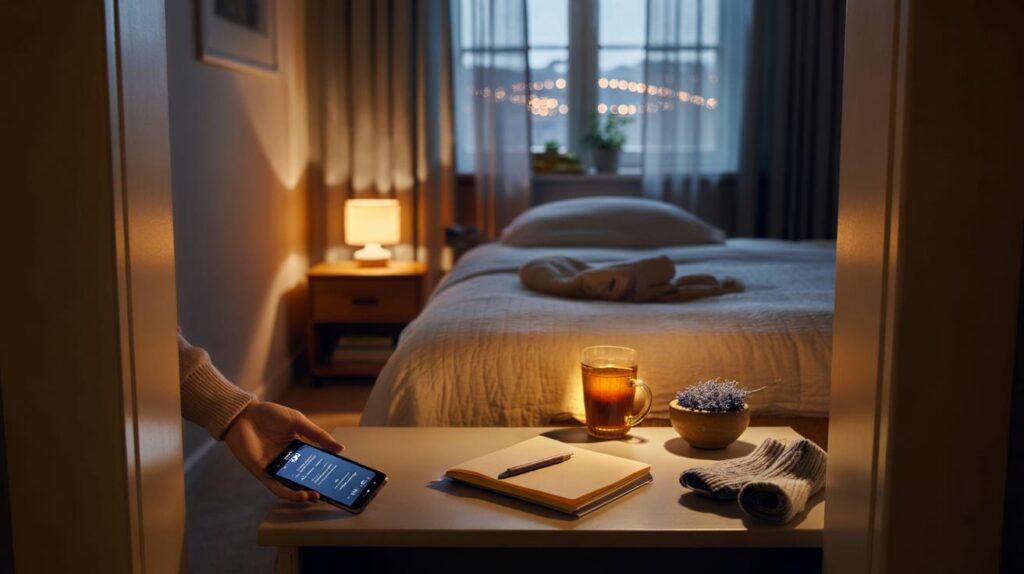
Restless nights don’t begin in bed. They start on the sofa, thumb-gliding through headlines, kitchen lights still blazing, mind chewing on tomorrow’s to‑do list. The fix doesn’t need a wellness retreat. It fits into a **10-minute ritual** that quietly flips your brain from “go” to “slow”. No apps. No white noise whales. Just human cues your body already understands.
The kettle clicks off with a soft sigh, and the flat goes dim. Streetlight lace curls across the curtains. I put my phone face down on the fridge, as if it were a noisy guest asked to wait in the hall. A small lavender bowl on the counter smells like clean sheets. In the next room, the duvet hangs open like an invitation. A minute passes. Then two. Breath starts to deepen without being told. There’s a tiny flicker of relief that feels both ancient and very modern. The day slips its shoes off. Something in the nervous system takes the hint. Like a dog that knows when the lead comes out.
The 10-minute window that changes your night
Before bed, the brain craves low stakes and clear signals. It listens for patterns more than words. When light drops, when movement softens, when inhalations slow, it assumes safety and starts the descent. That’s all a ritual is: a set of predictable cues the body recognises. You’re not “biohacking.” You’re offering the system what it evolved to expect at dusk. No need for perfection. One or two repeatable moves, same order, same time, and your bedtime self stops arguing with you. The routine does the talking. Sleep follows the script.
Take Mia in Leeds. Two kids under five, partner on shifts, a brain like a pinball machine after 9pm. She carved a 10-minute island at 22:30 and kept it small: dim lights, two lines in a notebook, 4-7-8 breathing, shoulder stretch, socks on, bed. On nights she did it, she fell asleep in under 20 minutes. On nights she skipped it, she was still checking emails at midnight. One in three UK adults report poor sleep, says the NHS, yet most have never tested how a tiny set of cues can cut the mind’s chatter. Mia didn’t buy a gadget. She changed the atmosphere.
The logic is simple. Deep sleep starts with a seesaw tilt from sympathetic arousal (alert and vigilant) to parasympathetic dominance (rest and repair). Light in your eyes, notifications pinging, late hot food — all keep the seesaw pinned on the wrong side. Rituals reverse that physics. Dim light eases melatonin release. Slow exhale breath nudges the vagus nerve. A “mind sweep” writes tomorrow down so your brain stops rehearsing it. When you repeat the same sequence, your cortex links step one with step four. The moment you turn the lamp low, your body is already halfway to bed. Pavlov, but kinder.
The 10-minute deep-sleep ritual, step by step
Here’s a method that fits in a song-length window. Minute 0–1: drop brightness — lamps on, overheads off, screens parked in another room, curtains drawn. Minute 1–3: jot a mind sweep — three bullets for tomorrow, one thing you’re grateful for. Minute 3–6: gentle floor work — “legs up the wall” for 90 seconds, then neck and jaw softening, then a slow reach for your toes. Minute 6–9: 4‑7‑8 breath — inhale 4, hold 7, exhale 8, repeat four times. Minute 9–10: sip something warm and plain, like chamomile or warm water with a pinch of salt if you’ve been sweating. That’s it. Lights down, thoughts parked, muscle tone softened, breath as a lullaby.
Common snags creep in. You do the breathing… with the phone still peeking. You stretch under bright kitchen LEDs. You write the mind sweep as a new to-do list and trip your stress wire again. We’ve all had that moment when the pillow feels like a meeting. Try this instead: keep the sequence boring on purpose. Dim first, then mini-journal, then body, then breath. Don’t switch the order. Avoid screen glow for the last 60 minutes if you can; if you can’t, use warm filters and hold the device at chest level, not in your face. Let’s be honest: nobody does this every single night. Aim for most nights, and forgive the rest.
Some nights won’t glide. Travel, toddlers, deadlines — life interrupts. Your ritual still matters on messy days because ritual equals control, not perfection. A sleep physiologist I spoke to put it simply:
“Night routines work when they’re cue-based, short, and the same. Tiny beats fancy. Your nervous system loves boring.”
- Start at the same time give or take 15 minutes.
- Turn big lights off first. Make it your start gun.
- Keep the mind sweep to four lines, max.
- Pick two stretches you actually like.
- End with the longest exhale you can manage, without strain.
Carry the calm into tomorrow
A 10-minute ritual is not a new identity. It’s scaffolding for the part of you that forgets how to land. The point isn’t that you do it flawlessly. The point is that repeated cues reduce the time it takes you to cross the bridge from buzz to bed. As the gap shrinks, mornings feel different. You wake without the buzzing hangover of midnight scrolling. Your temper steadies. Coffee tastes like pleasure again, not armour. If you share a home, your atmosphere rubs off on others — like turning the volume down in a room everyone thought was “just loud.”
There’s a quiet pride that comes from choosing a vibe on purpose. *This is your cue to be the DJ of your own bedtime.* Try the sequence for one week, same time, same order. Notice which step your body starts anticipating. Note the nights it doesn’t click, then try again the next. You might tweak it — swap the stretch, change the tea, add a warm shower or a short window-open moment for cool air. Keep the bones of it. The rest can breathe. And when it works, tell a friend. That’s how small rituals become culture.
| Point clé | Détail | Intérêt pour le lecteur |
|---|---|---|
| Light first | Cut overheads, use lamps, warm tones for 10 minutes pre‑bed | Faster melatonin rise and calmer mood without gadgets |
| Mind sweep | Three bullets for tomorrow + one gratitude line | Reduces rumination and eases the mental handbrake |
| Breath over effort | 4‑7‑8 breathing, four cycles, slowest exhale wins | Activates rest-and-digest so you drift instead of push |
FAQ :
- Does this replace therapy or medical help?If insomnia is chronic or linked to pain, anxiety, or sleep apnoea, speak to a clinician. This ritual is a behavioural cue set, not a cure-all.
- What if I wake at 3am?Keep the room dark, breathe long out-breaths, and try a mini mind sweep by dim light. If you’re wired after 20 minutes, get up, read something low-stakes, then repeat the last two steps and return to bed.
- Is caffeine in the afternoon a deal-breaker?For many people, yes. Caffeine has a long half-life. Try switching to decaf after lunch, and make your ritual’s warm drink non-stimulating.
- Can I swap 4‑7‑8 for another technique?Absolutely. Box breathing, humming, or a timed long exhale all nudge the same system. Choose the one you’ll actually do.
- What about screens before bed?Keep a **digital sunset**: park the phone outside the bedroom, use warm filters in the last hour if you must use it, and prioritise audio over video. Your brain will thank you.



Merci pour cet article, hyper clair. J’ai testé hier: lumière tamisée, 4‑7‑8, petite tisane — endormi en 15 min. Je pensais avoir besoin d’applis, en fait non. Bravo !
Le 4‑7‑8 me donne un peu la tete qui tourne; normal ou je respire comme un phoque ? Et le sel dans l’eau chaude, c’est pas contre-intuitif juste avant de dormir ?