
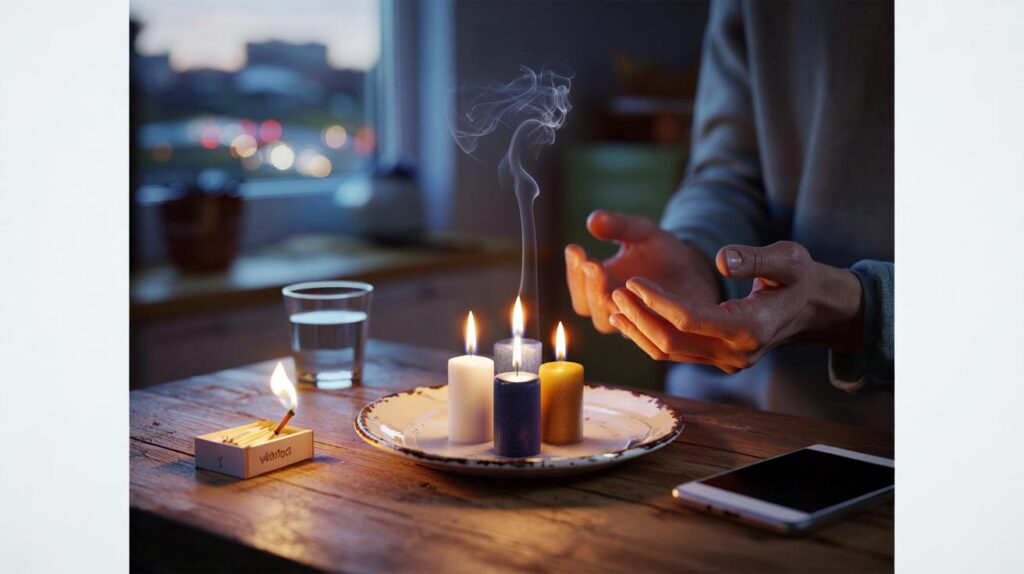
A small, human ritual that fits on a kitchen table and cuts through the noise: three flames, one intention, a calmer you.
The first time I tried the three-candle ritual, the city was yawning into evening. Buses sighed outside, and my phone kept lighting up with little demands. I placed three stubby candles on a chipped plate, struck a match, and listened to the quiet fizz of sulphur meeting flame. The room softened in seconds, the way a song lowers a guard.
I watched the wax find its flow, the shadows climb the wall, and my breath hitch then steady. One candle for the weight I carried, one for the chatter in my head, one for the space I wanted to hold. A tiny theatre, with no audience but me. Then something shifted I couldn’t quite name.
The air changed.
Why three candles work on busy, modern nights
Three is a shape your brain trusts. It’s the triangle that holds, the rhythm of beginning–middle–end, the habit of pattern-seeking minds. When you give your attention to three points of light, you spread the load and focus at once. It’s simple, domestic, and a little bit ancient without trying too hard.
The flames also give your senses a job. You smell warm wax. You see flicker. You hear near-silence. That sensory bundle tells the body, This is different from the rest of the day. And because it’s small and repeatable, it becomes a signal you can actually keep.
There’s a practical side too. Our nervous system likes predictability, and rituals are just that with a softer face. Three candles become three steps your body learns to anticipate. After a few sessions, your breath often drops sooner, thoughts slow a touch faster, and your posture loosens without a lecture. It’s not magic. It’s wiring meeting intention.
One woman, a night bus, and a triangle of light
Leila is a ward nurse who gets home well past midnight. She keeps three tea lights by the kettle, a tiny treat she lights while her pasta boils. First flame: I’m off duty. Second: I’m safe. Third: I’m here. She told me her smartwatch tracks her heart rate falling during those six minutes. Not a study. A small proof.
Tom, a new dad, does his version on the bathroom counter because it’s the only room with a lock. Three candles form a triangle around the toothpaste. He sits on the loo lid, breathes slow, and lets one thought per candle land. He says it buys him a better five hours of sleep than doom-scrolling ever did.
These tiny scenes matter because they’re real life. The triangle on a plate, the match in your hand, the way you look at fire and think of grandparents. Underneath, it’s basic design: three anchors, one line of sight, a body that loves rhythm. That’s why it sticks.
How to try the three-candle ritual tonight
Pick three simple candles you actually like. Colours can carry a vibe: white for clarity, blue for calm, gold for confidence. Place them in a triangle—two at the base, one at the top—on a plate or saucer. Sit. Breathe in for four, out for six, three times. Light from left to right, then the top. Whisper three words that suit your night: release, soften, arrive.
Keep it short. Three to seven minutes is enough. Turn your phone face down. If fragrance bothers you, go unscented. If you prefer meaning over colour, assign each candle a role—body, mind, boundary—and let your attention touch each in turn. Let the wax drip without fuss. Let your shoulders follow.
Common snags are normal. You’ll think of emails. You’ll wonder if you’re “doing it right.” You might choose fancy candles and then dread using them. Be gentle with yourself—this is supposed to feel human, not heroic. We’ve all had that moment when the ritual becomes another item on a list. Let’s be honest: nobody actually does this every single day. Better to do it twice a week and love it than force it and quit.
“Three flames. Three breaths. One you.”
- Best times: after work, before bed, or when you change roles (colleague to parent, busy to quiet).
- Simple words to say: “Release, restore, return.” Or “Ground, clear, invite.”
- Placement tip: triangle facing you for receiving; point away for letting go.
- Keep nearby: matches, a small plate, a cup of water.
Reading the room, not the rules
Rituals live best when they listen back. Some days you’ll need distance, so widen the triangle and sit farther away. Other days you’ll want warmth, so bring the base candles closer and cup your hands near the heat. You can swap colours to match your mood, or keep three plain tea lights and let the act do the heavy lifting.
This is small magic you can do in a kitchen at 7:12am. If a candle splutters, it’s not a sign—you probably cut the wick too short. If your mind races, let it jog and watch it from the doorway. If you’re grieving, let one candle stand for the thing you can’t say yet.
Safety note that still respects the mood: keep flames away from curtains, never leave them alone, and use a stable plate. Blow them out slowly when you’re done, watching the smoke curl like a curtain falling. The end can be its own tiny bow. Your nervous system loves that cue.
What three candles quietly teach you
There’s a reason the old stories used fire to mark thresholds. A modest ritual trains you to notice the hinge moments in your day: leaving work at the door, tending the mind before sleep, greeting your own company. Three points of light draw a border where noise can’t quite cross, and in that border you remember who’s driving.
The beauty here is portability. Hotel room? Three tea lights on a saucer. Office lunch break? Three LED candles and the same three breaths. The triangle keeps its shape wherever you plant it. It becomes a pocket door you can slide shut and open at will, without asking anyone’s permission.
You might find the ritual morphs with the season. In summer, you’ll finish faster and step outside. In winter, you’ll linger and let the wax pool. Some evenings the words will matter. Others, silence will be the point. The practice doesn’t demand purity. It asks for presence, for a handful of minutes where you meet yourself without noise. That’s rare. That’s gold.
| Point clé | Détail | Intérêt pour le lecteur |
|---|---|---|
| Three-point placement | Triangle on a plate, base towards you, top as focus | Creates instant structure and a felt sense of safety |
| Breath + words | Three cycles of 4–6 breathing and three intention words | Calms the body and frames the mind without effort |
| Meaningful colours | White=clarity, Blue=calm, Gold=confidence (or go unscented/neutral) | Personalises the ritual and deepens engagement |
FAQ :
- Which colours work best for the three-candle ritual?Choose colours that match your intent: white for clarity, blue for calm, gold for warmth. If in doubt, plain tea lights work beautifully.
- How long should each session last?Three to seven minutes is enough. End when your breath feels heavier and your shoulders drop a notch.
- What if one candle goes out?Relight it without drama, or let that be the message to simplify. It’s a ritual, not a test.
- Can I use LED candles?Yes. You lose the scent and heat, but the shape, breath, and intention still carry the effect.
- Is this tied to a specific religion?No. It’s a secular, personal practice you can adapt to your own beliefs or none at all.



Merci pour cette pratique minimaliste. Je l’ai testée hier soir après une journée pourrie: triangle simple, souffle 4–6, trois mots (relâcher, adoucir, arriver). Franchement, j’ai dormi plus vite et sans ruminer. Petite question: vous conseillez d’allumer gauche-droite-puis-haut; ça change quoi si on inverse? Et aprés, on garde la même intention plusieurs jours ou on varie?