
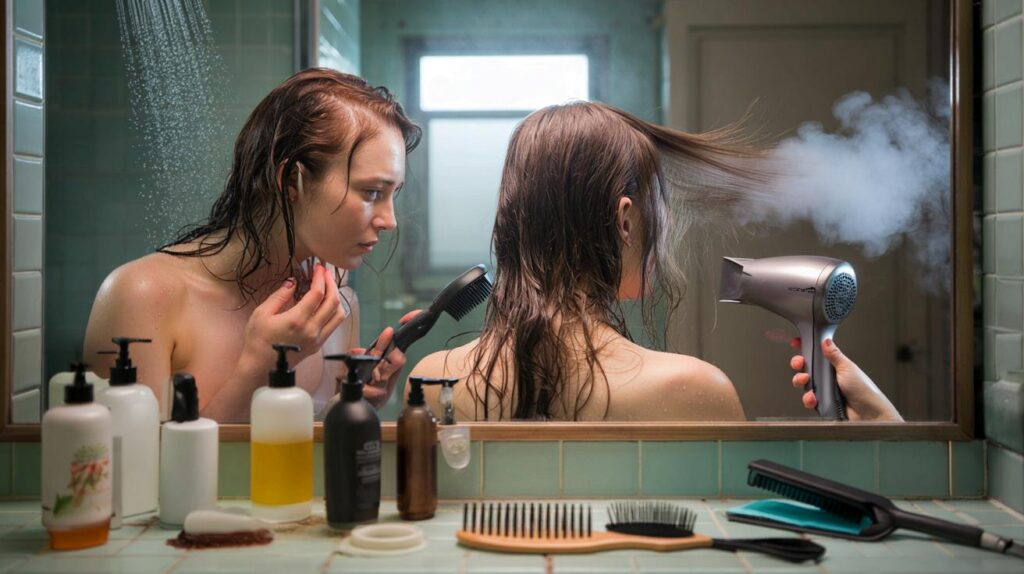
Your hair routine is trying to be helpful. Then life happens: a rushed wash, a too-hot dryer, a shelf of products that don’t talk to each other. The result looks polished at 8am and exhausted by lunch. Strands feel drier, the scalp gets jumpy, and your ends carry the story of every past mistake.
What if the problem isn’t your hair type, but the tiny habits that chip away at it each week?
The bathroom mirror was fogged, the kettle grumbling in the kitchen, and I was rubbing shampoo into my scalp like I was scrubbing a saucepan. The blow-dryer roared, the straighteners clacked, and my fringe folded into a crease I didn’t ask for. We’ve all had that moment when you catch your reflection in the lift doors and think: Why does it look tired already?
Days later, a stylist handed me a wide-tooth comb and said, quietly, that my hair wasn’t stubborn. I was. I thought I had bad hair; turns out my habits were the problem. The fix started with three small mistakes I kept repeating.
Small, but loud.
Mistake 1: Washing like it’s 1999 — your scalp isn’t a frying pan
The “squeaky clean” feeling is a trap. Your scalp is skin with a microbiome, not a greasy surface to strip. When you overwash or scrub too hard, you nudge it into defence mode. More oil, more flakes, more itch. **If your hair squeaks, it’s already unhappy.** The cuticle — that delicate shingle roof — lifts under hot water and harsh friction, then never quite lies flat again that week. Colour fades faster. Ends fray. You’re not dirty; you’re dehydrated.
Take Maya in Hackney, who ran every morning and washed every morning. Her ponytail felt fluffy by noon, so she doubled down with clarifying shampoo. A month later she was booking scalp treatments she didn’t need. Her fix was dull on paper: wash every second day, rinse cool, massage with pads of fingers not nails, and add a light conditioner to roots just once a week. Two weeks later, her scalp calmed, and that mid-day fluff turned into shape.
Here’s the logic. Sebum is a built-in conditioner that travels from root to mid-lengths when you brush gently. When you strip it daily, the scalp sends a memo: produce more. Hot water swells the hair fibre, then it contracts like a temperamental wool jumper. Repeated cycles weaken it. Hard water adds minerals that cling to strands, making them feel rough no matter what you apply. Swap one wash for a cool-water rinse and leave-in. Space shampoos. Use a shower filter if you can. The hair stays on your head longer that way.
Mistakes 2 & 3: Heat without a plan, and product chaos
Think like a sound engineer, not a DJ. Start by towel-squeezing, not rubbing. Apply a heat protectant on damp, not dripping, hair — section by section from ears down, then one mist over the crown. Dryer on medium heat, high airflow, nozzle on, 15–20 cm away. Point airflow down the strand, not across it. Two passes per section, max. Straighteners: 170–185°C for fine to medium hair, one slow pass. Curler: count to eight, release into your palm to cool. Heat doesn’t ruin hair; sloppy heat does.
The second trap is the product buffet. Oils on top of heavy creams can suffocate your cuticle. Mixing protein and strong bonders back-to-back can make hair crisp, not strong. Rinsing conditioner after 30 seconds? You’ve wasted it. Let’s be honest: no one really does that every day. Try a simple cadence: cleanse, condition, protect, style. One star product per step. If you love an oil, use a half-pea on ends after heat, not before. If your leave-in flakes, it’s clashing with your gel — switch one to a lighter formula.
“Great hair isn’t born in the salon; it’s built in the five minutes you don’t rush,” says London trichologist Ayesha Rahman.
- Keep water lukewarm; finish with 10 seconds cool to seal down the cuticle.
- Use a detangling brush only on damp hair with slip, starting at the ends.
- Heat protectant every single time you use heat, even “just a quick touch-up”.
- One clarifying wash every 2–3 weeks to reset, then a hydrating mask the week after.
- Swap pillowcase to satin or silk to cut friction and morning frizz.
What changes when you stop fighting your hair
When you remove the three saboteurs — hard washing, chaotic heat, product overload — hair starts doing that quiet, cooperative thing you thought belonged to other people. The blow-dry holds, the wave bends where you ask it to, and the scalp goes back to being invisible. You notice the sound of your dryer is lower because you’re using it less. You get back ten minutes. **Great hair is consistent, not perfect.**
Your routine becomes a rhythm instead of a panic. You pick up the same four products, and they behave. You skip a wash and your roots don’t shout about it. Friends ask what you’ve done, and the answer is slightly boring: fewer mistakes, more patience. Hair is mood and memory; it keeps score of those tiny daily choices. Share your own tweaks with someone who’s given up on theirs. The fix might be a centimetre to the left, or one notch down on the heat dial.
That’s the quiet magic — when something you live with every day finally stops arguing back.
| Point clé | Détail | Intérêt pour le lecteur |
|---|---|---|
| Stop over-washing | Space shampoos, use cooler water, massage gently | Longer-lasting style and calmer scalp |
| Plan your heat | Protectant on damp hair, medium heat, limited passes | Shinier finish with fewer split ends |
| Simplify products | One hero per step, avoid heavy stacking, clarify monthly | Less build-up, predictable results, money saved |
FAQ :
- How often should I wash my hair?Think scalp first, not hair length. Oily or fine scalps may need every 1–2 days; drier or curly types often thrive at 2–4. On workout days, try a cool-water rinse plus conditioner on ends, then a light leave-in.
- Do silicones ruin hair?They don’t ruin it; they sit on the surface and reduce friction. That’s protective with heat. If you notice build-up or dullness, use a gentle clarifying shampoo every couple of weeks and follow with a hydrating mask.
- What temperature should my straighteners be?Start lower than you think. Fine or fragile hair: 150–170°C. Medium: 170–185°C. Coarse or resistant: 185–200°C. Always pair with heat protectant and keep passes slow and few.
- Can I air‑dry without frizz?Yes. Towel-squeeze, apply leave-in for slip, and “plop” curls in a cotton T-shirt or microfibre towel. Don’t go to bed with wet hair — that’s friction and creases waiting to happen.
- Why does my hair feel dry even after conditioner?Could be hard water, not enough time for conditioner to work, or a protein–moisture mismatch. Leave conditioner on 2–5 minutes, finish cool, and add a lightweight leave-in. If water is hard, consider a shower filter.



Merci pour cet article, j’ai compris que c’est moi qui martyrise mon cuir chevelu. J’ai arreté de frotter comme une casserole (coupable!), passé l’eau tiède, puis seche-cheveux en medium. En 10 jours: moins de gratouilles, mes pointes font moins paille, et mon brushing tient enfin. Par contre je suis perdue sur les “bond builders” vs protéines: comment savoir si je fais trop? Mon gel peluche parfois avec mon leave-in, je suppose que c’est le clash dont vous parlez.
Sérieusement, finir à l’eau froide a-t-il un impact mesurable ou c’est juste une sensation? Si vous avez une source (hors pub), je prends.