
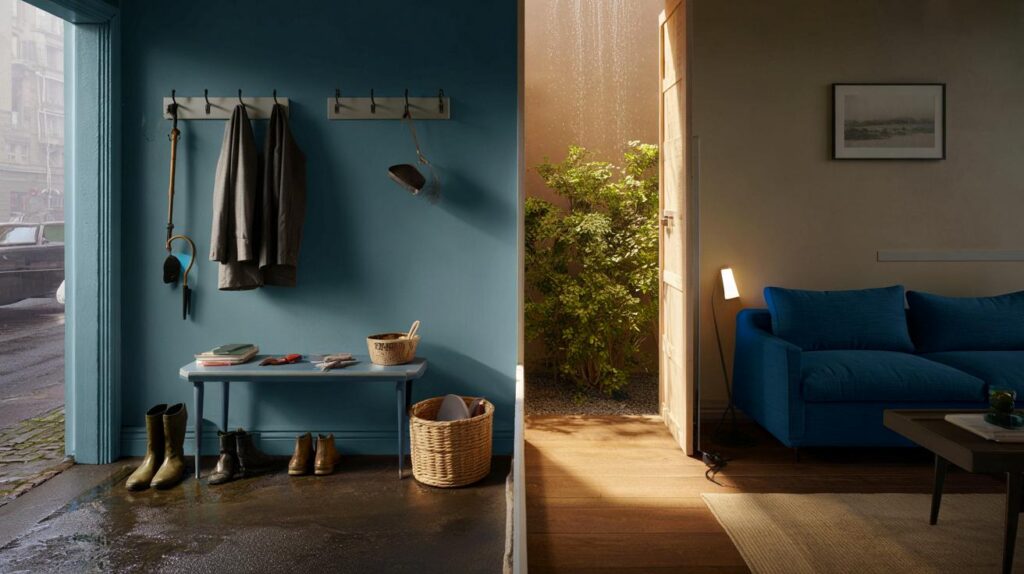
There are places in every home that seem to swallow air and mood. You tidy the surfaces, light a candle, and yet something still feels heavy. The good news: those sticky pockets of energy hide in predictable spots, and a few tiny shifts can loosen them in minutes.
I walked into a friend’s flat just after a rainstorm, the kind that turns London pavements into mirrors. The hallway met me first: a tangle of boots, a cold draft trapped behind coats, a key bowl overflowing with receipts. In the living room, the right-hand corner behind the sofa felt oddly still, as if the air hadn’t moved since last Thursday. Under the bed, a suitcase sighed with old summer clothes. *The place was neat at a glance, but the feeling lagged behind.* We laughed, we made tea, we opened a window. Then we moved one chair five centimetres. Something shifted. A small click you could almost hear.
Where your home’s energy really stalls
Start with the entry. It isn’t just a strip of floor; it’s the throttle of the whole house. Bags, post, umbrellas, all gathering in that split second when you arrive. The mind dumps what the hands can’t carry. **Your hallway sets the tempo for everything that follows.** When the entrance narrows, you feel it in your shoulders. People speak quieter. Footsteps slow. Clearing it isn’t about looks. It’s about flow you can sense before the lights are even on.
Then there are the corners and the gaps behind big furniture. Every home has one that never quite breathes: the wedge behind a sofa, the angle beside a bookcase, the triangle where a floor lamp leans into a wall. Dust loves inertia; air avoids dead ends. You’ll notice it in the way a room smells after a night with the windows shut, or how the same corner hosts the same pile again and again. I watched a family move a sofa a hand’s width and the room started to feel taller. Not tidier. Taller.
Finally, the under-bed and the bottom of wardrobes. These are silent storage fields, and they collect more than shoeboxes. They collect half-made decisions: trousers to mend, letters to answer, photos you’re not ready to sort. **Corners don’t just hold dust; they hold decisions you’ve postponed.** Under the bed is close to your body all night. It’s not mystical to say that matters. Think airflow, think ease of mind, think about not sleeping on a library of loose ends. Small changes down there can alter the tone of a morning.
Simple moves that get things moving again
Try a three-step flow reset that fits inside ten minutes. Open two opposite windows to make a path; feel the draught, even if it’s brief. Create a clear 90-centimetre walkway from your door to your most-used room; scoop the drop-zone into a single basket for later sorting. Shift one bulky piece by 5–8 centimetres away from the wall to break the vacuum pocket. **Under-bed clutter whispers at 3 a.m.** If you can, lift the bed on sliders to pull everything out in one go, then only return what you truly need in sealed boxes with labels you can read without crouching.
In corners, think triangle. Two objects already define it; a third is where the pile starts to breed. Keep only one living thing there: a lamp you actually switch on, a plant you actually water, or a chair you actually sit in. We’ve all had that moment when a “temporary” stack becomes part of the décor. Let’s be honest: no one does that every day. That’s why you pick micro-moves: a weekly five-minute sweep, a monthly under-bed pull, a seasonal hallway reset when coats change. Small, repeatable, a little boring. Correctly boring.
When the hallway feels like a traffic jam, borrow a hotel trick: wall hooks at two heights, a shallow tray for pocket stuff, and a rule that nothing lives on the floor overnight. It sounds strict, but it’s really about easing your arrival.
“Energy follows ease,” an organiser told me once. “Make the easy thing the tidy thing, and the room will do half the work for you.”
- Entryway drill: clear path, one basket, two hooks per person.
- Corner refresh: slide furniture out a palm’s width; add light or a plant.
- Under-bed edit: empty, clean, return only sealed, labelled essentials.
- Five-minute Friday: open windows, shake mats, lift one rug corner.
- Seasonal swap: rotate coats, shoes, and bags with the weather shift.
A small shift, a different house
Give this a week and watch for subtle signs. The shoe that stops wandering. The way your shoulders drop when you walk in. The corner that no longer eats mail. You may feel silly moving a sofa by a hand’s width. You may laugh at labelling a box “winter socks”. Do it anyway and take note of how the room sounds at night, how the morning smells, how you pause less before leaving. The home didn’t change shape. You changed the friction inside it. That’s what stuck energy is: friction you can’t see. Tackle the entry, the corners, the under-bed, and you’re not just tidying. You’re giving your mind a clean runway. Share it with someone who’s stuck on their own threshold.
| Point clé | Détail | Intérêt pour le lecteur |
|---|---|---|
| Entryway sets the flow | Clear a 90 cm path, use hooks and a tray, one catch-all basket | Instantly lighter arrivals and fewer lost items |
| Corners and behind furniture | Slide heavy pieces 5–8 cm; add light or a single purposeful object | Air moves better, piles stop forming, room feels taller |
| Under-bed and wardrobe bottoms | Empty fully, clean, return only sealed, labelled essentials | Calmer sleep, quicker mornings, less mental clutter |
FAQ :
- How do I know energy is stuck?You’ll feel hesitation at the doorway, see repeat piles in the same spots, and notice stale air in corners after a closed night.
- Do I need to declutter the whole house?No. Start with the three hotspots. They deliver the biggest mood shift for the least effort.
- Is this just Feng Shui by another name?Call it what you like. It’s airflow, light, and decisions made visible. If it helps you breathe easier, it works.
- What if my space is tiny?Go vertical in the entry, lift the bed on storage, and use slim furniture so air can slide behind it.
- How often should I do the reset?Weekly five minutes for maintenance, monthly under-bed pull, seasonal wardrobe swap. That cadence keeps the flow alive.



Merci pour ces conseils ! J’ai déplacé le canapé de 5 cm et la pièce a vraimment l’air plus haute.
Honnêtement, parler d’“énergie” me laisse dubitatif. N’est ce pas juste du ménage et un peu d’aération ? Où sont les preuves ?