
Self-care has been turned into a shopping list: candles, crystals, creams. Lovely, sure, but useless at 7:43 a.m. when your toast burns and your inbox pings like a fire alarm. The real question is simpler and messier: what can you actually do today, in minutes, that helps you feel human again?
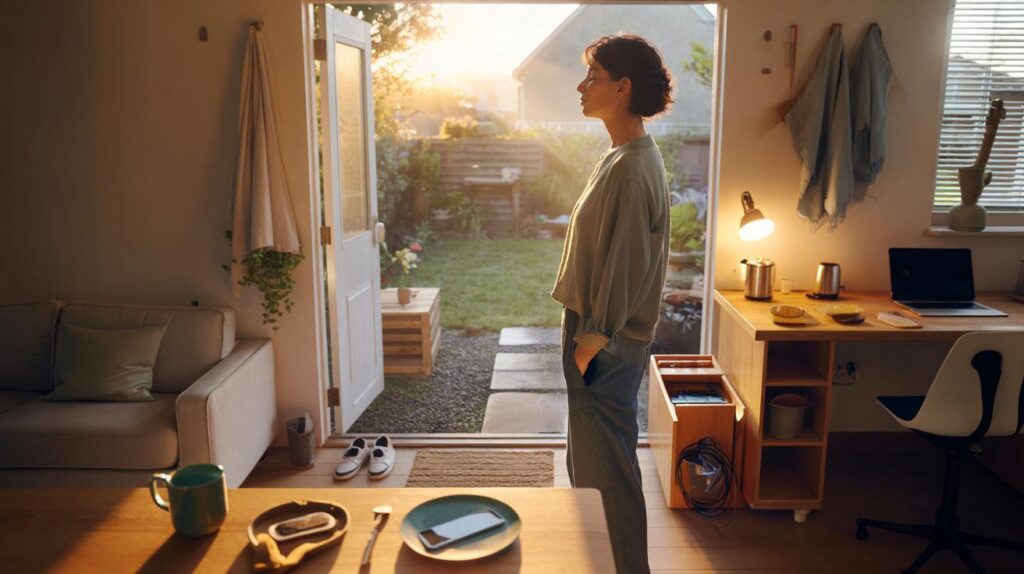
The kitchen is still dark when the kettle clicks. You scroll, thumb on autopilot, as a dozen red dots blink for attention. Outside, a bus sighs at the stop; inside, your mug warms your hand. You put the phone down, just for a minute. You look out at the pale sky and take one slow breath that feels like it belongs to you.
This is where self-care quietly begins.
You open the back door and step into the cool. One minute of morning light on your face, no sunglasses, no faff. Then a tiny stretch, a sip of tea you actually taste, and a single thought: what would make today gentler by 5%? Nothing fancy, yet it worked.
What self-care looks like when no one is watching
Self-care gets loud on social media, but in real life it’s barely visible. It’s the 60-second breathing reset before a tricky email. It’s a two-minute tidy that means the sofa welcomes you back later. **Real self-care is how you spend your minutes, not your money.**
Maya, 38, started taking a 10-minute walk after lunch around the same block. No podcast, no phone in her hand, just a loop past the newsagent and the lime tree by the roundabout. On week three, she noticed she wasn’t crashing at 3 p.m. like before. Her boss noticed her calmer tone first.
Small rituals work because they reduce decisions. Your brain loves shortcuts, and rituals are friendly ones. They act like punctuation marks in a frantic paragraph of a day. You don’t need motivation for a comma. You just keep the rhythm going.
10 daily rituals that quietly change your day
Start with two anchors: a morning minute of light and a one-breath pause before your first message. Stand by a window or step outside, then inhale for four counts and exhale for eight. Later, set a “digital sunset” where your phone sleeps in another room 30 minutes before you do. That single boundary reshapes tomorrow.
Layer in three micro-moves: a 10-minute post-meal walk, a two-minute desk stretch, and a 120-second tidy of whatever’s in your way. Add one kindness ritual: send a “thinking of you” text to someone each day. Let’s be honest: nobody does this perfectly every day. That’s fine; you’re building a groove, not a prison.
Rituals stick when they’re obvious, easy and satisfying. Put your walking shoes by the door, leave a glass by the kettle, and pair a habit with something you already do. **Make it so simple it feels almost silly.** The wins are small on purpose.
“Slow is a speed.”
- 1) Morning light minute: open the window or step outside, face the day.
- 2) One-breath pause before the first message or meeting.
- 3) 10-minute post-meal walk to reset your head, not your step count.
- 4) Two-minute desk stretch: neck, shoulders, wrists.
- 5) 120-second tidy: clear the one surface you see the most.
- 6) Five-minute phone declutter: remove one app, one notification category.
- 7) Gratitude text: one honest sentence to a real person.
- 8) Single-task tea or coffee: sit, sip, no screen.
- 9) Boundary phrase: “I’m not available then—how about tomorrow morning?”
- 10) Digital sunset: phone parked away 30 minutes before bed.
Your nervous system’s best friend is boring
We’ve all had that moment when the day avalanches and you feel six steps behind. Boring rituals catch you before the slide. They aren’t glamorous, and no one claps when you put your phone in a drawer at 9:30 p.m. Your sleep does, silently.
Here’s a trick: name your ritual like a playlist. “Reset Walk”, “Quiet Cup”, “Inbox Breath”. Language gives shape to repetition, and repetition turns into identity. **Start small, repeat often, and let the day meet you halfway.**
Your future self isn’t a stranger; it’s you, slightly less frazzled. Protect them with tiny decisions today. Ask: what would make the next hour easier? Then do the smallest version of that. Soyons honnêtes : person—no, wrong language—Let’s be honest: nobody does this perfectly every day.
Leave room for the day to surprise you
Self-care isn’t a tidy checklist. On some days it’s three rituals; on others, it’s one breath before you press “send”. The point isn’t to win at wellness. It’s to feel a little more like yourself in the in-between moments that usually vanish.
Try swapping indulgence for maintenance. A walk that steadies your thoughts beats a bath you never find time to run. You’re not fixing yourself; you’re supporting a system. That’s kinder, and it lasts longer.
Notice the texture of your day as you add these shifts. The clink of the mug. The cool air on your face. The relief of saying “not available then” without a paragraph of apology. *Tiny rituals make a day that feels less like a fight and more like a conversation.*
| Point clé | Détail | Intérêt pour le lecteur |
|---|---|---|
| Rituals over treats | Swap occasional pampering for daily micro-actions | Build steadier energy without extra time or cost |
| Make it tiny, make it obvious | Pair actions with existing cues and keep them two minutes or less | Easier to start, harder to skip when the day gets busy |
| Protect boundaries | Use one simple phrase and a digital sunset | Fewer last-minute squeezes, better sleep, calmer mornings |
FAQ :
- How long should these rituals take?Most live between one and ten minutes. Short is the point, so they actually happen.
- What if I skip a day?Skip the guilt and go again at the next natural cue—after lunch, at the kettle, before bed.
- Do I need special apps or tools?No. A timer, a window, a mug and a decent pair of shoes will carry you far.
- How do I stick to them with kids or shift work?Anchor rituals to moments you already have: doorways, meal finishes, handwashing.
- Are bubble baths and face masks “bad” self-care?They can be lovely treats. These rituals just keep you steady on the days without candles.



Saved this. The morning light + one-breath pause felt tiny but shifted my whole tone before email. “Real self-care is how you spend your minutes, not your money” hit home after years of buying candles I never lit. Thank you for making it doable, not performative 🙂