
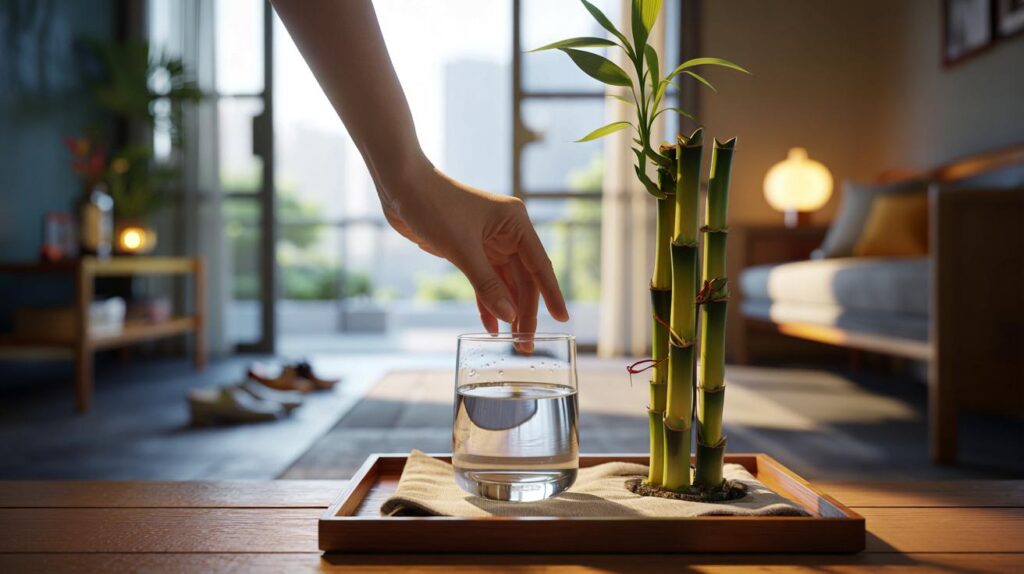
Clutter hums quietly in a home. The mind catches every unfinished task, every tangled wire, every shoe left like a comma in the hallway. Many women across East and Southeast Asia meet that hum with a small, almost shy gesture that changes the whole mood of a room.
I watched it on a rain-bright morning in a sixth-floor flat above a market. A woman rinsed a clear glass, slid three slim bamboo stalks inside, and topped it with fresh water that caught the light. No drama. No new furniture. Just a small bowl-like stillness on a sideboard near the door. The apartment shifted. The buzzing fridge felt quieter. The window’s traffic softened into a faraway ribbon. She wiped a ring of water with her thumb and smiled, as if a knot in the day had finally untied. The air felt taller, softer, kinder.
Then she did nothing. And the room did the rest.
The quiet water-and-bamboo ritual that softens a day
It’s simple: water, wood, light. In countless homes from Seoul to Singapore, you’ll spot a clear glass with lucky bamboo on a tray by the entry, or in the east corner of the living room. The combination is not grand. That’s the point. It’s a whisper of nature inside the noise of a city day.
Think of the life around that glass. School bags thud. Keys clink. A text pings. Then your eye lands on green lines rising out of still water, and your shoulders drop a fraction. We’ve all had that moment when a small, tidy detail calms the whole picture. One minute you’re juggling a dozen tabs in your head. The next, the room has an anchor.
Feng Shui, at heart, is a practical language about how energy moves. Water cools and gathers; wood grows and lifts. In the family and health area (traditionally the east), the water–wood duo is said to nourish stability and peace. Even without the philosophy, the logic stands. Green signals life, a vertical shape cues breath, and a reflective surface tells the brain, “There’s depth here.” The mind stops bracing for impact. It leans in.
How to set it up like women who grew up with it
Start with a clear cylinder or tumbler you like to touch. Add three or five bamboo stalks, roots rinsed, leaves trimmed clean. Fill with fresh water up to the lowest node, then place the glass where morning light brushes it, ideally to the east of the space or by your entry shelf. A small dish beneath keeps the base dry and turns it into a tiny altar to calm. Tie a thin red thread near the top if that tradition speaks to you.
Change the water on two fixed days each week. Monday resets the tone; Thursday carries you to the weekend. Wipe the glass, trim any yellowing leaf, and let that minute be a breath for you too. Don’t bury the plant in stones. Let the roots show. The clarity is part of the medicine. Let’s be honest: nobody really does this every day. Two tidy check-ins are enough to keep the mood steady.
People ask, “Is it just decor?” It isn’t for them. It’s a micro-ritual that recuts the day’s edges. The room seems to breathe again. A Hong Kong–born friend put it better:
“It’s like combing the room’s hair. Quick. Gentle. Then everything sits right.”
- Choose clear glass, not coloured, so light plays and the water stays honest.
- Three or five stalks feel purposeful. Avoid four in Cantonese-speaking homes.
- Place at eye level or just below. You want to meet it, not peer down at it.
- Swap water twice weekly. A tiny task that pays back all day.
- If the bamboo struggles, use a stem of leafy pothos or a single monstera leaf.
Small extras that keep serenity sticking
Pair the bamboo with a 90‑second doorway reset at dusk. Align shoes to the side, shake the doormat, open the window a hand’s width, and ring a soft chime three times. One sip of fresh water goes to the plant, one breath goes to you. This is housekeeping for the nervous system. Your future self will thank you at 10 p.m.
Skip the clutter around the glass. Don’t crowd it with trinkets or force it in full sun. If a leaf dies, remove it quickly. If pets nose the water, shift it to a safe shelf and place a coaster as a “landing pad” for your eye lower down. *On days when life gets messy, do the one tiny thing you can keep.* The glass, the water, the green. Repeat the minimum, not the maximum.
Two quiet add-ons whisper serenity without shouting. A soft, dimmable lamp behind your main seat will give you a gentle horizon line at night. And a small cloth or tray under the glass turns “plant in a cup” into a **quiet ritual on purpose**. The edge you draw with that tray becomes a boundary for your thoughts. It says, “Here begins calm.”
There’s a reason this looks effortless. The design cues are ancient, the maintenance is low, the message is clear. It’s the softest kind of discipline: pleasant enough that you’ll actually keep it. In a world that sells serenity in thirty steps, this is one. And it holds.
Where the feeling comes from, beyond the look
The science is not the point, but it smiles in the background. Biophilic design—bringing living forms into daily sightlines—lowers heart rate and steadies attention. A small vertical plant in still water gives you direction and rest in one hit. The glint on the water draws the gaze. The vertical green lifts it. Your mind senses a safe scene: light, growth, and a clear boundary.
Feng Shui names those cues in its own way. Water gathers qi, wood rises with it, and the east loves a gentle morning glow. A clear glass is like a promise kept in public. Your brain sees that promise twice a day, when you leave and when you return. There’s comfort in that loop, especially in homes with kids, roommates, or night shifts that pull routines apart.
This is also why the trick travels. In a studio flat, it defines “home” without a wall. In a family house, it anchors the chaos of a hallway. In a shared space, it becomes communal without being precious. Call it Feng Shui. Call it common sense. It is **the soft power of water**, disguised as a plant in a glass.
What not to do, and what to try when life gets loud
Don’t place the glass where feet will kick it or where direct sun will cook it. Avoid mirrors that reflect the front door head‑on; it bounces the calm back out. Skip dried plants around it. They send mixed messages. If you’re tempted to add crystals, keep them small and clear, so the focus stays on living green and clean water. The gist: let clarity be the star.
If the bamboo wilts, swap to cut greens in water. A single, glossy philodendron leaf looks like a poem. Use filtered water if your tap runs hard. A tiny pinch of charcoal in the base can keep it sweet. On travel weeks, move the glass to a cooler corner and lower the water line. When you return, rinse, refresh, and reset. **Serenity is a practice, not a purchase.**
When the day refuses to soften, expand the ritual a breath at a time. Place your hand on the glass for three seconds and count. Do it twice. That’s it. If you can stretch, add the 27‑item shuffle: move 27 small things by an inch—books, frames, jars on a shelf. Not a tidy-up, just a nudge. Rooms wake up when you nudge them.
Some women add scent only at night. A drop of citrus on the tray, never in the water. Others keep a tiny notebook under the cloth and write one line before bed. “Light today.” “Too many emails.” “Good soup.” The glass holds space; the line gives it shape. Your house stops feeling like a queue. It turns back into a room with a heart.
The open door you feel when you walk back in
Stand in your doorway tonight and look for a place where your eye can land and rest. Not a grand gesture. A single, clear view that steadies your breath. That is what this water‑and‑green trick gives you every day. It’s not a trend. It’s a way of telling your home, and yourself, “We’re okay.”
Stories travel fast online. Methods even faster. This one survives because it’s cheap, quick, and friendly to real life. It meets you where you are—busy, distracted, carrying more than you admit. Then it asks for one small action, twice a week, and repays you every time you pass by. You may find people pausing at your shelf, touching the glass with a fingertip, smiling without mentioning why. That’s the measure that matters.
Try it. Then ask your mother, your neighbour, your group chat what they keep by their door. You’ll hear recipes, superstitions, and tricks that hold families together in a quiet way. This is one of them. It’s just water and a bit of green, sitting in the right place, patiently, waiting for you to come back.
| Point clé | Détail | Intérêt pour le lecteur |
|---|---|---|
| Verre clair + bambou | 3 ou 5 tiges dans l’eau, racines visibles | Rituel simple qui apaise visuellement |
| Emplacement | Est de la pièce ou par l’entrée, lumière du matin | Calme perçu dès l’arrivée chez soi |
| Entretien | Eau changée 2 jours fixes par semaine | Habitude réaliste, effet constant |
FAQ :
- Can I use fresh leaves instead of lucky bamboo?Yes. A pothos stem, a philodendron leaf, or a single monstera leaf in clear water works beautifully.
- How many stalks should I use?Three or five feel intentional. Many avoid four in Cantonese contexts due to a sound association.
- Is tap water fine?Often yes. If your water is very hard, let it sit overnight or use filtered to keep the glass clear.
- Where should I avoid placing it?Direct hot sun, wobbly shelves, or right where a mirror bounces the front door back at itself.
- How soon will I feel a difference?Many people feel calmer the day they set it up. The steadier change comes from refreshing the water on repeat.



Merci pour cette astuce toute simple ! J’ai mis 3 tiges de bambou dans un verre clair à l’est du salon et je change l’eau lundi/jeudi comme suggéré. Impression de calme immédiate—le bzzz du frigo paraît moins présent, c’est fou. Merçi pour la clarté des conseils (le fil rouge, la petite coupelle, etc.).
Je suis curieux·se mais un peu gêné·e par le titre: “femmes asiatiques”. Ça me semble réducteur et pas très précis culturellement. Pourriez‑vous citer des sources ou traditions spécifiques (région, école de Feng Shui) pour éviter l’essentialisation? Sur le fond, l’idée eau+bois me parle, mais j’aimerais des références plus concrètes.