
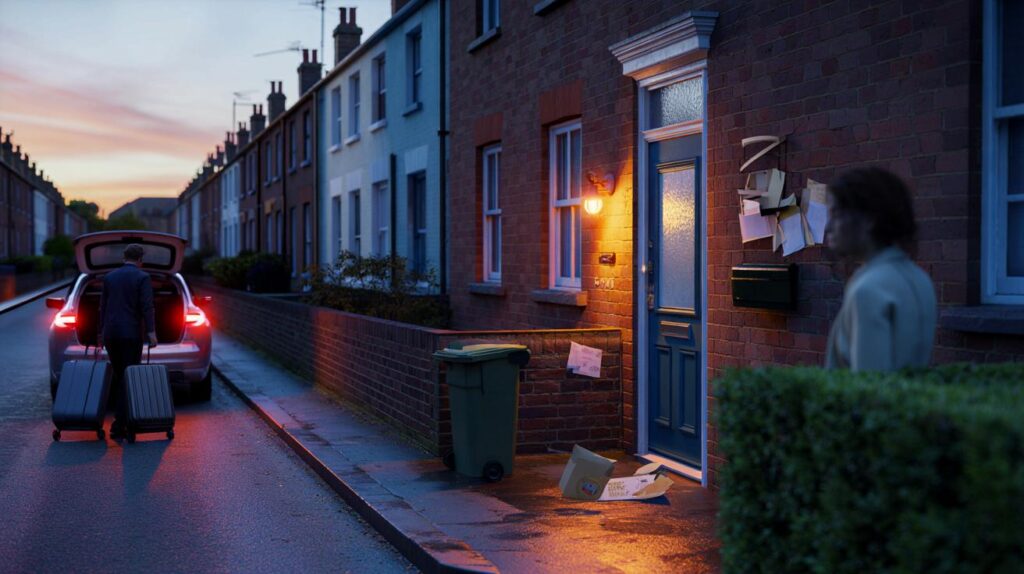
There’s a tiny habit that shouts “no one’s in” louder than any broken lock. People make it every day on their way out, keys in mouth, bag on shoulder. It’s not leaving a window ajar or forgetting the back door. It’s something far simpler: letting your home broadcast your absence.
The Friday sunset looked painted on, the kind that turns terraced brick into copper. I watched a man on my street do a quick last-minute dash: windows clenched shut, letterbox taped, hallway lamp flicked on and left glowing. He glanced at his phone, tossed a “Back Sunday!” into a group chat, then rolled his suitcase to the Uber. Two hours later, our road was a neat row of dark houses and one with a lamp burning like a stage prop. You could feel the script.
Across the week the same patterns appeared: curtains locked in daylight, bins left skewed on the kerb, a calendar pinned to a kitchen wall readable from the side window. Most of us think this is tidy and safe. It often isn’t. Burglars look for easy wins. They read the tells we forget we’re sending. The mistake is telling.
We’ve all had that moment when the door clicks and you wonder if you left a light on or a post-it note saying “milk in fridge”. That edge of doubt is where this begins.
The silent signal burglars watch for
Here’s the pattern thieves love: a house that looks paused. Curtains shut in the daytime, the same lamp lit after midnight, no shoes by the door, no clatter, no change. It’s the visual equivalent of a screensaver. Modern life trains us to tidy everything before we leave, to “close” the house like a laptop. That neatness becomes a beacon. A lived-in home breathes. An empty one holds its breath.
Think of the neighbour who walks the dog at 7am and 10pm. They see your hallway lamp on every night, same glow, same angle. They notice your post peeping for three days. They hear no radio, no kettle. Their brain makes a note. So does someone walking by with less friendly intent. In one UK case last autumn, a small cul-de-sac had three break-ins in a fortnight. Not because of fancy tech. Because, as one resident put it, “we accidentally told them when we were away.” It started with a “Back Monday!” Instagram story.
Why does this mistake matter so much? Because burglars play probability. They don’t need to be geniuses; they just need to be good at reading patterns. A predictable pattern beats a fortified door. When your home behaves the same every time you leave, you hand them a timetable. No one’s checking the front. No dog is coming to the door. No sudden light shift. That stillness is the green light.
How to break the pattern without breaking the bank
Start with micro-changes. Vary the obvious. Leave one blind half-open in a room that isn’t street-facing. Use a plug-in timer that shifts a lamp by 20–40 minutes each evening, not exactly on the hour. Ask a neighbour to pull your bin in and mix your post into theirs if you’re away for a long weekend. A cheap radio on a low timer in the kitchen does more than a high-end camera at 2am. Small, human signals beat expensive theatre.
Common mistakes come from good intentions. People leave lights blazing all night, which looks stranger than a warm flicker at 8pm and nothing at 11. Some draw every curtain tight, turning a house into a black box. Others splash “Off to Lisbon!” on public feeds. Don’t blame yourself; routine is comforting. Let’s be honest: nobody really does that every day. If you’re forgetful, set a “home check” that takes 90 seconds: windows latched, timer set, letters scooped, one blind left natural. It’s a habit you can keep.
The social side matters. Your house can shout even when you’re not there—not just with lights, but with your online trail. Broadcasting your absence is the modern doormat key.
“We don’t need to catch burglars outsmarting Hollywood alarms,” a veteran neighbourhood officer told me. “We need homes that don’t accidentally put up a vacancy sign.”
- Delay trip posts until you’re back.
- Keep delivery notes off doors; redirect parcels or use pickup points.
- Alternate a lamp location if you use timers.
- Share a simple rota with a trusted neighbour: bins, post, blinds.
- Keep a pair of shoes by the door and a mug by the sink. Lived-in cues matter.
The big mistake, named and faced
Call it what it is: the tell is telling. We leave home and make it look empty, or shout that we’re gone. The fix isn’t paranoia; it’s rhythm. Think less fortress, more choreography. Let the house breathe a little while you’re away. A soft light one night, a dark house the next. Bins that don’t linger. Curtains that don’t look frozen. A neighbour who knows your “normal”. The best deterrent is a home that acts like someone might walk through the door at any minute. That single shift—from broadcast to ambiguity—changes the whole equation.
There’s a quiet truth here that lingers beyond locks and cameras. Homes used to hum because we lived in smaller circles; someone always noticed a change. Now we travel more, post more, live behind glass. The trick isn’t to hide from the world; it’s to stop handing out free schedules. It’s a mindset as much as a checklist. You don’t need gadgets to make a house look lived in, just a little theatre and some neighbourly solidarity. Share this with the person who waters your plants. Share it with the friend who leaves lights blazing like a lighthouse. And maybe, next Friday at sunset, your street won’t look like a row of paused screens.
| Key points | Details | Interest for reader |
|---|---|---|
| The big mistake | We “announce” we’re away through frozen routines, all-dark days, always-on lights, and online posts. | Helps you spot your own tells and stop advertising absence. |
| What actually deters | Small, human signs: varied lighting times, blinds not fully shut, post collected, a touch of everyday mess. | Practical tweaks you can do tonight without spending much. |
| Neighbour factor | Quiet agreements on bins, letters, and quick checks, plus delayed social posts. | Free, friendly protection that feels like community. |
FAQ :
- What’s the single biggest “I’m away” tell?The same light glowing at the same time every night, paired with shut-in-daylight curtains and uncollected post. Together, they read like a sign.
- Are smart cameras and alarms worth it?They help, especially for alerts and evidence. Yet pattern-breaking and neighbour eyes often prevent the attempt in the first place.
- Should I leave a car on the drive?If a car is normally there, yes. Ask someone to use the space while you’re gone. A car that never moves for a week can also look suspicious.
- Is it safe to post holiday snaps while away?Better to wait until you’re home. If you must share, limit visibility to close friends and avoid time stamps or “back Monday” captions.
- Do timers make my house look staged?Not if they’re set with drift and used in more than one room. Randomised or offset timers beat exact o’clock lighting. Pattern beats lock—so break the pattern.



This is the first time someone explained why a single lamp on a timer can backfire. The idea of a house that looks “paused” is spot on. Any advcie for flats where the hallway light is the only street-facing cue? Would a low radio be enough?