
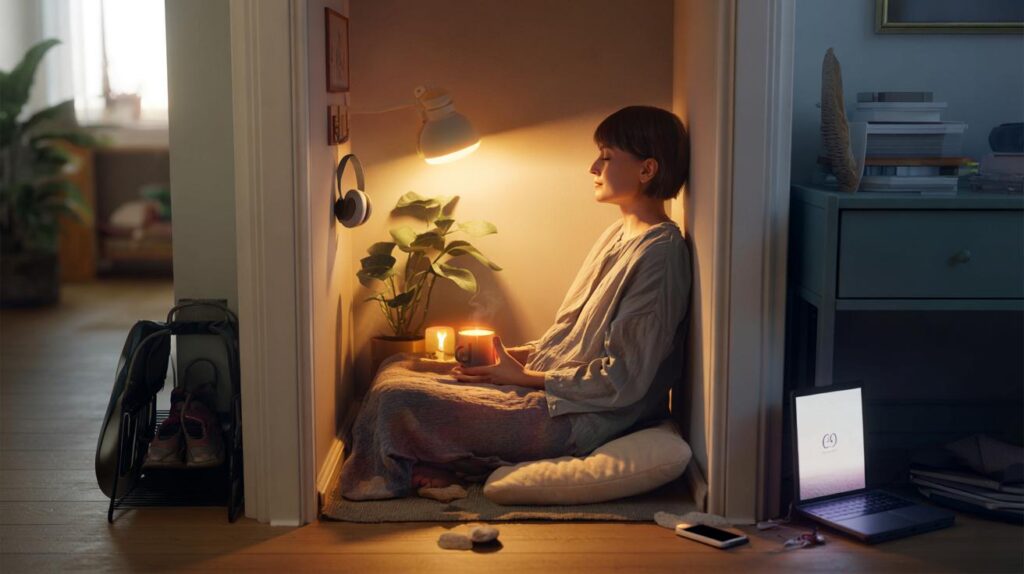
The noise finds us everywhere now — kitchen radios competing with email pings, a toddler’s wail colliding with late-night Slack. Homes that once felt like cocoons now echo with tasks, alerts, and moods we don’t always recognise. The “calm corner” method was born in classrooms and therapy rooms, but it makes frightening sense in a flat, a bedsit, a family home. Not as a pretty nook. As a way back to ourselves when the day becomes too loud.
The other morning I watched a neighbour crouch by her stairwell, cup of tea in hand, just as the school run sprint began outside. She’d tucked a cushion against the skirting board, a small plant beside it. She held that mug like a buoy between two tides — emails waiting upstairs, a child negotiating socks downstairs. She closed her eyes, breathed once, twice, and the hallway softened as if wrapped in wool. It lasted four minutes. She stood, eased her shoulders, and went back into the day with a different face. The room didn’t change, but the weather did.
The quiet corner that changes the script
A calm corner isn’t a design trend; it’s a boundary with a job. In a home where everything bleeds into everything — work into laundry, dinner into deadlines — it tells the body, here’s where the nervous system can land. Think of it as a micro-sanctuary, the place that turns big feelings into smaller ripples. Not a retreat in the fancy sense. A place to take your own hand and say, steady.
Marcus, a night-shift paramedic in Leeds, made his in the narrow space beside the shoe rack. A folded blanket became a seat, a clip-on lamp gave him a warm circle of light, and he hooked his noise-cancelling headphones over a wall peg. He sits there before his 6 a.m. sleep, running a two-minute breath count, thumb on a cool pebble from his last sea day. He swears it halves his spin-down time. Five minutes of slow, nasal breathing nudges the body toward rest-and-digest, and a small ritual tends to stick when it has a physical home.
Brains love cues. When a corner is consistent — same light, same texture, same posture — you build a loop that’s faster than a to-do list. The chair becomes the signal, your hand finds the pebble, your lungs remember the count. This is less about “positive vibes” and more about friction. You remove the faff that blocks you from pausing, and the pause starts to happen. The corner doesn’t fix the day. It changes the way you meet it.
How to build one without buying anything new
Pick the least contested spot at home and claim a square metre, even less if space is tight. Sit on a folded towel against a wall, choose a warm lamp or a candle, and give your hands something to hold. A book, a smooth stone, knitting, a notepad — anything that anchors touch. Name the place out loud. “This is the calm corner.” Then decide the ritual: three songs, ten slow breaths, one page of writing, or a cup of tea you finish without scrolling. *Leave your phone outside.*
Common snags creep in. People over-decorate until the corner feels like a showroom, then stop using it because it’s precious. Parents send children there as punishment, so the spot becomes sticky with dread. Couples rush each other’s pauses or turn the corner into storage. Be kind to the mess of beginnings. Let’s be honest: no one does this every day. A corner works because it’s humble and forgiving, not because it looks like a magazine spread.
We’ve all had that moment when the air feels heavy and a small ritual makes it breathable again. That’s the job description here. Use the corner for five minutes before the school run, after a hard call, when tears brim, or when your jaw won’t unclench.
“A calm corner isn’t ‘time out’. It’s ‘time in’ — a place to feel your feelings without being swallowed by them.”
- Light: warm lamp, candle, or daylight. Keep it consistent.
- Seat: cushion, folded blanket, a chair with a corner of wall at your back.
- Hands: page and pen, bead bracelet, pebble, knitting, worry stone.
- Sound: hush, white noise, or one familiar playlist.
- Ritual: breaths, tea, body scan, two pages of scribbles.
- Boundary: short, clear, and simple — “When I’m here, I’m pausing.”
Living with it, not worshipping it
Most corners fade when life gets loud, which is why tiny rules help. Keep it visible. Keep it ordinary. Use it when you’re okay, so it’s not only linked to storms. If you have kids, model it first and invite them later, never mid-tantrum. If you live alone, set a daily micro-appointment — kettle on, sit down, breathe — and miss it without guilt when the day shakes you. A corner is a conversation starter with your own body. Learn its language on quiet mornings and you’ll hear it on the noisy ones.
| Point clé | Détail | Intérêt pour le lecteur |
|---|---|---|
| Location matters | Choose a spot that’s easy to reach and rarely contested | Reduces friction, increases actual use |
| Simple ritual | Breaths, tea, page, song — pick one and repeat | Makes the pause automatic, not a decision |
| Tools that cue calm | Warm light, tactile object, soft seat, no phone | Signals safety to the nervous system |
FAQ :
- What exactly is a calm corner?A small, consistent spot at home designed for short, restorative pauses. Think “press pause”, not “escape”.
- Is it only for children?No. It began in classrooms, yet adults benefit as much — sometimes more — when stress piles up.
- How long should I use it?Two to ten minutes is enough. Short and repeatable beats long and rare.
- What if my home is tiny?A cushion by a radiator, a windowsill with a plant, the end of a bed — even a hallway niche works.
- Can I add scent or music?Lightly is best. A familiar track or a soft scent can help, while too much stimulation can crowd the senses.



J’ai improvisé un coin avec une serviette pliée, une bougie et un galet; 3 minutes de respiration, ça m’a sauvé après le coucher des enfants. Merçi pour l’expression “time in” — ça change tout.