
Expensive security systems dominate ad breaks, with glossy footage of burglars stopped by dazzling tech. Yet the people who study break-ins keep repeating the same awkward truth: most would-be intruders walk away from a home that looks busy. The cheapest smart upgrade quietly nails that.
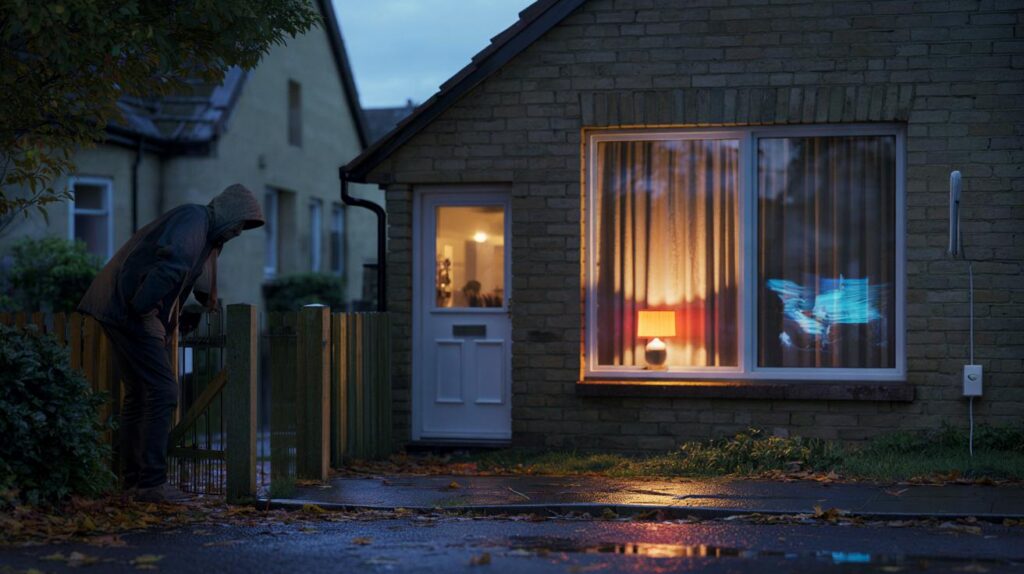
It was a Tuesday evening in late autumn, the kind that smells of damp leaves and takeaway chips. I watched from the pavement as my neighbour’s hallway light blinked on, then the living-room lamp threw a warm oval across the curtains, followed by the faint flicker of what looked like a TV. A figure in a hoodie slowed by the gate, weighed it up, then drifted on without touching the latch.
Inside, nobody was home. Two £10 smart plugs and a bargain bulb were doing the acting. The street felt oddly safer, and not because of sirens or signs. It was the illusion of life — the rustle behind the light. He didn’t come back.
The low-cost trick burglars really hate
Ask seasoned officers and even ex-offenders what stops a burglary, and one theme keeps returning: signs of life. Not a siren that might be ignored, but movement you can’t predict — a lamp that shifts, a glow that travels room to room. That’s the “presence” trick, and smart lighting does it better than a sticker on a window.
It’s why presence-mimicking routines are quietly becoming the sleeper hit of home security. They’re cheap, snappy to set up, and hard to second-guess from outside. **The cheapest high-impact feature isn’t a new alarm panel at all — it’s smart lights and plugs that make your place look lived in when you’re miles away.**
A few weeks ago, a single mum in Salford told me she set a £12 smart plug to power a dusty lamp her nan left behind. She paired it with a budget smart bulb by the stairs. From the street, the glow drifted from hall to lounge between 5.45pm and 9pm on a random shuffle. A car cruised past twice one evening and then never again. No drama, no footage to upload, just nothing happening — which is the point.
Crime prevention teams in UK forces have long advised timers and “lived-in” cues when you’re out. Smart kits simply take the old-school trick and make it lifelike. Instead of one light burning all night like a beacon, you get small shifts of activity that mirror normal life: lights switching at dusk, a radio murmuring at dinner time, a brief burst in the hall as if someone popped to make tea.
There’s a blunt logic behind it. Burglars weigh risk against reward. An empty house can be scoped and entered on a timetable; a possibly occupied one is a coin toss with a human on the other side. Alarms raise noise, but neighbours often wait before calling, and response takes minutes. Presence lighting messes with the first decision point at the gate. **Burglars are deterred by uncertainty.**
From outside, the cues are subconscious: a TV flicker that’s not quite in rhythm, a kitchen light that pops on at the exact moment the street gets dark, a hallway glow that fades a few minutes later. It’s not theatrical. It just feels like someone’s home. And that feeling steers opportunists towards an easier mark.
How to set it up for less than £30
Start small. Pick one smart plug and one smart bulb from a reliable brand, the kind you can control with your phone without a hub. Put the bulb in your hallway or landing. Put the plug on a table lamp in your lounge where it’s visible through curtains. Build a routine that starts at dusk, not a fixed time, and add a random offset of 10–30 minutes.
Then, add movement. Create two scenes: “early evening” (lamp on, hallway off) and “late evening” (hallway on briefly, lamp dimmed). Tell the app to shuffle them within a window. If your platform offers it, enable Away Mode or “presence simulation” so the timing varies daily. Link a small radio to a second plug on weekends for an hour. This is theatre, but quiet theatre.
We’ve all had that moment when you lock the door and still glance back, wondering if your home will look empty by nightfall. Don’t leave a single lamp blazing from 5pm to 2am — it reads like a stage set. Don’t make the mistake of lighting rooms you’d never use together. Keep the glow soft and believable, and avoid blue-white bulbs that scream office. Let the scene breathe; one room at a time is enough.
If you’re using smart blinds or curtains, stagger them a little after lights change, even if it’s just one window. And give your setup a test from outside on a walk. Let’s be honest: no one reprogrammes routines every single day. Build in randomness once, then leave it to do its job while you live yours.
There’s a human layer to this too. A visible pattern tells a story to anyone drifting by: someone’s tidying up, someone’s watching the match, someone’s putting the kettle on. The story is the lock.
“An alarm tells you a house is guarded; lived-in light tells you someone might be behind the door. Offenders don’t like doors with people behind them.”
- Use dusk-based schedules rather than fixed times to follow the seasons.
- Randomise within a window so no two nights match.
- Pair one indoor light with subtle TV flicker on a plug-in “fake TV” box.
- Let a hallway or landing light come on briefly, then go dark again.
- Keep curtains or blinds in their normal positions for that day of the week.
Rethinking what “secure” looks like
There’s a cultural shift in this, and it’s bigger than apps. For years we’ve equated security with hardware and adrenaline: warning decals, keypad beeps, cameras in every corner. Presence lighting nudges us back to something more ordinary — the cues of a lived home — and uses tech to hum along in the background. *The best systems vanish into your routine until you forget they’re there.*
The knock-on effect is communal, too. When several homes on a street glow and dim in a believable rhythm, the area looks awake. That helps older neighbours who can’t juggle apps, and it helps the night-shift nurse who leaves before dawn. You don’t need a WhatsApp group or a sticker on every wheelie bin. A little choreography goes a long way.
If you already have a monitored alarm, this isn’t a replacement. It’s a front line that acts earlier, at the moment someone is deciding whether to test your gate. Add a doorbell camera later if you want evidence. Start with light, because light whispers “not worth it” before anything needs to be recorded. **Cheap, quiet, believable — that’s the calculus burglars notice.**
| Key points | Details | Interest for reader |
|---|---|---|
| Presence-mimicking smart lighting deters | Randomised lights and plugs simulate occupancy at dusk and evening | Low-cost setup that reduces the chance of a break-in |
| Keep it believable, not bright | One or two rooms, soft warmth, short hallway bursts, varied timing | Looks real from outside without wasting energy |
| Pair with simple add-ons | Radio on a smart plug, “fake TV” flicker, dusk-based schedules | Boosts deterrence without buying an expensive alarm |
FAQ :
- What’s the “cheap smart home feature” experts rate so highly?Smart presence lighting: budget smart bulbs and plugs set to randomised, dusk-based routines that make your home look occupied when you’re away.
- Will this replace a traditional alarm?No. It works earlier in the chain by discouraging attempts. Alarms and cameras still matter for detection and evidence. Think of presence lighting as the first layer that quietly prevents trouble.
- Do I need an expensive hub to do this?Not at all. Most mainstream bulbs and plugs from brands like TP-Link Tapo, Kasa, or Wiz run via Wi‑Fi and a phone app. Look for “Away Mode”, “Random” or “Presence Simulation” in the routine settings.
- Isn’t leaving lights on wasteful?LED bulbs sip power, and these routines run for short, varied windows. A couple of low-watt lamps for a few hours costs pennies. The trade-off versus risk and peace of mind is strong for most households.
- What about privacy and hacking fears?Stick to reputable brands, update apps and firmware, and use strong, unique passwords. You’re not streaming video here — just controlling lights and plugs — which keeps the data exposure modest.



Definately resonates. We swapped one always-on lamp for a Tapo plug + warm bulb and set a dusk-based, randomised routine. Two minuites to set up, pennies to run, and the place simply feels “lived in”. Our street’s had a few try-the-gate types lately; ours skipped us twice this month. Not magic, but a smart first layer before alarms/cams. Thanks for the clear, practical tips.