
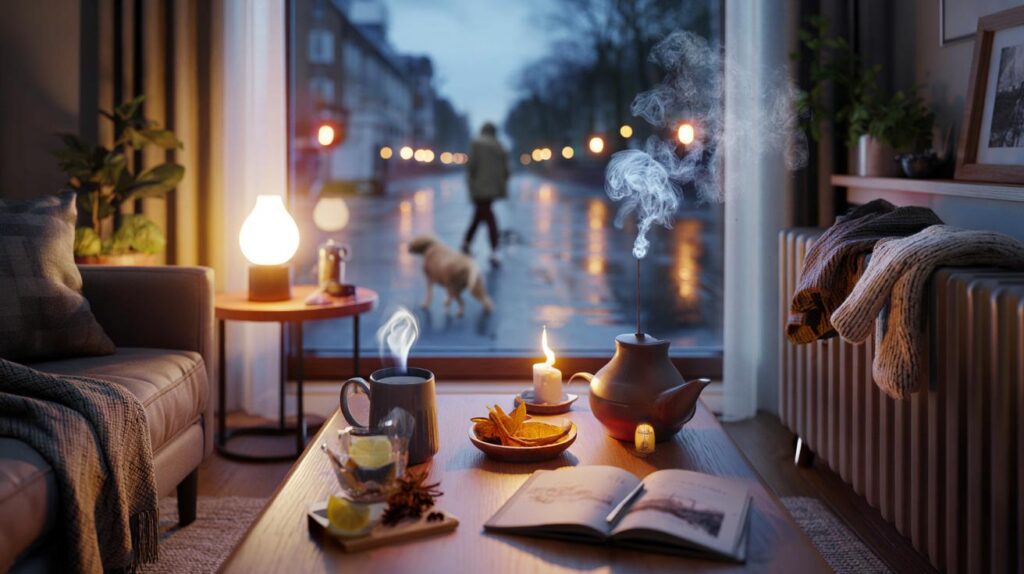
The first truly cold evening arrives like a quiet guest. You notice it at the window, where breath prints the glass, and on the pavement, darker and slick. The day shrinks, the inbox expands, and the living room light suddenly matters more than usual. We go looking for warmth in small, repeatable ways. We want a routine that doesn’t feel like a chore, but a gentle landing strip for the long nights.
The streetlights flick on before I’ve even put the kettle on. The neighbour’s dog does a quick loop, nose low to the wet leaves, while someone bikes past with a squeaking chain, hood up. Indoors, I flick the lamps to low, tuck a blanket over the arm of the sofa, and stand by the window for a moment as the room exhales. The house smells faintly of orange peel and old books. Outside is crisp and blue; inside is amber and slow. A tiny ceremony forms without me naming it. Something else settles in. Start here.
The case for a winter-evening ritual
On cold days, the hours after work can feel like an empty corridor. You walk down it, scrolling and snacking, only to land in bed too wired to sleep. A simple routine turns that corridor into a small set of rooms, each with its own light and purpose. It brings shape to a season that loves to blur. **Your environment changes your state faster than willpower ever will.** Try switching one lamp, boiling one kettle, pressing pause on the noise. Watch your brain follow the cues.
In Manchester, I met a nurse who works shifts and calls her ritual the “reset loop”. She gets home at six, moves her coat onto a peg, and puts on a cardigan with elbows patched by her gran. Then she chooses one song to play while she tidies the coffee table. It takes three minutes. UK surveys suggest a large share of adults feel lower in mood as light fades, especially from November. Her trick isn’t grand. It’s repeatable. She says it stops the evening turning into an accidental doom-scroll.
There’s a quiet bit of science tucked inside all this. Warm light nudges melatonin earlier, softening that hard edge between screen glare and sleep. Predictable cues reduce decision fatigue, the little taxes of “what next?” that drain the joy from a weekday. When you repeat small steps at the same time, your body anticipates comfort and releases it like a saved file. You’re not forcing rest. You’re allowing it to arrive on time. It’s a friendly kind of Pavlov.
How to build a cosy routine that actually sticks
Start with a 30-minute “arrival window”. Minute 1–5: change the light. Table lamps on, overheads off, one candle or diffuser lit. Minute 6–10: change your layer. Socks, jumper, robe, whatever says “indoors” to your brain. Minute 11–15: tiny reset. Clear surfaces you can see in a single glance. Minute 16–20: warm something. A pot of tea, broth, or a mug of hot water with lemon. Minute 21–30: pick one quiet anchor—journal, a chapter, gentle stretching, or a phone call to someone you like. Consider it a hug you can schedule.
Keep it small enough to survive a rough day. We’ve all had that moment when the train’s delayed, the fridge is empty, and the only clean thing is a towel. Your ritual should still work then. Choose cues you can do half-asleep: lamp, sweater, kettle. Skip anything that demands perfect motivation. Avoid the trap of “optimising” it into a to-do list. Let’s be honest: nobody really does this every day. The goal is a soft habit, not a performance.
This is not about making your home look like an advert. It’s about creating signals that welcome you back to yourself. **Winter doesn’t have to feel like a shutdown; it can be a soft launch for calm.**
“Once I named the first ten minutes after work, everything else felt optional,” said a reader from Leith. “I call it ‘lighting the harbour’. After that, I’m home.”
- Light: warm bulbs, low lamps, one flame if safe.
- Layer: swap your outside skin for a soft inside one.
- Reset: clear what your eyes land on first.
- Warmth: tea, broth, or a heated wheat bag.
- Anchor: one quiet act you enjoy even when tired.
A season worth leaning into
Cold nights can sharpen the best parts of home. Steam on a mug, a book crackling open, socks drying on a radiator—this is small theatre you get to sit inside. Not an escape from life, but a way to stay with it more kindly. Keep a few things ready near the sofa: a pen, a playlist, a scarf that becomes a blanket. They don’t have to match. They just have to be waiting.
| Point clé | Détail | Intérêt pour le lecteur |
|---|---|---|
| Light first | Swap harsh overheads for warm, low lamps | Faster shift from work mode to rest mode |
| Make it tactile | Layer up: socks, jumper, throw, heated pad | Signals safety and slows the nervous system |
| One anchor | Pick a tiny, enjoyable act you’ll repeat | Consistency without effort, even on busy nights |
FAQ :
- What time should I start a winter-evening routine?Pick the moment you cross the threshold at home. If that shifts, tie it to a cue like “first lamp on” rather than a clock.
- Can I do this with kids or flatmates around?Yes—make the first five minutes communal: lights, music, snacks. Then each person takes a tiny anchor of their own.
- Do I need fancy candles or diffusers?No. A sliced orange simmered with cloves in a pan adds scent and warmth on pennies. Or boil the kettle and breathe the steam.
- What if I work late and feel too wired?Shorten the ritual to 10 minutes: light, layer, warm drink, two pages of reading. Consistency beats length.
- How do I avoid scrolling the night away?Move your charger to another room. Put your phone on a “harbour” shelf and switch on a lamp in the opposite direction.



Loved this—going to try the 30‑minute arrival window tonite. Lamp on, kettle on, socks on—simple cues, big shift 🙂