
Delivery apps have turned our streets into conveyor belts of convenience. That same blur of bikes, cars and high-vis jackets also gives strangers a reason to stand at our doors, to peer over hedges, to press our buzzers at odd hours. The line between service and scrutiny is thinner than we like to admit.
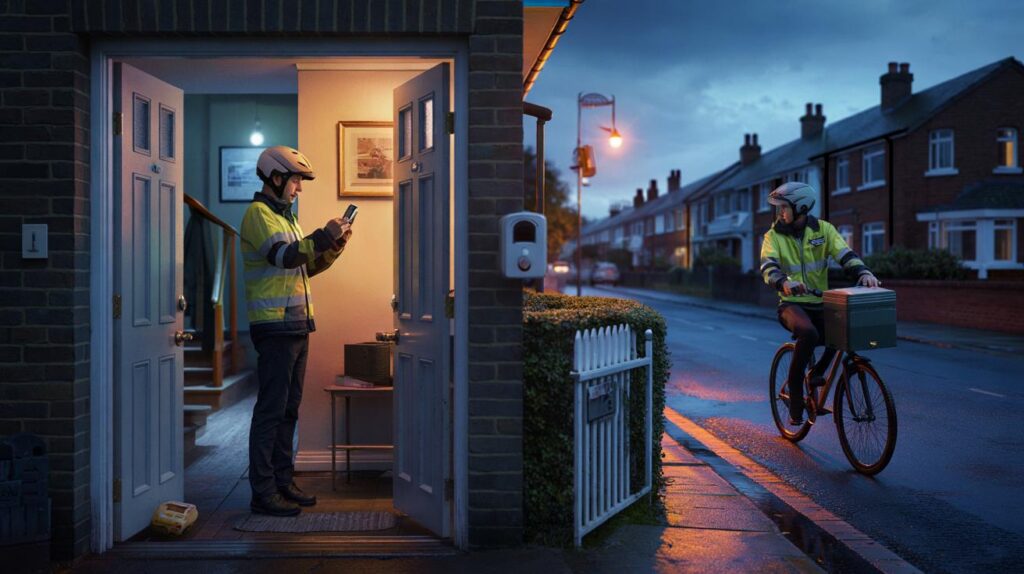
You hear him before you see him: the soft squeak of a brake, the shuffle of a backpack, the tap-tap on his phone. He takes a photo of the package on your doorstep, lingers half a beat, and angles his camera towards the hallway like he’s framing a postcard. Across the road, another rider scrolls his app, glancing up, scanning windows, logging whatever the algorithm asks. *The front door has become a data point.*
He nods at the doorbell camera and cycles off into the twilight, swallowed by the fleet. You wonder what the app captured. Or what he did.
A new kind of doorstep reconnaissance
When everything arrives at the door, the door becomes theatre. Drivers are meant to photograph proof of delivery, to find names, to check flat numbers, to wait just long enough for a handover. That legitimate choreography lets any stranger linger under the soft cover of “I’m just dropping this off.”
It’s the perfect camouflage for quick eyes. A glance at a side gate. A note of a blind spot. A mental picture of a hallway lined with parcels and a TV glow. The uniform can be a hoodie and a lanyard one day, a puffer jacket and a branded tote the next. It all looks normal in a city that runs on tap-to-door.
Ask people on any British cul-de-sac and you’ll hear the same pattern. A woman in Leeds got three “phantom” late-night buzzes — no parcel, just a photo of her doorframe in the app. Two days later, a man tried her back gate while her partner was away. A dad in Croydon noticed his building suddenly had more “hand it to me” requests from new accounts, followed by a spate of fence-hopping and porch thefts. Police forces from Manchester to the Met have warned of burglars posing as couriers for “distraction knocks,” using delivery season as cover.
These aren’t film plots, just the small abuses of a system built for speed. In an ocean of driver accounts, subcontractors and occasional stolen logins, a bad actor can blend in for a day’s work, harvest the data of a dozen addresses, and vanish.
Criminals don’t need a lock-picking course when they can read our routines. Delivery windows map who’s in and who’s out. Doorstep photos reveal house numbers, sightlines and security habits. Order notes often spill more than we think — gate codes, “back door always open”, “please call if no one answers — neighbour has a spare key”. The playbook is less jewels and crowbars, more timestamps and soft signals.
Apps reward completion and speed, not suspicion. A single uniform can be hired by the hour. A stolen jacket or a screenshot can travel faster than a police alert. The result: the screen on your doormat looks like customer care, while doubling as a reconnaissance tool.
How to break the pattern without breaking the convenience
Start by shrinking the data your door gives away. Use collection points or secure lockers for non-urgent orders. For home drops, switch to “leave in a safe place” with a genuinely hidden, off-camera spot — a lockable parcel box or a side storage that isn’t visible from the pavement. **Leave less at the door.**
Write neutral delivery notes. No codes, no routines, no hints about absence. Use first initials on doorbells and parcels, not full names. Enable one-time PIN handovers if your app offers it, and verify the driver inside the app rather than through the peephole. A motion light and a low, angled camera discourage lingering shots. We’ve all had that moment when a dinner delivery felt like a hug after a long day. Let it stay just that, without broadcasting your schedule.
Rotate your patterns. Vary delivery times when you can, so your porch isn’t a predictable daily shelf. Set reminders to bring parcels in quickly or ask a neighbour to collect. **Verify the person, not the uniform.** If someone asks to step inside “to take a photo”, refuse. If your gut nags, it’s allowed to. Let’s be honest: nobody does that every day.
“A delivery is a socially acceptable knock on any door,” a veteran burglary detective told me. “What keeps you safe is controlling what that knock can learn about you.”
- Use pickup points for high-value items
- Strip personal info from order notes and door labels
- Install a parcel box or designate a hidden drop spot
- Turn on one-time PINs and in-app verification
- Vary delivery times and collect fast
What this means for trust on our streets
The promise of delivery is intimacy without contact. Food, clothes, medicine — arriving like magic. The risk is that the most private parts of life now live on the threshold, exposed to a stream of strangers whose time is tracked to the second. Convenience isn’t the enemy; blind routine is.
Small changes ripple out. A building that shifts to lockers alters the rhythm of the stairwell. A street that shares safe drop spots on a WhatsApp group makes the unknown feel less unknown. **Make your home look unpredictable.** Curtains that change, lights that flick, a radio on a timer — not theatre, just a nudge that says, “Someone’s here.”
The darker side of delivery isn’t the rider at your door. It’s the soft data we leak when speed becomes the only ritual. We can keep the good bits — hot meals, late-night parcels, weekly staples — and still close the window a little. The apps will keep evolving; so will the people who misuse them. The trick is to stay human in the loop, to notice what the camera can’t. What we share at the threshold is a choice. What’s left unsaid might be the safest thing you do today.
| Key points | Details | Interest for reader |
|---|---|---|
| Delivery apps can mask doorstep reconnaissance | Legitimate behaviours (photos, waiting, checking phones) create cover for quick observations | Explains why a normal scene can still feel invasive |
| Soft data fuels targeted crime | Routines, order notes, visible parcels and sightlines can signal when and how to strike | Shows which habits increase risk without scare tactics |
| Small defensive habits work | Lockers, neutral notes, one-time PINs, hidden drop spots, pattern variation | Practical steps that preserve convenience |
FAQ :
- How do I tell a real driver from a fake?Use the app: check the driver’s name, photo, and vehicle. Ask them to confirm the one-time PIN or order name without revealing it first. Don’t rely on a jacket or bag alone.
- Are parcel boxes worth it?Yes for houses and low-rise. A lockable, bolted box off the main sightline cuts theft, shortens doorstep time, and removes porch “clutter” that advertises absence.
- What should I put in delivery notes?Keep it bland and location-only: “Leave in parcel box by side gate.” No codes, no schedules, no neighbour names. Avoid hints like “I’m at work until 7”.
- My building won’t allow lockers. Any alternatives?Use nearby collection points, coordinate with a trusted neighbour, or shift deliveries to daytime at work. A simple shelf behind a screen in a shared hall beats the open mat.
- Do cameras really deter bad actors?They deter lingering and help auditing, especially with motion lights. Pair them with good habits — fast parcel pickup and unpredictable routines — for the real effect.



Strong piece. The bit about “soft data” hit home. I switched to a lockable parcel box last year and the phantom buzzes stopped. Quick Q: do any apps default to one‑time PINs yet, or is it still opt‑in?
Is there actual data on crime trends tied to delivery seasons, or are we connecting dots because it feels creepy? Not dismissing the risk, just want stats not anecodtes.