
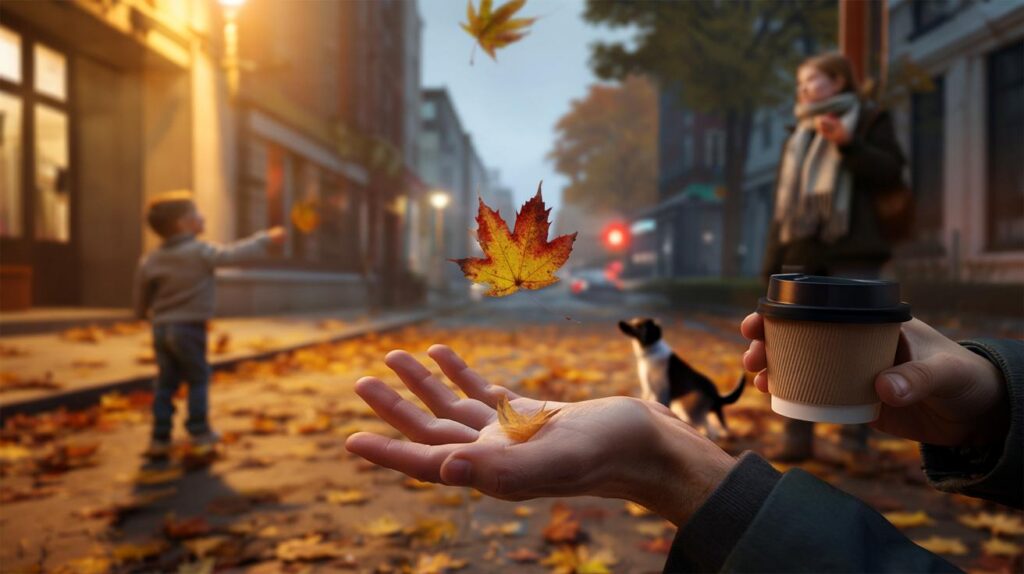
The day folded into amber and smoke, and the pavement on my street turned into a slow river of leaves, each one loosening from its branch like a final exhale; I stood with a lukewarm coffee, listening to the hush of their landing, the faint papery slap that says the year is tipping, ready or not. A neighbour tugged at their scarf, a child tried to catch a leaf mid-fall, and somewhere a dog barked as if to argue with the season, as if noise could pin time to the tree. The light thinned and, for a moment, so did the distance between memory and now.
What are they trying to tell us?
The quiet psychology of a leaf’s last descent
Watch a leaf let go and you’ll feel it in your ribs. It’s not drama, more a soft thud of recognition, like the body knows endings don’t always come with fireworks. Autumn is a masterclass in letting go.
On a Wednesday in late October, a woman on the 8.12 to Brighton pressed her forehead to the window and tracked a leaf spiral past, then another, and another. She’d just left a message she’d rehearsed for weeks, the kind that empties the throat and makes silence loud. The train curved, the landscape blurred, and she put a hand on her chest, as if the motion outside had shifted something inside.
There’s a reason our brains spark when seasons change. We anchor time to colour and light, and leaves are the most honest calendar we have, switching from fierce green to ember-red to the quiet of brown. The tree seals off each stem, the leaf loosens its grip, and gravity writes a simple story our minds can read: ending, release, rest. Letting go can feel like a small death and a quiet freedom at once.
How to read the leaves: small rituals that actually help
Try a three-step walk when the leaves are falling. First, match your pace to your breath for ten steps; count if you need to. Second, name three colours you can see, one texture you can feel, one sound you can hear. Third, pick a single leaf and whisper what you’re ready to set down, then tuck the leaf in your pocket and carry the promise until you reach your door. It’s not magic, but it’s a door you can open with your own hand.
Don’t turn it into a performance. If you’re filming the canopy for your feed, you’re missing the hush that teaches the point. We’ve all had that moment when the season taps us on the shoulder and we try to brush it off with a to-do list. Let’s be honest: nobody really does that every day. Better to do it once with your whole attention than repeat it ten times with half a heart.
Some days won’t give you words. That’s fine. Start with a sentence and let the trees do the heavy lifting.
“When nature models release, the nervous system listens,” a counsellor told me, “and the body follows slower than the leaf, but it follows.”
- Go early or near dusk if you can; transitional light mirrors transitional moods.
- Hold one leaf, not a handful; single focus calms scattered thoughts.
- Say it aloud if you’re alone; the air steadies meaning.
- Leave one leaf on a windowsill; a quiet anchor for the week.
The season’s open question
Falling leaves don’t preach, they ask. What are you carrying that belongs to another season? What can rest for a while without vanishing? They are not only an ending, they’re a handover, the tree passing resources back into the soil, a measured retreat rather than defeat. The leaves are not dying; they are making space.
Maybe that’s why the sound of them underfoot is both a crunch and a sigh. It reminds us the story continues underground, in the dark, where no one is watching and the work is slow. The future compost is everywhere, ordinary and brave. You step, it answers, and for a beat the world is in conversation with your shoes.
Not every fall is a failure. Some are rehearsals, small departures that teach return. And if the branch looks bare for a spell, well, emptiness is a shape too.
| Point clé | Détail | Intérêt pour le lecteur |
|---|---|---|
| Falling leaves mirror release | Trees seal off stems, let go deliberately | Offers a model for choosing what to set down |
| Rituals ground emotion | Three-step walk links senses, breath, intention | Turns vague feelings into tangible action |
| Meaning grows in the quiet | Less performance, more presence, single focus | Reduces overwhelm and invites clarity |
FAQ :
- Why do falling leaves make me feel oddly emotional?Your senses are reading a change in light, colour and rhythm, which nudges memory and expectation. Transitions stir mixed feelings—relief, sadness, curiosity—all at once.
- Is there a “right” meaning to attach to autumn leaves?Not really. Common themes are release, cycles, and rest, yet the meaning that lands tends to be the one tied to your current season of life.
- How can I use this feeling without getting gloomy?Give it a job. Take a short walk, name a single thing to set down, and place one leaf somewhere visible as a reminder of your choice.
- What if autumn makes me anxious or low?Light changes can nudge mood. Try morning daylight, gentle movement, and brief social contact. If low mood persists or deepens, speak to a GP—help is real and practical.
- Can this be a family ritual with kids?Yes. Turn it playful: pick “hero leaves,” tell a one-line story for each, and choose a “rest leaf” to leave outside for the earth.



Beautiful piece—’Autumn is a masterclass in letting go’ will stick with me. Thank you.