
You want to feel luminous without announcing it. A glow people notice before they name it. Not a cloud of perfume, not a makeup trick. Just a quiet sign that you’re switched on, rested, ready. The kind of presence that makes a room soften a shade. There’s a way to do it that’s almost invisible. It sits on the skin like a secret.
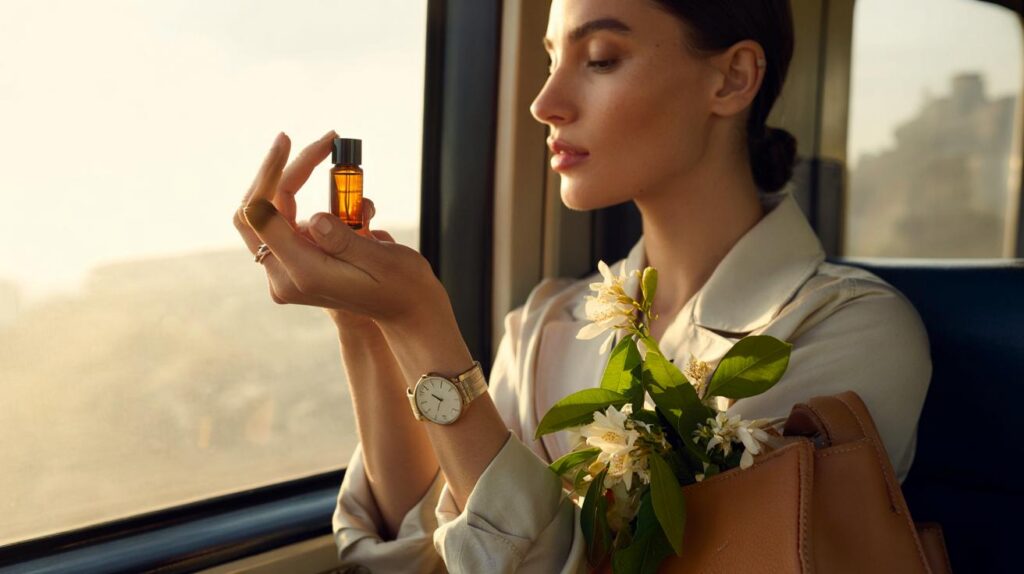
The woman next to me on the 8:12 to London Bridge had that kind of presence. Not flash, not loud. She was reading, jacket sleeves rolled, sunlight clipping her wristwatch. Every time the carriage swayed, a breath of orange blossom threaded the air. The note was delicate and clean, like waking in new sheets. She wasn’t wearing a “perfume”, not in the usual sense. She’d dabbed a trace of neroli essential oil in jojoba along her pulse points, then forgot about it. Everyone else suddenly seemed more rushed than they meant to be. She only used one drop.
The quiet power of neroli
There’s a difference between smelling good and radiating ease. Neroli sits in that space. It’s distilled from bitter orange blossoms, a tender floral with a green, honeyed core. It doesn’t shout. It flickers. The skin holds it close, releasing little waves when you move. Like light off a ring, it catches and fades, then returns. **A single drop goes a long way.**
Call it a micro-aura. A presenter I met at a conference swears by one drop on her collarbone before stepping on stage. She says people lean in more, as if the room inhales at the same time. Small studies have linked blossom and citrus aromas with lower self-reported tension and steadier heart rate in stressful moments. You don’t need white coats to tell you what your shoulders already know. This is a nervous system whisper, not a megaphone.
What makes it work is simple psychology. Sillage-heavy perfumes tell the world who you are; neroli hints at who you’re becoming. The note is bright without being sugary, fresh without smelling like laundry, elegant without feeling formal. You catch it yourself at odd moments and your face relaxes. People read that softness before they parse the scent. That’s the radiance: micro-expressions made kinder by a flower.
How to wear it so only you know
Start with dilution. Take 1 drop of neroli essential oil and mix it into 1 teaspoon (5 ml) of jojoba or grapeseed oil. That’s a gentle, skin-kind blend you can use daily. Dab a fingertip’s worth onto your wrists, then touch those wrists lightly to your collarbones. Dot inside the elbows if you’re wearing sleeves, or the back of your knees if you’re not. For hair, warm a pinhead of the blend between your palms and skim the ends. It’s a halo, not a flag.
Most people overdo it. The goal isn’t “wearing neroli”, it’s “carrying calm”. Skip the direct-to-skin drop – it’s wasteful and can be irritating. Patch test your blend in the crook of your elbow and wait a day. Citrus oils like bergamot can react with sunlight on skin; neroli doesn’t, which is one reason pros love it for daytime. Let the oil sink in before jewellery. And if pets are curious, keep the bottle capped and out of reach. Let’s be honest: nobody does that every day.
Turn it into a ritual that takes under thirty seconds. Keep your little roller in your bag or by the kettle, and pair it with something you already do – phone on flight mode, palms together, breathe twice. **Neroli is non‑phototoxic.** It plays nicely with unscented moisturiser: one drop of your diluted blend pressed onto cheekbones makes skin look awake without the gleam. The smallest thing can change the whole mood of a day.
“Think of neroli as the colour white in your fragrance wardrobe,” says a London perfumer I spoke to. “It cleans the canvas, lifts the eye, and lets everything else feel intentional.”
- 1 drop neroli + 5 ml jojoba = daytime blend
- Pulse points: wrists, collarbones, back of knees
- Stealth trick: trace inside a watch strap or scarf seam
- Face-safe: use a milder mix (1 drop per 10 ml) for cheekbones
- Storage: dark bottle, cool cupboard, lid on tight
A glow people feel before they name it
We’ve all had that moment when someone walks in and the room feels less spiky. You look up without thinking. That’s the effect you’re after, and neroli has a gift for it. The scent reads as human, not “fragranced”, and it stitches seamlessly into your day. Try it before a tough call, a nerve-prickling date, or the slow slide of a late afternoon. You’ll notice the corners of your mouth change first, then your pace. Others meet that energy and mirror it back. **It smells like sunlight on silk.** Share the trick if a friend asks. Keep it quiet if that feels right.
| Point clé | Détail | Intérêt pour le lecteur |
|---|---|---|
| Choose neroli | Bitter orange blossom oil with a soft, green-floral profile | A discreet, uplifting note that reads as “you”, not “perfume” |
| Dilute smart | 1 drop per 5 ml carrier for body; 1 drop per 10 ml for face | Skin-kind use, less irritation, better control of intensity |
| Apply like a secret | Pulse points, hair ends, scarf seam, inside watch strap | Creates a close halo and a steady, wearable glow |
FAQ :
- What exactly is neroli?It’s the steam-distilled essential oil from the blossoms of the bitter orange tree. The scent is floral, green and lightly honeyed.
- Is neroli safe in daylight?Yes. Unlike some citrus peel oils, neroli isn’t phototoxic. Citrus equals flowers here, not rinds.
- Can I layer it with my usual perfume?Absolutely. Use your neroli blend on the skin and spray your perfume once on clothes. You’ll get lift without a muddle.
- What carrier oil works best?Jojoba is a favourite because it mimics skin’s own sebum and feels weightless. Grapeseed or fractionated coconut also sit cleanly.
- Any precautions?Patch test first. Keep oils away from eyes and out of reach of children and pets. If you’re pregnant, ask a qualified aromatherapist for tailored advice.



Je ne pensais pas au néroli pour un effet “présence” plutôt que parfum. La dilution 1 goutte/5 ml dans le jojoba est hyper claire, merçi ! Testé ce matin sur les poignets et le creux des clavicules: ça reste proche, pas entêtant. J’aime bien l’idée de la trace dans la lanière de montre.
Intéressant, mais les “petites études” citées… où sont les références? Baisse de fréquence cardiaque, ok, mais placebo controlé ou simple auto-évaluation? Sans sources, ça reste du storytelling.