
You paid for a “smart” washing machine, then went back to the same old routine: slam the door, pick Cotton, press start. Your bill climbs, your evenings vanish in spin cycles, and the laundry drum still isn’t on your side. The fix might be a single button you’ve ignored since day one.
The kitchen is quiet except for the faint click of the fridge, and the LED on the washer is winking like it knows a secret. The school uniforms are piled on the chair, a damp reminder of tomorrow. I watch a neighbour tap her phone, glance at the machine, then pour tea like nothing’s happening. Her wash will finish at 7am, right when she wakes, and she’ll pay less for it than I did for mine this afternoon. *A tiny change that buys back your evening.* She shows me the icon — a little clock I’ve scrolled past for years — and shrugs. There’s a button hiding in plain sight.
The tiny clock that changes the whole rhythm
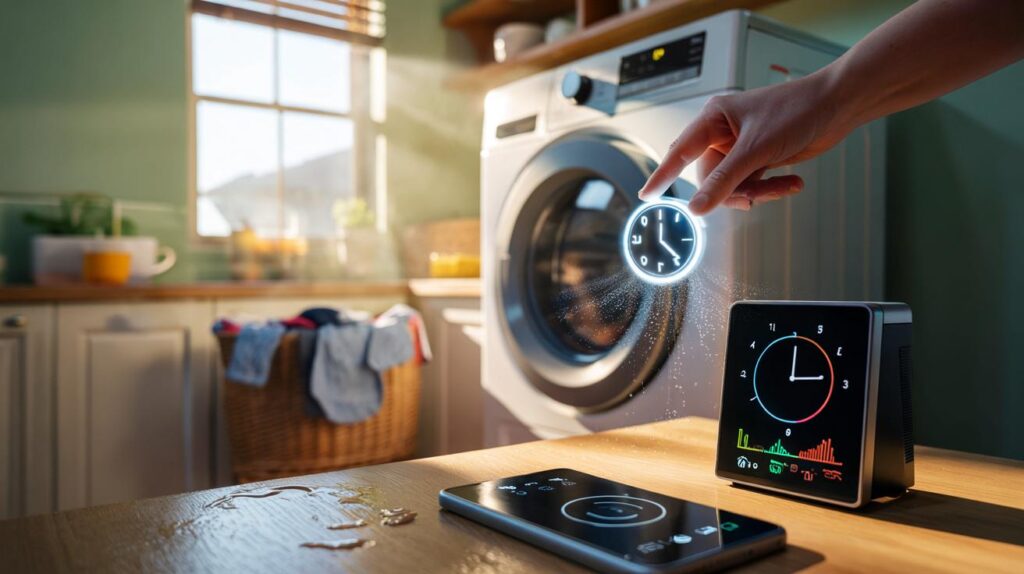
Most smart washers have a “Delay Start” or “Finish In” button, usually a small clock icon. You set when you want the wash to finish, and the machine does the maths. The drum whirs while you sleep or when the grid is quieter, and you wake to a done load instead of a chore.
Pressing that clock shifts your wash into cheaper hours on time-of-use tariffs like Economy 7 or modern flexible plans from big UK providers. Many off-peak windows are late at night or mid-day, when electricity costs less and demand drops. The machine becomes a quiet night worker, not a demanding evening boss.
Energy-wise, heating water eats most of a wash’s electricity. Push cycles into off-peak and choose a cooler programme, and you trim the two biggest costs in one go. You also save your time — the wash ends when you need it, not when the machine decides. **One small tap gives you back a slice of your day and a slice of your bill.**
What it looks like in real life
Sophie in Leeds used to run a 40°C mixed load after dinner, then forget the drum until midnight. Now she sets “Finish at 07:00” before bed. Her smart meter shows much calmer peaks, and her mornings are less frantic because the laundry is ready to hang while the kettle boils. The routine feels almost boring. That’s the point.
On a flexible tariff, my neighbour tracked three weeks of night-finished washes. The washing itself didn’t change. The timing did. Her energy app logged more kWh at cheaper rates, and her dryer use shrank because she added an extra spin at the end of each wash. The saving wasn’t flashy, yet it was there every week — like finding coins under the sofa, again and again.
Noise is the obvious worry. Many machines have a “Quiet” or “Night” option that reduces end-of-cycle beeps and balances spin speeds. Rubber feet and a folded towel under a shaky leg stop the midnight tap dance. If you’re in a flat, pick the gentler 800–1000 rpm spin at night, then do a quick “Spin/Drain” in the morning to finish strong.
How to use the forgotten button, today
Look for a clock icon labelled Delay Start, Delay End, Finish In, or Finish At. If your machine has a companion app, it might sit under Scheduling. Choose the time you want the wash to finish, count back your usual cycle length, then set it. Add a cooler programme (20–30°C) and select an extra spin to cut tumble-dryer time.
We’ve all had that moment when laundry hijacks the evening and dinner goes cold. Avoid the trap by choosing a finish time that matches your life, not the other way round. Let’s be honest: nobody really does that every day. If you tend to forget wet clothes in the drum, schedule the end for when you’re actually home and moving — early morning, lunch break, or just after the school run.
Detergent still matters. Liquids dissolve easily in cooler water, pods are fine if they’re not jammed under heavy jeans, and powder likes the main drawer with a quick wipe after. **Clean the drawer and door seal once a month and the whole system behaves better.**
“Scheduling is the quiet superpower of a smart washer. It doesn’t just lower bills — it shrinks the mental load.”
- Pick “Finish at 07:00”, not “Start at 03:00”. It’s easier to plan around waking up to a done load.
- Use 30°C for everyday mixed fabrics. Save 40°C for muddy kit or bed linen.
- Add “Extra Spin” to cut tumble-dryer minutes dramatically.
- Turn on child lock once the schedule is set, so curious fingers don’t cancel it.
Why this tiny choice pays off beyond your bill
The button is about control, not just cost. When a chore runs in the background on your timetable, you’re freer to cook, read, call your mum, or just sit. Your machine stops barking orders. Your home sounds different at 7pm without the rush of water and spin cycles.
There’s a grid story here too. When more of us move energy-hungry tasks to quieter hours, peaks soften and blackouts become less likely. You don’t see the difference, yet you feel it in steadier pricing and calmer evenings. It’s ordinary, unglamorous progress. **Change the time, and the task changes shape.**
If the machine can think a little for you, let it.
That clock icon won’t solve laundry mountain week after week. It does make the mountain gentler. Tuck the chore into a slot that suits you, pay a friendlier rate, and let the drum get on with it. Someone will always swear by a boutique detergent or a miracle stain stick. This is simpler. Try it for three nights and see what happens in your energy app, in your hallway, in your head. You might start guarding those quiet evenings like a favourite jumper.
| Key points | Details | Interest for reader |
|---|---|---|
| “Delay Start/Finish” saves money and minutes | Run cycles in off-peak windows and finish when you wake | Lower bills and no late-night laundry chores |
| Pair timing with cooler washes and extra spin | 30°C for daily loads; add extra spin to cut dryer time | Better results with less energy and faster drying |
| Smart habits beat fancy features | Noise tweaks, child lock, simple routines that stick | Less faff, more calm, same machine |
FAQ :
- What if I don’t have a smart tariff?You still gain by finishing when it suits you, and pairing a cool wash with an extra spin reduces overall energy use and dryer time.
- Will clothes smell if they sit finished for hours?Set the finish close to when you wake or return home. If they do sit a bit, run a 10–15 minute “Rinse/Spin” to freshen fast.
- Is night-time washing too noisy in a flat?Use “Night” or quiet settings, balance loads, and reduce spin speed at night. Do a quick high-speed spin in the morning if needed.
- Does Delay Start increase wear on the machine?No more than a standard cycle. It’s the same programme, just scheduled. Keep the filter clear and run a monthly drum clean for longevity.
- What if my washer only has “Delay Start”, not “Finish At”?Check your usual cycle length, then set the delay so it ends when you want. Many apps show a live end-time once you choose a delay.



I’ve had Economy 7 for years and still ignored that little clock. Just tried “Finish at 07:00” and my evening felt instantly calmer—definitley keeping this habit.
Genuine question: on a flat-rate tariff, am I actually using less energy or just shifting it? Does 30°C + extra spin beat a 40°C standard cycle by, say, 20–30%? Any data?