
PMS can flatten a week that was meant for living, not just enduring. Many of us don’t want to pop a pill for every twinge, mood dip, or 3 a.m. wake-up. The question hanging in the air: what’s the gentle way through?
On a rainy Tuesday in Manchester, I watched a woman on the tram silently press a scarf to her lower belly like a tiny shield. She blinked at a window streaked with water, fished out a cereal bar, and breathed in for four counts as the carriage shuddered. No drama. Just a private negotiation with her body. I noticed how she sat a little taller after a minute, as if she’d made space inside her ribs. Her face softened. The stop bell pinged and she didn’t get off. She simply stayed and kept breathing, like a small pact had been made. Something about that felt like news. A quiet revolution, right there on the 8:42.
Why gentleness works on PMS
PMS isn’t a character flaw. It’s a real cluster of physical and emotional symptoms tied to shifting hormones in the luteal phase. When the dial spins to irritability, cramps or fog, your nervous system often hums on a higher setting. Tap that hum down a notch, and the rest follows.
Consider this: studies suggest up to 90% of people who menstruate feel some PMS, while a solid minority report symptoms intense enough to disrupt work or sleep. A Brighton retail manager told me she went from sobbing at stockroom boxes to being “basically functional” with three simple rituals: a warm compress at bedtime, a 15-minute dusk walk, and a magnesium-rich snack. Not perfect. But kinder.
Here’s the logic. Hormones fluctuate, prostaglandins drive cramps, blood sugar wobbles, and stress hormones can spike at the worst moment. Gentle inputs—heat, breathwork, light movement, steadying foods—nudge the body toward balance without a sledgehammer. **Small levers can shift heavy feelings when you use them consistently.** It’s not magic. It’s physiology with a softer touch.
The gentle toolkit: daily moves that ease the luteal phase
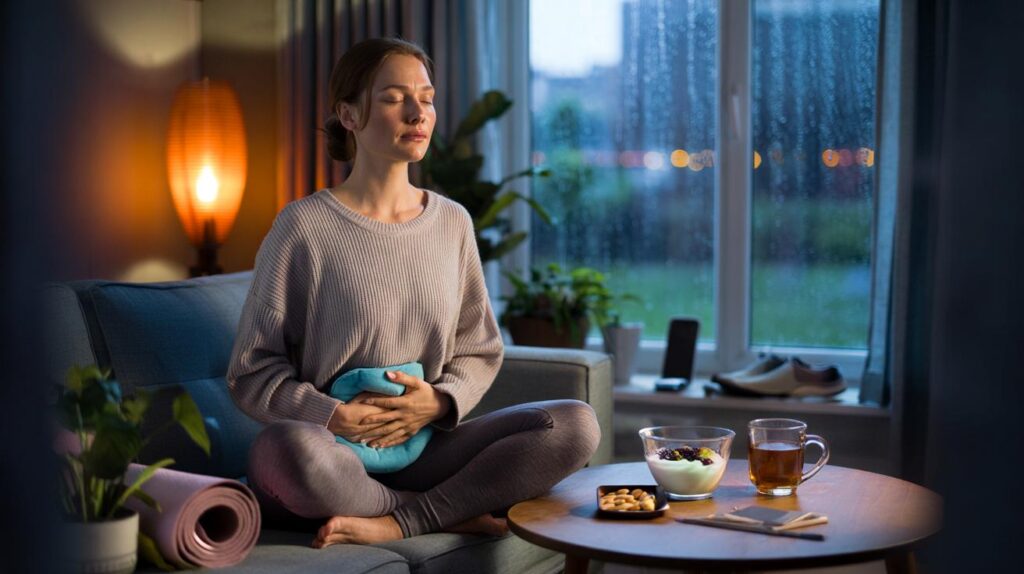
Start with a 90-second breath reset. Sit, feet flat, one hand on your abdomen. Inhale through the nose for four, hold for two, exhale for six. Repeat 10 cycles. Then place a warm pack low on your abdomen for 10 minutes—before bed or as your emails load. Add a slow walk outside, even one block. Sunlight calibrates sleep and mood. Heat eases muscle tension. Breath tells your system you’re safe.
Don’t try everything at once. Pick one or two habits you can actually carry on a busy day. Maybe it’s swapping your mid-afternoon coffee for rooibos, or adding Greek yoghurt and berries to breakfast for protein and steady glucose. We’ve all had that moment when a tiny change feels pointless. It isn’t. Let’s be honest: nobody does that every day. The point is gentle persistence, not perfection.
Food helps more than you think. Aim for slow carbs, lean protein, leafy greens, nuts and seeds. Calcium and magnesium are the quiet heroes; oily fish and flax add omega-3s that can dial down inflammation. *A calmer plate breeds a calmer evening.* Pair it with light movement—yoga, swimming, a mellow cycle—and you’ve got a trifecta the body understands.
“When I treat PMS like a storm to steer around, not a wall to smash through, everything hurts less,” a reader messaged me after trying a two-week ‘gentle plan’—more sleep, fewer ultraprocessed snacks, nightly breathwork.
- Micro-routine to try: 90-second breath, 10-minute heat, 15-minute walk, magnesium-rich snack.
- Gentle swaps: fizzy drinks to sparkling water with lemon; doomscroll to a warm shower and stretch.
- Rest cues: dim lights after 9 p.m., analogue wind-down, phone parked face-down outside the bedroom.
A kinder cycle is possible
There’s a line where softness becomes strategy. **Gentle doesn’t mean passive; it means precise.** Choose cues that lower stress signals, stabilise blood sugar, and soothe muscles, then repeat them when your cycle whispers “late luteal”. Track how you sleep, what eases cramps, which snacks stop the 4 p.m. crash. Share what works. Borrow what doesn’t. Keep the tone friendly in your own head.
| Point clé | Détail | Intérêt pour le lecteur |
|---|---|---|
| Breath + heat combo | 4-2-6 breathing and a 10-minute warm pack | Quick, drug-free relief for cramps and anxiety spikes |
| Steady-fuel eating | Protein at breakfast, magnesium/calcium, omega-3s | Fewer crashes, more stable mood and energy |
| Gentle movement | 15–30 minutes of walking, yoga, or swimming | Reduces pain perception and improves sleep quality |
FAQ :
- What counts as “gentle” exercise?Think movement that leaves you able to hold a conversation: walking, yoga flows, light cycling, a slow swim. If you dread it, scale it down. Consistency beats intensity.
- Do supplements actually help PMS?Evidence is strongest for calcium and magnesium, with some support for vitamin B6 and omega-3s. Check interactions if you take other treatments, and start low.
- Can diet changes really shift mood swings?Yes—by smoothing blood sugar. Add protein and fibre to breakfast, keep snacks simple (nuts, fruit, yoghurt), and ease up on ultraprocessed foods in the late luteal phase.
- Is caffeine making my PMS worse?For some, yes. Try a two-week trial of cutting back after midday. Swap in herbal tea or half-caf. Notice if sleep and irritability improve.
- When should I speak to a professional?If symptoms derail work, relationships, or sleep, or if you suspect PMDD. Track two cycles and bring notes. Gentle tools help, and tailored medical support can sit alongside them.



Merci pour ces conseils concrets ! Je vais tester la respiration 4-2-6 et la bouilotte de 10 minutes ce soir, plus un snack riche en magnésium. J’aime l’idée de petites habitudes, pas la perfection 🙂