
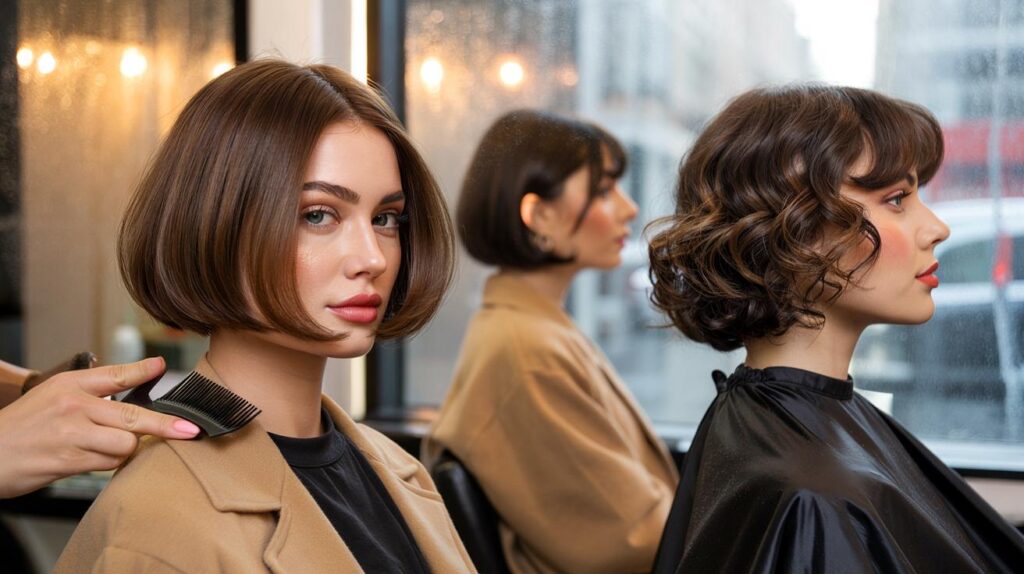
You’re staring at your reflection, hair tied in a tired knot, wondering if a sharp change could reset the whole week. A cut that looks chic on the school run and glamorous under restaurant lights. We’ve all had that moment when the hair-itch arrives and won’t leave.
It started on a Wednesday in Soho, just after the rain. The salon windows steamed, kettles clicked somewhere out back, and a woman in a camel coat sat down with a phone full of screenshots. “I think I want that Italian bob,” she said, almost whispering, like asking for a secret recipe. Snips began, soft and deliberate, as the city thudded outside and the cape collected small commas of hair.
The mirror did the magic trick. With each pass of the scissors, her jaw sharpened, her eyes lifted, her shoulders relaxed. When the dryer went off, the room changed temperature. The hair wasn’t heavy or try-hard. It moved. People glanced up from foils and magazines, the way you notice a good coat drifting past on the street. The feeling in the room was simple. Something fresh had landed.
Why this cut is everywhere — and why it actually works
The Italian bob is the bob for people who think they can’t wear a bob. It sits around jaw to collarbone, with a clean outline and weight where it flatters most: the ends. Think soft bevel instead of hard geometry. Airy movement rather than rigid precision. It’s the difference between “styled” and “well-bred hair” — that effortless, swishy thing you notice and can’t quite label.
On Tube platforms, in lift mirrors, at school gates — it’s everywhere once you learn the shape. Stylists from Manchester to Marseille are fielding the same request: a bob that doesn’t box the face. One colourist told me her Friday slot has become “Italian hour”, with clients waving screen grabs of Hailey, Kaia, Vittoria. Not because they want to look like them. Because they want that feeling of lightness without losing presence.
Here’s the quiet genius: it’s built on balance, not bravado. Keeping the perimeter neat gives polish, but internal softness lets it breathe. Slight graduation hugs the neck without collapsing. Ends are polished, not poker-straight. That balance means round faces get lift, square jaws get curve, fine hair gets shape, and curls keep their character. The geometry flatters bone structure while the movement flatters real life.
What to ask your stylist — and how to keep it yours
Start with the line: ask for a chin‑to‑collarbone bob with a blunt perimeter and subtle internal weight removal for movement. Mention a slight bevel at the ends so it tucks cleanly without going pageboy. If you like a fringe, say “soft, eyebrow‑skimming fringe” for a French hint; if not, ask for face‑opening pieces that kiss the cheekbones. Bring two photos: one for shape, one for texture.
Hair stories matter. If yours flips out at the ends, ask for micro‑graduation at the nape to help it tuck. If you’re curly, request a dry refinement pass so the shape respects shrinkage. If you’re fine, avoid heavy texturising shears at the perimeter; you want fullness, not fray. Your lifestyle should drive finish: glossy and sleek for boardrooms, airy and tousled for weekends. Let’s be honest: nobody really does that every day.
This cut thrives on honesty between you and the chair. Say how much you’re willing to style in the morning and what kit you actually own. Hair should be fun, not homework.
“The Italian bob isn’t blunt or wispy — it’s plush,” says London stylist Amara Shah. “We keep the ends dense, then melt the weight inside so it swings.”
- Italian bob checklist: two inspo photos; your natural texture; your fringe preference; preferred finish (sleek or airy); how often you’ll trim (6–10 weeks).
- Salon language: blunt perimeter, soft internal layers, slight graduation, bevelled ends, face‑framing pieces.
- Home kit: medium round brush, light mousse, shine serum, wide‑tooth comb.
The styling sweet spot at home
The good news: this isn’t a high‑maintenance diva. On wash days, apply a walnut of light mousse at the roots and a pea of serum on the ends, then rough‑dry until 80% done. Switch to a medium round brush for the last few minutes, directing ends under with a gentle C‑shaped pull. Flip your parting while drying, then flip it back for lift. It’s a five‑minute routine that looks like twenty.
On non‑wash days, revive with a spritz of water and a little heat at the ends. If your hair puffs, a paddle brush and cool setting will smooth without flattening. If you’re curly, refresh clumps with a mist and a dab of curl cream, then diffuse for two minutes. The trick is to keep the ends plush and the crown calm. One small tweak, big payoff.
There’s a quiet confidence to living in this cut. It’s put‑together without shouting. It embraces your texture rather than fighting it. And when you catch yourself in a window — bus stop, café door — that subtle swing can change your posture. Face‑framing without fuss. Low‑maintenance without compromise.
Why it feels like a mood shift, not just a haircut
Trends come and go, but the Italian bob landed because it solves a real, daily puzzle. It sharpens edges without hardening the person. It looks expensive even when you’ve just yanked on a jumper. It makes room for earrings, for lipstick, for a sudden red scarf. And it keeps growing out handsomely, so your calendar doesn’t run your mirror. Little wonder it’s the year’s breakout star — it respects time, texture, and life.
| Point clé | Détail | Intérêt pour le lecteur |
|---|---|---|
| Shape that flatters | Blunt outline with soft internal movement and a slight bevel | Lift and swing without stiffness |
| Custom to texture | Dry refinement for curls; gentle graduation for flips; minimal texturising for fine hair | A tailored result that behaves at home |
| Easy routine | Five‑minute blow‑dry, light mousse, quick refresh on day two | Salon polish with everyday speed |
FAQ :
- Will the Italian bob suit a round or square face?The balanced perimeter lifts cheekbones and softens angles. Adjust the length between lip and collarbone to tune the effect.
- Can I wear it with a fringe?Yes. Try a soft, eyebrow‑skimming fringe for a French feel or longer curtain pieces for openness.
- What about curls or coils?It shines on curls. Ask for a dry refinement pass and keep the perimeter plush so the shape stays generous.
- How often do I need trims?Every 6–10 weeks keeps the line crisp. If you like a looser vibe, stretch to 12 — it grows out gracefully.
- What products actually help?A light root mousse, a heat protectant, a touch of shine serum, and a medium round brush. Keep it simple and consistent.



Obsessed with how practical this sounds. The checklist + home kit breakdown is exactly what I needed, and the five‑minute blow‑dry is speaking to my lazy soul. Going to ask for a chin‑to‑collarbone bob with a blunt perimeter and bevelled ends, plus those cheekbone pieces. I definately appreciate the reminder to bring two photos. Booked for next week—wish me luck 🙂