
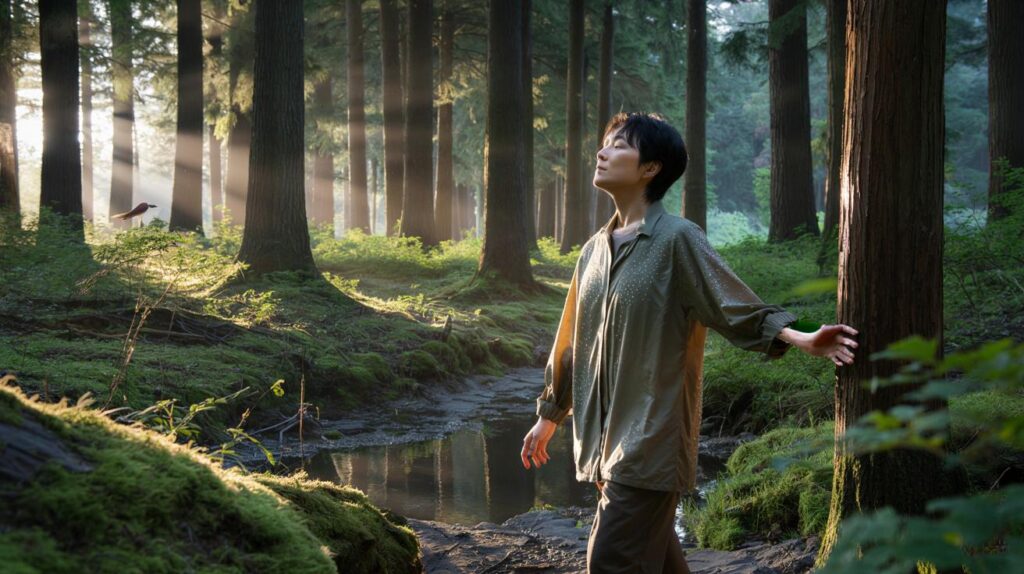
You fall into bed on time and still feel wired. The room is dark, the phone is face down, and your brain keeps humming like a fridge. Pills sound tempting, podcasts help a bit, and yet the night stretches. Somewhere, a quieter switch exists. It might be in the nearest patch of trees.
I first clocked it on a wet afternoon in Epping Forest. A soft rain was speckling my jacket, that pleasant tick-tick on nylon, and a jay stitched blue across the path. A dog trotted past, tail like a metronome, and the air smelt faintly of resin and cold soil. No music. No step counter. Just the huff of my breath smoothing out until it didn’t feel like my body anymore, but a room with the windows open.
Back home I slept like a stone. No clock-checking. No dread.
The trees had done something I couldn’t quite name.
Shinrin-Yoku: why a slow walk in trees settles your night
Shinrin-Yoku, or forest bathing, began in Japan in the 1980s as a public-health nudge. It isn’t a hike or a sport. It’s being with trees in a way that lets your nervous system unwind. You wander slowly. You breathe. You pay attention to bark, light, tiny movements of leaves. The point is to invite calm, not chase it.
For a city brain, this is almost rebellious. We spend our days in rectangles of glass and email pings, then wonder why our thoughts thrum at midnight. The forest offers the opposite. Fractal greens. Asymmetry. Soft, scattered sounds. Your body reads that as safety. Heart rate eases. Shoulders drop, almost by themselves.
In Tokyo, researchers have tracked what happens inside the body during these walks. Cortisol tends to dip. Blood pressure slides a notch. Heart-rate variability shifts towards parasympathetic activity — the “rest-and-digest” setting that primes you for sleep. One small trial found participants who spent an afternoon among trees reported longer, deeper sleep the same night compared with an urban stroll. It’s not magic; it’s better conditions. The forest lowers the day’s noise so night doesn’t have to fight it.
Part of the effect is chemistry. Trees release phytoncides, aromatic compounds that can dial down stress responses. Another part is light and timing. Natural light in late afternoon cues your body clock, so melatonin rises more cleanly after dark. Movement adds weight too. Easy walking builds **sleep pressure**, a friendly kind of tired that doesn’t feel like burnout. Fold these together and bedtime stops being a battle and becomes gravity.
How to try it tonight (even if you live on a busy street)
Think small and precise. Twenty to forty minutes in a green space, late afternoon or early evening, works well for many people. Turn your phone to aeroplane mode. Walk slowly enough that a toddler could keep up. Pick three trees and really look: veins on a leaf, a spider’s line, damp moss. Breathe in for four counts, out for six, for five rounds. Sit for two minutes and listen for the farthest sound. That’s it. No goals. Just time well spent.
We’ve all had that moment when sleep feels like a test you’re failing. The instinct is to power through the day to “earn” rest, then collapse. Forest bathing flips that script. Go earlier. Go gentler. If a full park visit feels impossible, try five minutes under a single tree on your street. *Go at the pace of a leaf.* Soyons honnêtes : personne ne fait vraiment ça tous les jours. Regular-ish beats perfect. You’re building a habit your nervous system recognises.
Common snags: turning it into fitness, blasting music, snapping photos for half the walk. Nice things, wrong time. Treat this like brushing your teeth for your brain. Light, consistent, a little boring in the best way. Notice what tiny detail hooks your attention today, then let it drift.
“Let nature enter your body through the five senses,” says Dr Qing Li, one of Japan’s leading forest medicine researchers. “If you open the door, the effects come in.”
- No woodland? Try a tree-lined cemetery, a riverside path, or a quiet square with old planes and lindens.
- Short on time? Three five-minute “green pauses” beat none at all.
- Sensitive to pollen? Go after rain, when the air is cleaner.
- Evenings indoors? Use cedar or hinoki oil, a bowl of soil for scent, and soft nature sounds.
- Winter trick: daylight between 3–5pm helps your clock align with the night.
What this changes after dark
Bedtime starts earlier than bedtime. A forest visit widens the gap between day-stress and night-rest so your body doesn’t have to slam on the brakes at 11pm. You notice it in little ways. Fewer rehearsed conversations in your head. Less scrolling. A yawn that actually means sleep. The night feels like a blanket, not a task.
This isn’t a cure-all. Sleep has many moving parts: caffeine, light, late emails, the baby upstairs. Shinrin-Yoku simply improves the conditions you can control with one gentle, enjoyable habit. It pairs well with the basics — dim lamps, cool room, less **blue light**. If anxiety spikes, forest time earlier in the day takes the edge off, so the evening isn’t carrying all the weight.
There’s something older at play too. Humans are built for uneven paths and birdsong. The forest doesn’t fix your life. It reminds your body how to land. Try it for a week. Notice what changes. Then keep the bits that feel kind, and let the rest go.
| Point clé | Détail | Intérêt pour le lecteur |
|---|---|---|
| What it is | Shinrin-Yoku is mindful time among trees, not exercise | Sets a clear, doable practice |
| When to go | Late afternoon or early evening, 20–40 minutes | Aligns your body clock for easier sleep |
| How it helps | Lowers stress markers, boosts parasympathetic tone, builds gentle tiredness | Explains why sleep comes faster and deeper |
FAQ :
- What exactly is “forest bathing”?It’s unhurried time in nature using all five senses. No swimming, no targets. Just attention and calm.
- How long before bed should I go?A late-afternoon session often works best. If evenings are your only window, finish at least an hour before lights out.
- I live in a dense city. Will a small park do?Yes. Any tree-rich space helps. Even a quiet street with mature trees or a riverside path can deliver benefits.
- What if I have allergies or asthma?Choose low-pollen days, go after rain, and favour broadleaf parks over conifer-heavy woods in high pollen season. Carry your meds and keep it gentle.
- Is this a replacement for workouts or therapy?No. Think of it as a companion. It can ease stress, complement treatment, and make sleep hygiene stick.



Merci pour cet article, très inspirant. J’ai essayé 25 minutes dans un petit square au coucher du soleil, téléphone en mode avion, respiration 4/6… Résultat: endormi en 10 minutes, zéro réveils nocturnes. La métaphore de la “fenêtre ouverte” m’a parlé.
Effet réel ou placebo? Vous citez une “petite étude” sur le sommeil après une balade en forêt: auriez-vous la référence précise (auteurs, année) et la taille de l’échantillon? Intéressé aussi par les données sur la variabilité de la fréquence cardiaque.