
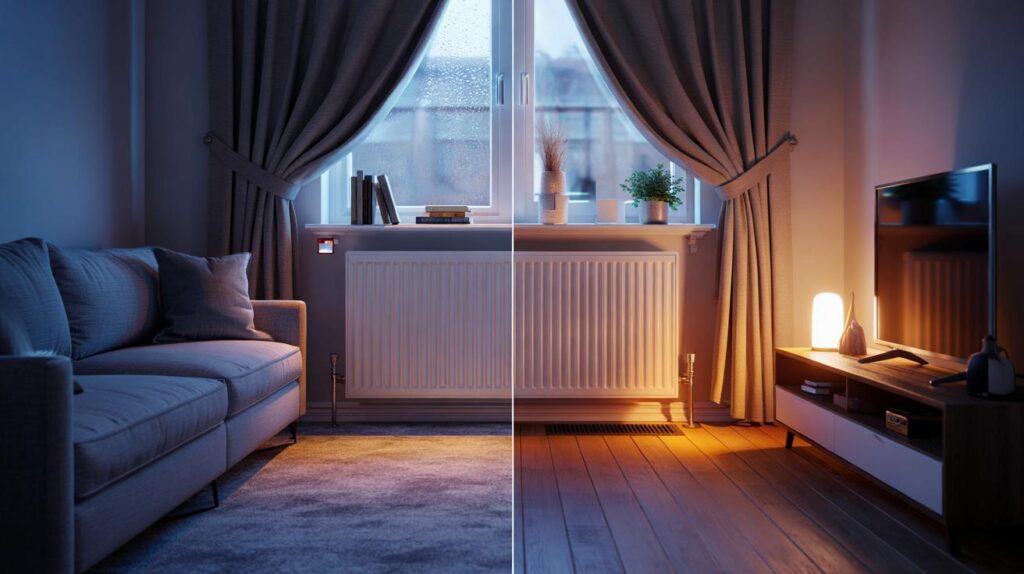
Energy bills are rising fast, yet many households miss a simple fix hiding in plain sight in their favourite room.
As temperatures dip and boilers hum back into life, one quiet layout choice in the living room can drain heat and cash. It slips past daily attention. It sits where comfort and décor meet. It is easy to put right if you know what to move and by how much.
That quiet culprit in the living room
Across the country, well-meant styling choices choke the very airflow that keeps rooms warm. A sofa nudges a radiator. Floor-length curtains rest on warm steel. A TV cabinet covers a vent. Heat gathers where it cannot help you. The thermostat climbs. The bill follows.
Leave at least 30 cm of clear space in front of every heat source. Clear the top surface as well.
Radiators and vents rely on convection. They warm air, which rises, pulls cooler air through the emitter, and sets up a loop. Block that loop with fabric, wood or stacks of books and the emitter heats the obstacle, not the room. You feel a cool draught across the floor and assume you need higher settings. You do not. You need free air.
How furniture and curtains trap heat
Dense textiles act as a blanket over warm metal. The textile warms fast. The room warms slowly. Heavy furniture across fins or grilles slows the intake of cold air, so the circulation stalls. Long curtains that drape over a radiator create a pocket of warm air behind fabric. The window and wall get toasty. The family does not.
Tell-tale signs you are wasting heat
- Warm radiator, cool knees: the emitter feels hot, but sitting areas feel chilly.
- Cold corners: the far side of the room stays nippy even after hours of heating.
- Thermostat creep: you nudge the dial higher by 1–2°C to feel comfortable.
- Uneven warmth: one side of a room bakes, the other side lingers at 17–18°C.
The costly layout mistakes households repeat
Most problems start with three choices: furniture pushed to walls beneath windows, thick curtains hung to the floor, and storage placed over heat sources. Each steals output you have already paid for. Energy advisers commonly see losses large enough to matter over a full season.
| Obstacle | Typical symptom | Estimated waste | Simple fix |
|---|---|---|---|
| Sofa in front of radiator | Back of sofa hot, seating area cool | 5–15% higher run time | Slide sofa 30–45 cm forward; add radiator shelf |
| Floor-length curtains over radiator | Window bay warm, room slow to heat | 10–20% heat trapped | Tie curtains to the side; fit shorter or lined curtains |
| TV unit covering vent or grille | Fan or convector noisy, room uneven | 5–10% airflow loss | Raise unit on legs; shift 20–30 cm clear |
| Clothes on radiators | Damp lingers, musty smell, slow warm-up | Up to 15% output blocked | Use an airer; ventilate briefly when drying |
| Books, plants on radiator top | Hot items, cool room | 5–10% lost convection | Keep tops clear; add a narrow shelf above |
What to change today
Start with airflow. Nothing should sit flush against a radiator face. Nothing should drape over the top. Space chairs and consoles so air can rise without hitting a solid surface. The difference shows up within a single heating cycle.
Rule of thumb: every 1°C you avoid adding can trim heating demand by around 7–10% when airflow is free.
Small moves, quick wins
- Pull heavy furniture at least a ruler’s length from emitters. More space, more circulation.
- Fit inexpensive reflective panels behind radiators on external walls to bounce heat back.
- Tie back curtains during the day; close blinds and curtains at dusk to hold warmth in.
- Bleed radiators, then balance the system so each room heats evenly.
- Dust fins and grilles. A thin film of fluff lowers heat transfer.
- Set thermostatic radiator valves so lived-in rooms sit at 19–20°C, bedrooms at 17–18°C.
How much money is at stake this winter
The numbers add up fast. A typical family in a gas-heated home might spend £900–£1,400 on space heating across the cold months. If blocked airflow forces a 15–20% longer run time, that adds roughly £135–£280 to the season’s cost. In homes using electric radiators or storage heaters, the penalty can be higher because each lost kilowatt-hour costs more. That is how a few layout choices can push a household towards an extra £200–£400, especially if the thermostat goes up by a degree or two to compensate.
Clear the airflow and hold the set-point: that is where the £200–£400 swing hides for many households.
Comfort improves as well. Free airflow reduces temperature stratification, so you feel warmer at the same set-point. That lets the boiler or heat pump cycle less, which also reduces wear. It is a quiet gain that repeats every evening you use it.
A 10-minute home check you can run tonight
- Stand at each radiator. Can you see the whole front and top? If not, move or tie back obstacles.
- Hold a tissue near the bottom of a convector. Does it waft upward? If not, something blocks intake.
- Feel for cold patches halfway up a radiator. If present, bleed the unit to remove trapped air.
- Measure distances. Aim for 30 cm clearance in front and 10–15 cm above the top edge.
- Sit where you usually relax. After 20 minutes of heating, check for cool ankles. If yes, review airflow and draughts.
Safety, comfort and the physics behind the fix
Heat builds where resistance exists. Fabrics near electric heaters risk scorching. Damp laundry on hot steel slows drying and can push indoor humidity up. That raises condensation on cold glass and feeds mould. Clearances help on all three fronts: lower temperatures on surfaces, faster heat distribution, and drier rooms.
Convection prefers a smooth path. Warm air rises, cool air falls, and the loop repeats. A shelf above a radiator can guide air into the room without blocking the top. Short, lined curtains insulate glass while letting air slip under and out. A ceiling fan on its lowest, downward setting can mix layers in rooms with high ceilings, cutting the “head hot, feet cold” effect.
Upgrades that stretch savings further
Simple add-ons pay back quickly. Reflective panels cost a few pounds and can reduce heat loss through external walls. Smart TRVs help keep only lived-in rooms warm at the right times. Door seals and draught excluders stop cold air sneaking along the floor, which makes blocked convection feel worse. If you use a heat pump, free airflow is even more valuable because emitters run cooler and rely heavily on volume, not very high temperatures.
Think airflow first, insulation second, and controls third. Together they steady comfort at a lower cost.
A worked example you can adapt
Take a medium-sized living room with one double-panel radiator rated around 1.8 kW at standard temperatures. Block the top with heavy curtains and the front with a sofa 10 cm away. Output to the room falls sharply. You raise the thermostat by 1°C to feel okay. The system now runs roughly 8–10% longer each hour. Over a four-month season at three hours’ use per day, that extra run time adds around 35–45 hours of burner or compressor use. Multiply by your unit rate, and you can see why airflow changes move real money.
Extra context for sharper decisions
Two terms help when planning changes. Radiator “balancing” means adjusting valves so all emitters heat at similar speeds. That prevents one hot room stealing flow from the rest. “Set-back” means lowering the heating slightly when you are away or asleep. Both work better once air moves freely. They also support health by trimming damp and cold spots where condensation forms.
If you like a snug aesthetic, choose smart fabrics and positions. Heavy curtains should meet the floor only where there is no radiator beneath. Layer thinner curtains over blinds for night insulation, and keep the lower edge above any emitter. Place sofas to face warmth from across the room, not to block it at source. These choices keep the style you want while protecting the budget you need.



Is a radiator shelf actually worth it, or just a gimick? Any before/after data?