
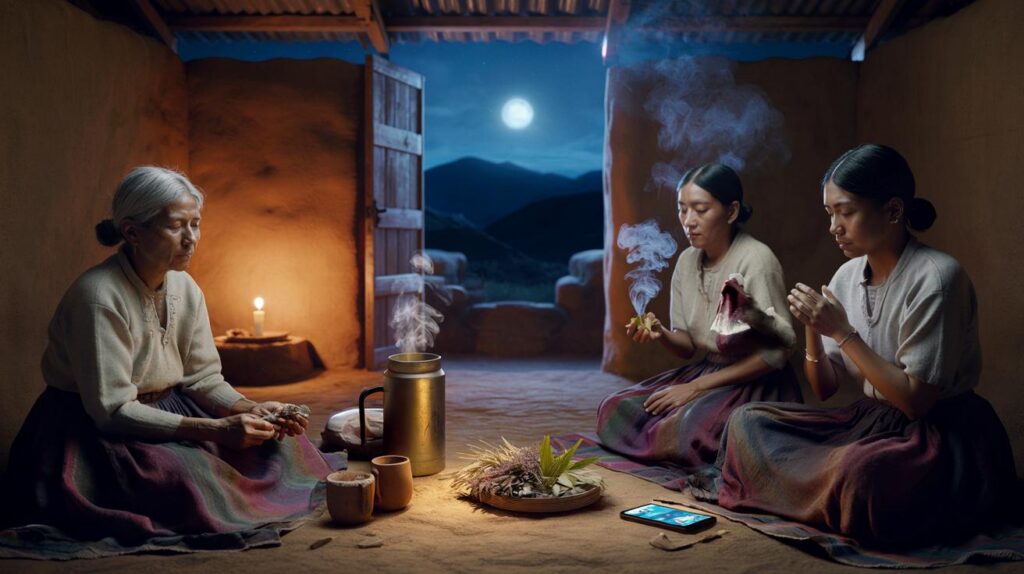
Between overflowing calendars and the blue glare of midnight screens, a quiet habit has slipped through generations of South American women. They call it “lunar rest” — a pocket of time tied to the moon, when work loosens its grip and the body calls the shots. **A pause that refuses rush.**
The first time I saw it was on a cold, clean night in the Andes. A handful of women padded into a small adobe room with a corrugated roof, the kind that hums when the wind moves. Someone lit eucalyptus and muña; the room filled with a sweet-green haze. Blankets unfurled like small fields. A thermos of coca tea clicked open, steam rising into the lamplight.
No one said “ritual”. No one said “self-care”. They just settled, shoulders sinking as if they’d been carrying invisible sacks. Outside, dogs barked and a boy chased a flat football down the lane. Inside, time slowed until it stopped scraping. Voices softened. Plans could wait. The moon did not.
The living shape of a pause
Lunar rest isn’t a museum piece. It slides into kitchens in Cochabamba and flats in Bogotá, just as easily as it lingers in highland villages. The principle is disarmingly simple: when the moon turns, take time. Not always a whole day. Sometimes a couple of hours with the door shut and the kettle on.
For some, the rest tracks menstruation; for others, it rides the full moon like a tide. You’ll hear abuelas speak of “descanso lunar” with the same ease they talk about bread and plantings. The details shift with place — a Mapuche grandmother might pause at new moon, a Quechua mother at the crest of the full — yet the feeling is recognisable: a deliberate softening of pace.
There’s logic under the poetry. The lunar cycle runs roughly 29.5 days; many menstrual cycles hover near that. They don’t always match, and no one expects them to. The moon becomes a public clock for a private need, a social signal to step out of the churn. It’s boundary-setting by the sky.
One woman, one night, one rule
Ask María in Santa Cruz what lunar rest looks like and she’ll point to her balcony. Two plastic chairs. One blanket. A battered radio tuned low. On full-moon nights she boils manzanilla, writes three lines in a notebook she keeps wrapped in a shawl, stretches her calves against the wall, and switches her phone off. That’s it. That’s plenty.
In Lima, a teacher named Jimena chooses new moon instead. She pads into the bathroom, lights a candle, and lets her bath go just a shade hotter than usual. She keeps a small jar of cocoa butter to rub into her arms, slow circles, as if polishing a story. A friend in Medellín swaps the bath for a walk under the jacarandas. Different cities, similar exhale.
The power sits in repetition. A recurring date with slowness becomes easier to keep than a vague promise to “rest more”. The moon does the reminding so you don’t have to. **Rest is a skill, not a reward.** And skills grow when we practise them without drama.
Why it still holds
There’s a social weave at work here. In the Andes, women’s circles often open with a k’intu — three coca leaves held together — as a nod to Pachamama, the earth that feeds them. In cities, the gesture might shrink to a single breath and a cup of tea. Either way, the ritual gives shape to rest. That makes it harder to skip.
It also disrupts the quiet bargain so many of us make with our devices and deadlines. We wait until everything is done; everything is never done. We’ve all had that moment when we catch ourselves answering emails at a bus stop and wonder what we’ve become. A lunar rest is a tiny union strike in your own schedule.
And there’s the body. Some call it “listening”, others call it “not pushing through”. Hormones rise and fall; attention does too. Syncing to the moon won’t fix a tough week. It can soften the edges. Let’s be honest: nobody really does this every month. The point is permission, not perfection.
Try it the gentle way
Choose a moon phase — new if you crave quiet, full if you feel social — and block two hours. Dim the lights. Boil something fragrant: chamomile, lemongrass, or a square of dark cacao whisked into warm milk. Put your phone in another room. Write three lines about what you’re shedding and three about what you’re calling in. Then sit still, like a lake at dusk.
Start small. Two hours beats an overplanned day you cancel. If you live with others, tell them, “I’m off-duty for a bit — I’ll be back at nine.” Expect the itch to “be productive”. That’s the point to notice the itch, not scratch it. *Rest can be a quiet kind of rebellion.* Be kind to yourself if it feels odd.
“Rest isn’t laziness. It’s listening.”
A few simple anchors help:
- Herbs with roots in the region: muña for the mind, ruda for boundaries, manzanilla for calm.
- Objects that feel grounded: a woven shawl, a smooth stone, a candle with a clean scent.
- One slow practice: breathwork in fours, or cat-cow bends on a blanket.
- Sound that supports, not swallows: soft pan flute, low drum, or the noise of your street.
- A closing sign-off: blow out the candle and whisper a thank you to the night.
Beyond wellness, a way to belong
This isn’t about chasing an ancient “hack”. It’s about a modest, steady way to be a person in a body, in a place, under a sky. In South America, that sky still punctuates life: market days, plantings, tides of conversation under corrugated roofs. The moon is a commons you can borrow too, whether you’re in Quito or Croydon.
You might use lunar rest as a monthly check-in, a place to name what you want and what you’re ready to lay down. You might simply drink tea in the dark and call it enough. **The moon keeps time; we decide what to do with it.** And sometimes, what we do is nothing at all.
| Point clé | Détail | Intérêt pour le lecteur |
|---|---|---|
| Lunar rest defined | A recurring pause tied to moon phases or menstruation | A simple, low-cost ritual you can actually keep |
| How it’s practised | Tea, low light, light stretches, quiet reflection, phone off | Clear steps to try tonight, not “someday” |
| Why it matters | Builds boundaries, restores attention, honours cycles | Better energy and focus without a full lifestyle overhaul |
FAQ :
- What exactly is “lunar rest”?A small, deliberate break that many South American women tie to the moon’s phases, used to slow down and listen to the body.
- Do I need to be on my period to do it?No. Some link it to menstruation, others use full or new moon as a communal cue.
- Is there science behind it?The moon doesn’t control us, but regular, protected rest and low light can calm the nervous system and improve sleep quality.
- Can men or non-binary people try it?Yes. The practice is rooted in women’s circles, yet the act of pausing under a shared sky belongs to everyone.
- How long should it last — and what if I miss a month?Two hours is a good start. Skip a month, start again. Rituals bend; they don’t break.



Merci pour cet article apaisant. L’idée de bloquer 2 heures à la nouvelle lune me parle beaucoup; je vais tenter manzanille + carnet, téléphone hors de la pièce. J’aime la phrase “le repos est une compétence” — ça remet les pendules à la lune, littéralement. Beau texte.
Je reste sceptique sur l’alignement lune–cycle (la science ne valide pas vraiment), mais le rituel comme rappel social me paraît malin. Au fond, peu importe la lune si cela aide à poser des limites. Juste, attention à ne pas romantiser les Andes pour vendre du “bien-être”.