
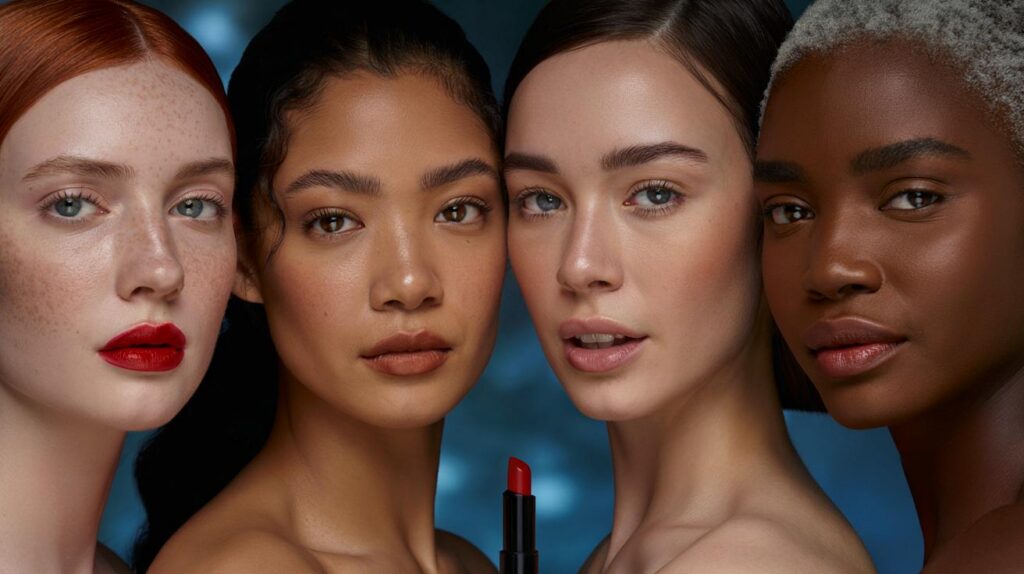
You open a lipstick drawer and it’s chaos: warm nudes, cool corals, mysterious berries that looked different online. Your undertone quiz said one thing, your bathroom light says another. We’ve all been there, watching yet another “universal” shade fail in daylight. Still, there’s a quiet rumour inside pro kits — a single colour that lands right on every face. The kind of shade that looks like you meant it.
The first time I clocked it was on the 8:12 to Paddington. A woman smudged on a red while balancing a coffee and a tote, no mirror, no drama. The train rocked, the colour settled, and the carriage changed. Heads turned like sunflowers. It looked like it belonged to her face. Later that day I saw the same kind of red again on a teenager in a hoodie, then on a silver-haired barrister outside the courts. Same effect. Same spark. It wasn’t an accident.
The shade makeup artists reach for when nothing else works
Ask any backstage artist what survives every kit edit and they’ll point to a true, blue-based red. Not cherry, not brick, not tomato. A balanced red with a cool undercurrent that sits right in the middle of bright and deep. It doesn’t shout over your features; it frames them. On camera it lifts the whites of the eyes, in real life it knocks back dullness after a long day. That’s why it keeps showing up in portraits, wedding albums, and on the train at 8:12.
I watched a team paint twenty faces for a charity gala — brown, olive, fair, freckled, deep — same bullet passed hand to hand. They didn’t swap to a bespoke nude for each person. They patted, blotted, and each mouth found its temperature. On the palest guest it looked classic. On the deepest it gleamed like lacquer. One woman whispered, “I never wear red,” then saw herself and grinned like she’d been let in on a secret. A small, electric moment, shared.
Why this red? Colour theory, yes, but also optics and psychology. A blue-leaning red sits across from yellow on the wheel, so it calms sallowness and brightens teeth. The mid-value depth means it neither drains fair skin nor disappears on rich tones. It’s vivid without feeling neon, and that balance lets undertones breathe rather than fight. Your natural lip pigment peeks through at the edges and customises the shade on contact. That’s the quiet trick: the lipstick adapts, so you don’t have to.
Finding your universal red — and wearing it your way
Start with the undertone test you can do in a bathroom queue. Swipe the red on the centre of the lower lip only, no base, no liner. Step into daylight and look for two things: do your teeth look brighter, and do your eyes feel fresher? If yes, you’ve nailed the undertone. Now dial texture. For daytime, tap the bullet on like a stain, press with a tissue, and repeat once more. For night, trace the cupid’s bow with the tip, then blur the edges with a fingertip for that soft, lived-in edge.
Common trip-ups: pairing a cool red with a very warm, brown liner that turns the whole thing muddy. Or applying straight from the bullet to dry lips, then wondering why it clings. Think skincare first — a quick buff with a flannel, a whisper of balm, a minute to sink in. Let’s be honest: nobody really does that every day. If you skip prep, grab a satin or blur-matte formula; it’s forgiving and still chic. And don’t chase an exact “dupe” for a photo you saw at midnight. Your lips aren’t a screen.
When panic strikes, pause for a breath and remember the rule artists repeat in quiet rooms: the red is here to serve your face, not the other way round.
“A blue-red is like good lighting in a tube — it lifts, cleans, and then disappears into the person.”
- Test in daylight on bare skin first, then with your usual base — the right red should work in both.
- If you fear bold colour, mix the bullet with clear balm on the back of your hand and tap on.
- To soften, blur the lip edge with a tiny brush or a clean cotton bud instead of heavy liner.
- For staying power, stain–blot–stain, then a trace of translucent powder through a tissue.
- If teeth look dull, you’ve gone too orange; if your face looks grey, you’ve gone too brown.
Beyond the bullet: what a “universal” red really gives you
A shade that suits everyone isn’t about sameness. It’s a shortcut to feeling clear and awake when life is messy. Some days you’ll wear it loud with a crisp flick; other days you’ll press on the faintest veil and call it done. The point is ease. A blue-leaning red pulls outfits together, rescues washed-out winter light, and gives summer skin a clean pop without the faff. It looks good on Zoom. It looks better in person. The more you wear it, the less “lipstick-y” it feels, because the eye stops seeing pigment and starts seeing harmony. And that’s the quiet power — a little tube that meets you where you are, then lifts you half a step higher.
| Point clé | Détail | Intérêt pour le lecteur |
|---|---|---|
| Blue-based red undertone | Balances warmth in skin and counteracts yellow tones | Brighter teeth, fresher eyes, no ashy cast |
| Mid-value depth, balanced saturation | Not too dark for fair skin, not too light for deep skin | One shade that reads flattering across tones |
| Flexible application | Stain by tapping, define with a soft blur, or go full swipe | One bullet, multiple looks from desk to dancefloor |
FAQ :
- What does “blue-red” actually mean?It’s a true red with a cool, bluish base, not orange or brick. That undertone brightens rather than dulls.
- Will a blue-red suit olive or golden skin?Yes. The cool base balances warmth in olive and golden tones, so the face looks clean and luminous.
- Can I wear it to work without feeling “done”?Tap it on as a stain, blot, and skip liner. It reads like healthy lips, not a full look.
- What finish is most forgiving?Satin and blur-matte. They smooth texture and feel comfortable, even without perfect prep.
- How do I stop it bleeding?Softly trace the edge with a clear wax pencil or a tiny touch of concealer, then apply and blot once.



Just tried my old blue-leaning red after reading this—instant teeth whitening effect. Didn’t expect that undertone tip to be so obvious in daylight; definately keeping one in my bag now.
Isn’t “universal” just marketing? On my olive skin, cool reds can look harsh unless I soften with balm. Any drugstore recs that actually hit that mid-value sweet spot?