
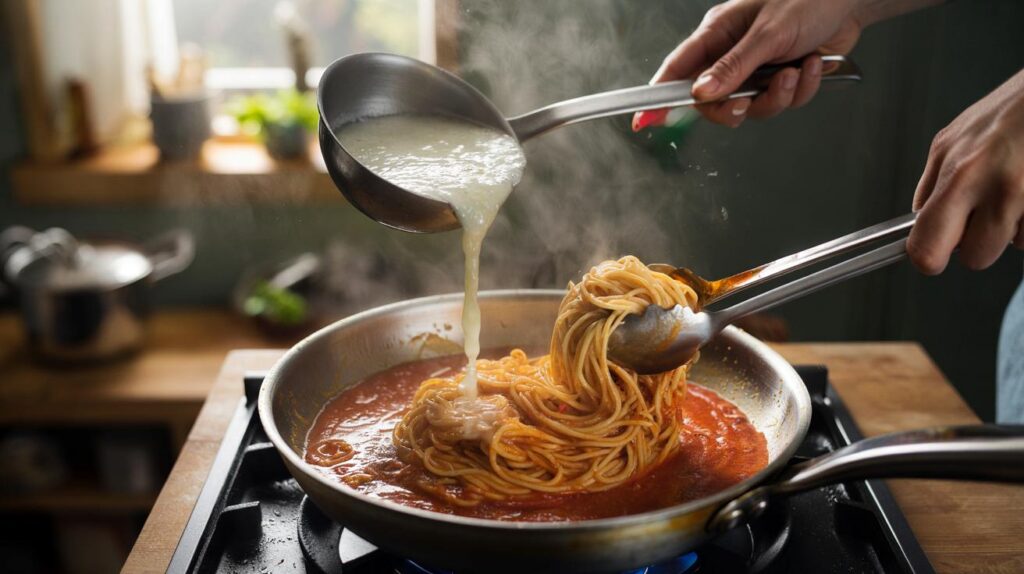
You think you’re cooking pasta. You might just be boiling it. What slips through your fingers, almost every time, is the bit that makes Italian grandmothers nod and chefs relax: the silky bridge between noodles and sauce. It isn’t the brand, nor the shape. It’s what happens in the pot, and what you pour down the sink without a second thought.
It’s a Tuesday in a small kitchen, the kind with a single wobbly shelf and a window that fogs when the water finally rolls to a boil. The phone balances on a cookbook, a sauce murmurs in a pan, and the spaghetti floats like pale rope, turning from chalk to gold. You stir, glance at the clock, and strain. Steam blooms. The sauce goes on. It tastes fine. Good, even. Still, something is missing, and you can feel it in the way the sauce sits on top like a hat instead of hugging each strand. The secret sits in the water.
The silky goodness you throw away
The magic you’re missing isn’t a hidden spice or a secret family trick. It’s the starch you rinse away or let blare down the drain. That cloudy liquid is a conductor, pulling pasta and sauce into the same key. It makes tomatoes taste rounder, butter feel lighter, and cheese melt into a glossy coat. Without it, sauce clings in patches and the finish turns dull. With it, everything hums.
I once made two bowls for friends on a damp London night, same sauce, same pasta. In one, I tossed the pasta with a ladle of its water in the pan; in the other, I just spooned the sauce over. Ten out of twelve reached for the glossy bowl before they’d even tasted. When they did taste, they didn’t say “starch”. They said “silky” and “cozy”. They said it felt right, like the pasta and sauce belonged together. That tiny ladle did that.
There’s a simple reason. Starch in the water acts like a gentle glue, helping fat and liquid shake hands. Toss pasta with sauce and a splash from the pot and you build an emulsion, the same science that makes mayonnaise stand up or gravy shine. The sauce thickens without flour, the noodles drink a little moisture, and the whole thing becomes one dish instead of two. *Yes, the water matters more than the packet.*
Do this instead: cook pasta like it wants to be cooked
Here’s the move: salt your water to roughly 1% by weight — about 10g salt per litre — and use less water than you think so it turns starchy. Keep it at a fierce boil, then stir well for the first minute to keep noodles from clumping. Cook the pasta until two minutes shy of ready. Move it to a pan where your warm sauce is waiting, add a ladle of that cloudy water, and toss. Add a knob of butter or a thread of olive oil and toss again. Watch the sauce go from splashy to shiny.
Common snags creep in. A pot that’s too small gives you clumps; water without salt gives you bland. Oil in the water? It just coats the pasta and blocks the sauce. Rinsing under the tap washes away every bit of help the starch can give. We’ve all had that moment where the pasta is perfect but the sauce is lagging; don’t let the noodles wait in a colander. They dry, they sulk, they overcook. Let’s be honest: nobody actually does that every day.
Think of the pasta water like a seasoning and a texture tool, not a waste product. It’s the difference between respectable and irresistible. Starch is your friend.
“Salt the water until it tastes like a well-made soup, then use that soup to marry the sauce to the pasta,” an Italian cook once told me over a noisy stove.
- Save the pasta water: scoop a mug before you drain.
- Finish in the sauce: 1–2 minutes, adding splashes as you toss.
- Salt guide: 10g per litre (or a heaped teaspoon per 1 litre kettle).
- Texture test: sauce should coat the back of a spoon, not puddle.
- Emergency fix: if it’s too tight, add a splash; too loose, toss over heat 30 seconds.
What else you’re missing when you cook pasta
There’s more hiding in plain sight. Toast pepper in the pan for cacio e pepe so it blooms before the cheese goes in. Warm bowls so the emulsion doesn’t seize on cold ceramic. Choose shapes with intention: ridges for chunky sauces, tubes for ragu, thin strands for quick, glossy finishes. Taste for salt in the water first, not in the sauce last. And don’t drown the pasta. Sauce should wrap, not smother. You’re not building a soup; you’re nudging two things into one. Share a bowl with someone and notice the quiet at the first mouthful, that small private nod. That’s the tell.
| Point clé | Détail | Intérêt pour le lecteur |
|---|---|---|
| Use starchy pasta water | Add a ladle to the pan to build an emulsion | Restaurant-level gloss and cling without extra cream |
| Salt by weight | About 10g salt per litre of water | Full-flavoured noodles, not bland strands that dilute sauce |
| Finish in the sauce | Cook pasta 1–2 minutes shy, then toss with sauce | Unified dish, better texture, less overcooking risk |
FAQ :
- Should pasta water really be “as salty as the sea”?Not quite. Aim for pleasantly savoury, like a light broth. About 1% salt per litre works for most tastes.
- Can I just add starch like cornflour to the sauce?It thickens, but it won’t taste the same. Pasta water brings both salt and the right starches for a natural emulsion.
- Do I need a huge pot?A medium pot is fine if you stir early and often. Less water actually boosts starchiness and flavour.
- Why not add oil to the water?Oil floats and coats the pasta, stopping sauce from clinging. Keep the oil for the pan at the end.
- Is rinsing pasta ever OK?Only for cold salads where you want to stop cooking and cool fast. For hot dishes, keep that starch on.



Je cuisine des pates depuis des années et je jetais toujours l’eau trouble. J’ai testé votre 10 g/L et la “émulsion” au ladle: sauce plus brillante, goût plus rond, c’est fou. Petit doute: avec des sauces à base de crème, on met quand même l’eau de cuisson? Merci pour la clarté, j’ai l’impression d’avoir débloqué un niveau! 😊