
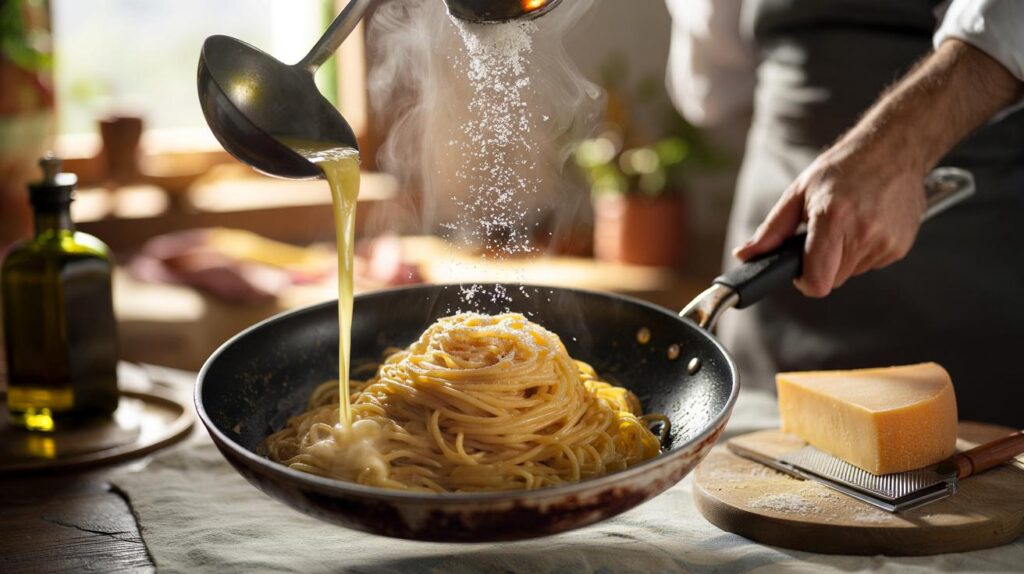
You know that glossy, restaurant-style pasta that clings to every strand like it was born there? At home it often slips, breaks, or turns chalky. The truth is, Italian chefs finish dishes with a tiny, almost invisible move — and it isn’t cream, tricks or gadgets. It’s a three-ingredient sauce hiding in the steam of your pot.
I’m standing in a narrow Roman kitchen where the windows don’t quite shut and lunch is late by exactly the right amount. A battered pan rattles on the flame as the chef tilts in a good pool of oil, then a ladle of the cloudy water that everyone else throws away. Cheese falls like snow. He doesn’t measure; he listens. He nudges the pan with a wrist flick that’s more conversation than technique. The liquid tightens, turns opalescent, and starts to cling. It looks like alchemy and smells like home. He smiles without looking up and says, “Acqua e forza.” Water and force. The secret isn’t a recipe. It’s a reaction.
The three-ingredient emulsion chefs don’t name
Behind silky plates in Italy lives a simple truth: the “sauce” is an emulsion of extra-virgin olive oil, starchy pasta water, and finely grated aged cheese. No cream, no roux, no mystery powders. Just friction and heat coaxing fat and water into a truce. It shows up in cacio e pepe and in things that never appear on menus, like a quiet bowl of courgettes and spaghetti in August. Chefs call the finishing step mantecatura — the final binding. It’s less a set formula than a habit, and once you learn the feel of it, your food stops shouting and starts humming.
Picture a Tuesday. You boil pasta in a pot that’s salinated like the Adriatic, set a pan on low with a slick of oil, and reserve a mug of that milky water. The pasta lands in the pan still a shade firm. You add a ladle of water and toss. You rain in cheese as the pan murmurs, not sizzles. The mixture goes from thin to glossy, from splashy to velvety, and you watch it grab onto the pasta like a handshake that means it. Maybe you finish with pepper or lemon zest. Dinner looks restaurant-smart, but nobody’s playing restaurant.
What actually happens? Starch particles from the pasta water suspend in the oil, forming tiny bridges that keep droplets from separating. Cheese proteins melt and help stabilise the mix while its fat rounds out the mouthfeel. Heat loosens everything just enough; movement breaks and disperses droplets until the sauce turns uniform. If the pan runs too hot, proteins seize and clump. If too cool, the emulsion never forms and stays watery. The sweet spot lives where the mixture steams gently and responds to your stirring like silk being pulled through a ring.
How to nail it at home
Use a wide pan, low heat, and a relaxed two-step. Start with a shallow pool of oil, then add two to three ladles of the pasta water for every generous spoon of oil. Toss or whisk until it looks lightly creamy, then add the pasta. Pull the pan off the heat and sprinkle in finely grated cheese in small showers, tossing between each to let it disappear. Add more water if it tightens too fast. Keep the pasta moving. Return to a low flame only if you need a touch more warmth to finish the bind.
Salt your boiling water boldly; bland water means a bland emulsion. Grate cheese fine like snow — big shards don’t melt evenly. If the sauce goes claggy, it’s usually heat or haste. Drop the flame, add a splash of reserved water, and toss until it relaxes again. We’ve all had that moment when the pan looks perfect, then the bowl looks dry five minutes later — add a spoon of hot water just before serving, and it will bloom again. Let’s be honest: nobody really does that every day. But when you do, the table goes quiet.
This isn’t Alfredo or a shortcut; it’s a method with rules that bend to your taste. You can nudge it toward the sea with anchovy, toward autumn with squash purée, toward brightness with lemon. The base stays the same: movement, controlled heat, and patience measured in seconds.
“Movement is seasoning,” the chef told me. “You think it’s cheese. It’s the way you make the water and fat agree.”
- Cheese guide: Parmigiano Reggiano for nutty depth, Pecorino Romano for sharp salinity, Grana Padano for gentle comfort.
- Pan cue: if you hear loud frying, you’re too hot; if it’s silent, warm it a touch.
- Swap alert: a knob of butter can sit in for part of the oil; it softens edges.
- Vegan route: miso + nutritional yeast + olive oil emulsion with hot pasta water, finished with lemon.
- Starch booster: a spoon of mashed potato or a bit of bean cooking water makes the emulsion bulletproof.
Why this tiny trick changes everything
You stop chasing sauces and start finishing dishes. That shift is small on paper, huge on the plate. The moment you hold back the heat, splash in the cloudy water, and fold in cheese gently, you start cooking like someone who trusts themselves. You can toss roasted broccoli through it, spoon it over white beans, or make leftover chicken sing. The sauce makes space for ingredients to taste louder without shouting. And once you’ve learned to read the pan — the flicker of gloss, the way strands stick then release — you’ll notice it in other places too, like risotto, where the final stir is the whole song. Add a whisper of nutmeg, or not. Taste, adjust, carry on.
| Point clé | Détail | Intérêt pour le lecteur |
|---|---|---|
| Three-ingredient base | pasta water, oil, and finely grated cheese form a stable emulsion | Simple shopping list; repeatable results on busy nights |
| Heat and movement | Work off the heat to add cheese; use tossing or whisking to bind | Prevents clumps; delivers that restaurant gloss |
| Flexible flavour | Add citrus, herbs, anchovy, chilli, or veg purées without breaking the base | One method, many dinners; fewer recipes to memorise |
FAQ :
- Can I skip cheese entirely?Yes. Build the emulsion with oil and hot starchy water, then layer umami with white miso and nutritional yeast. Finish with lemon zest and a pinch of sea salt for lift.
- What cheese works best?A hard, aged cheese with low moisture like Parmigiano Reggiano or Pecorino Romano. Grate it very fine so it melts evenly into the sauce instead of speckling.
- Does the pasta shape matter?Short shapes with ridges hold more sauce, long shapes show off the gloss. Use what you love, but keep an eye on water amount and tossing time for each.
- Can I make the sauce ahead?It’s a live emulsion, so it’s best made to order. If it tightens, revive with a splash of hot water and a quick toss until it loosens and shines again.
- Is this the same as Alfredo?No. Classic fettuccine Alfredo in Rome is butter and cheese bound with pasta water; many versions add cream. This method centres the emulsion itself, not a fixed recipe.
There’s a quiet thrill in turning steam and starch into something that feels like hospitality. You learn to hold back, to let the water carry flavour, to add cheese in small, confident gestures. The sauce isn’t a destination; it’s a way to move. One night it hugs courgettes and mint, another it softens chilli and garlic, and on a rainy Thursday it makes peas taste like spring. You’ll mess it up, you’ll fix it with another splash, and the table will forgive you. Teach it to someone, and watch how their hands change. Somewhere between the ladle and the toss, you’ll find your own rhythm with hard cheese and heat — a small piece of kitchen clarity worth passing on.



Testé ce soir: eau de cuisson + huile + parmesan finement râpé, en dehors du feu. L’émultion a pris d’un coup et les spaghettis brillaient comme au resto. Un filet de citron à la fin, c’était parfait. Merci pour la mantecatura expliquée!
Sérieusement, c’est pas juste un cacio e pepe sans le dire? Les proprotions 2–3 louches pour 1 cuillère d’huile me paraissent bien grasses. Et chez moi, ça a grumelé: peut‑être feu trop chaud. Des repères de température plus précis aideraient.