
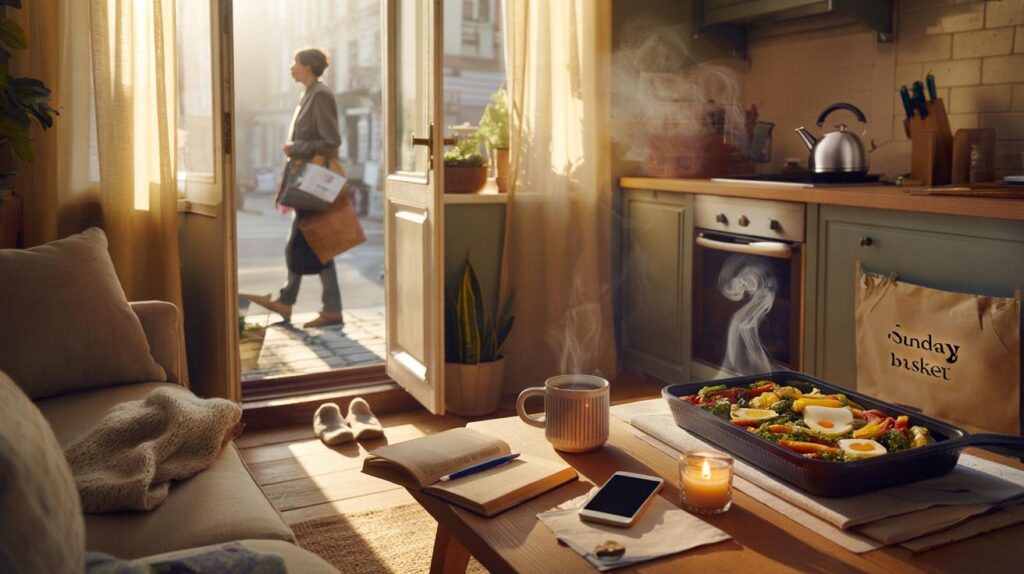
Sunday is the week’s hinge. Too often it swings between chores and dread: a blur of laundry, errands, and the creeping buzz of Monday. The “slow Sunday” flips that script. It’s not a spa day. It’s a gentle routine that gives your brain a lane to idle, your body a softer rhythm, and your week a calmer run-up.
At 9.07 am, the kettle whistles and light pushes through thin curtains. The phone blinks with a dozen little red circles. A pair of socks sits on the arm of the sofa like a half-finished sentence. You know this scene. A Sunday that wants to be restorative, yet keeps tripping over undone tasks and anxious tabs already open in your head.
We’ve all had that moment when the quiet of a free morning starts to sound like work. A neighbour drifts past the window with a paper under his arm, and you wonder if he’s cracked some secret code. *The quiet asks for a gentler pace.* What if the pace is the point?
What if we slowed it all down?
What “Slow Sunday” really looks like
Slow Sunday isn’t a list. It’s a tempo. Think of it as shifting from sprint to amble so your week doesn’t steal your day off. **Slow is a choice, not a luxury.** You keep the bones of a normal day—tea, a shower, a stroll—then resist the urge to fill every gap. That tiny bit of under-scheduling leaves room for breath.
Picture the city before it remembers to rush: the corner café moving at toast-speed, a park bench warming in the shy sun, the radio mumbling along with you. This isn’t performative leisure. It’s your ordinary, tuned down. A LinkedIn survey once found that around 80% of professionals feel “Sunday scaries”. That’s not a moral failure; it’s a cue. One reader, Maya from Manchester, started by guarding a 90‑minute pocket after breakfast—no screens, no plans, just light chores and a walk. Her Mondays stopped biting.
Why does it work? Your nervous system has two gears. You spend most of the week in “go”, so Sunday needs a clear bridge to “rest-and-digest”. That bridge is built with predictable, low-stakes actions that signal safety: warm drinks, daylight, steady movement, light tidying. Add a dash of novelty—a new route, a new recipe—and the brain wakes up without bracing. You’re not escaping Monday. You’re meeting it with a steadier baseline.
How to build a Slow Sunday routine
Start with a five-step arc. One, choose a sensory anchor: kettle, shower steam, or a real candle while you read. Two, claim an “analogue hour” after breakfast—paper book, pen, a crossword, anything without pixels. Three, take a 20–30 minute amble outdoors, even if it’s grey. Four, prep a simple meal you actually fancy; single-pan is your friend. Five, time-box a small admin window—just 30–45 minutes—to skim emails, mend a button, or set Monday’s top three. Then close it. Your day keeps its softness.
The biggest trap is turning Slow Sunday into a spreadsheet. Don’t stack six “healing” activities like you’re racing a wellness decathlon. If you’re parenting, caregiving, or working shifts, your slow might be a 25-minute pocket while a cartoon plays, or a twilight loop around the block. That counts. Let the ritual bend to your life, not the other way round. Let’s be honest: nobody actually does this every week. The rhythm works because it’s forgiving. Miss it, pick it up next time.
Think of friction. Reduce it the night before: clean mug on the counter, walking shoes by the door, a notepad open to a fresh page. **Your routine can be tiny and still be transformative.** One woman I interviewed keeps a “Sunday basket” by the sofa—letters, loose receipts, a tape measure—so small tasks stop migrating across the day. Introduce one thing at a time, and keep what earns its place.
“Rest isn’t something you earn at the end of the week. It’s the ground you stand on to live the week.”
- The 20-minute rule: if it takes less than 20 minutes, do it now or never—then forget it.
- The two-tab tidy: two 10-minute bursts to clear surfaces and reset one room.
- Single-pan supper: roast veg, olive oil, lemon, and an egg at the end. Done.
- Screenless sundown: one hour before bed without the glow.
- Monday-on-a-page: write your top three and one nice thing to look forward to.
Carrying the feeling into Monday
Slow Sunday isn’t about perfection; it’s about tone. When you choose a slower cadence for one day, the rest of the week hears it. The email pings still come. The commute still exists. **Rest on Sunday isn’t about doing nothing; it’s about doing less on purpose.** If your routine gives you three moments of genuine calm—a warm cup, a window of daylight, a tidy corner—you’ve changed the story your body tells itself about work and time.
You can even treat Monday like a sequel. Wear the jumper you love. Put a small treat at 3 pm. Keep that “top three” list visible, and let the rest be background noise. If the day swerves, your Sunday baseline is there to catch you. Share it with a friend, swap ideas, tweak it again next week. The point isn’t to live a perfect Sunday. The point is to leave yourself a little more intact.
| Point clé | Détail | Intérêt pour le lecteur |
|---|---|---|
| Set a sensory anchor | Start with a repeatable cue—steam, scent, sound—to switch gears | Easier entry into calm without overthinking |
| Time-box admin | One short window for life tasks, then close the tab on chores | Stops “Sunday scaries” from leaking across the day |
| Protect an analogue hour | Paper, pen, puzzle, or cooking—no screens, gentle focus | Reduces mental noise and improves sleep quality |
FAQ :
- What if my Sundays are already packed with family commitments?Borrow pockets. A 15-minute tea-and-window moment while the pasta boils, or a twilight walk with the buggy, still counts. Slow is a tone, not a timeslot.
- Can a “slow” routine make Monday productivity worse?Most people report the opposite. A calmer nervous system sharpens focus and reduces task-switching fatigue, so you start Monday cleaner.
- Do I need to wake up early for this to work?No. Wake when you can and build around that. Late rise? Fold your analogue hour into the afternoon, and take your walk before an early supper.
- How do I stop chores taking over the whole day?Use the two-tab tidy and a 30–45 minute admin block. If it doesn’t fit, it waits. You’re training the day to have edges.
- What if I get bored without my phone?Swap dopamine, don’t delete it. Music, a podcast during the walk, or a hands-on task like kneading dough scratches the itch without the scroll.



Merci pour cet article, hyper rassurant. J’ai testé ce matin une “heure analogique” (papier + thé) et c’était étonement ressourcant. Le “panier du dimanche” près du canapé, génial: mes reçus arrêtent de traîner. Des idées d’ancre sensorielle sans caféine? L’odeur d’orange ou la vapeur de douche, vous préférez?
Le slow dimanche c’est beau sur le papier, mais avec deux enfants et un job en shifts, je vois pas vraimant comment on s’organise. Des hacks ultra courts (5–10 min) concrets?