
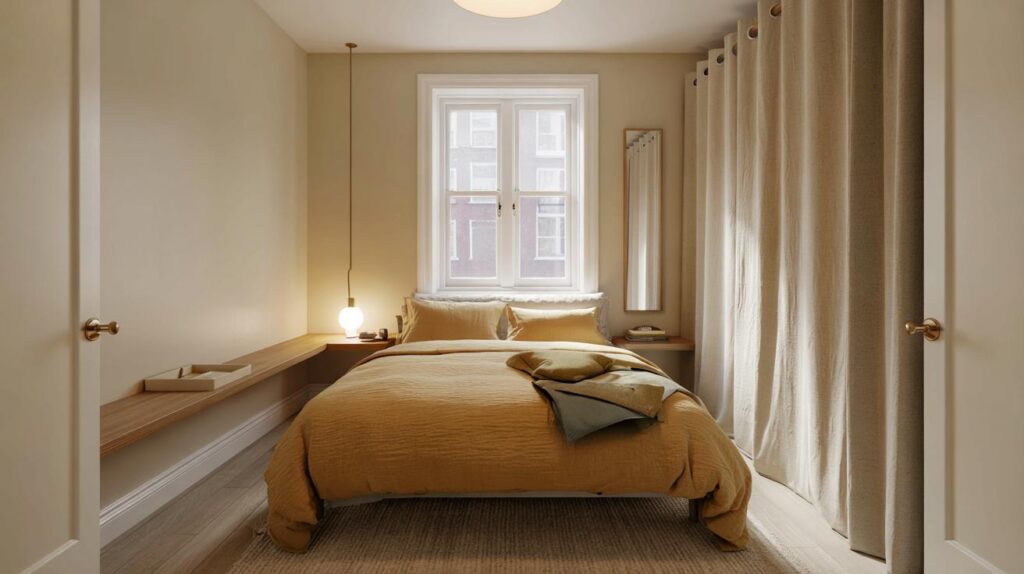
London rent eats square footage for breakfast, which leaves the rest of us falling asleep in rooms barely bigger than the mattress. The goal isn’t to make a shoebox look grand. It’s to make it feel serene, so your brain can go quiet the moment you close the door.
I’m standing in a top-floor box in Hackney, a bed squeezed under a sash window, double-deck buses humming below. The room is a palette of compromises: a too-wide chest nudging the door, a gap you sidle through, the usual tangle of chargers and clothes with nowhere to be. My friend flicks a warm lamp on and pulls a linen curtain across an open rail; the mess vanishes, the corners soften, the traffic noise feels further away. *The room exhales when the clutter stops staring back.* It’s still tiny, still rented, still London. It just feels kind.
Something small happens and everything changes.
Why tiny London bedrooms can feel calmer than you think
Serenity isn’t about owning nothing; it’s about seeing less. In the smallest rooms, the view from the pillow matters more than the square metres, and that’s the renter’s secret weapon. Place the bed so your first sight line is light, fabric or nothing at all, not cables and corners, and your nervous system stops scanning for chaos. A soft lampshade, a curtain hiding storage, a single calm colour repeated three times — the space reads as whole, not cluttered. Make the room behave; the size stops mattering.
In Bethnal Green, Aisha rents a bedroom that’s 2.2m by 2.9m — mattress to wall, that’s it. She rotated the bed so the foot faces the window and left a clear 60cm path on one side, then added a curtain to veil her open clothes rail. The United Kingdom’s Nationally Described Space Standard says a single bedroom starts at 7.5sqm; many London rooms flirt with less. Yet the trick wasn’t the centimetres. It was removing visual noise from the main sight line so the space felt deliberate, not improvised.
Calm scales with repetition and softness. Three materials only — say, pale wood, chalky paint, slubby linen — keep the eye from jumping. One temperature of light (2700K is warm without being orange) stops the room feeling like a shop. Low contrast makes walls recede, so corners blur and edges don’t jab at you. Mirror a vertical line opposite the door — a tall plant, a slim mirror, a hanging robe — and the room suddenly reads as taller. Small bedrooms aren’t a puzzle to solve; they’re a mood to set.
Renters’ tricks that buy serenity without a single drill hole
Start with a one-hour “touch once” tidy: everything in the room must either be used nightly or be completely hidden. Underbed drawers with 18–20cm clearance swallow out-of-season clothes in vacuum bags; soft bins on a top rail hold the rest. Use a tension pole for vertical storage and clip-on shelves for paperbacks. Swap a bedside table for a narrow ledge shelf and a plug-in sconce. One curtain on a ceiling track or a no-drill rod can hide a rail or box stack in seconds, which makes the room feel immediately intentional.
London renters swear by restraint more than gadgets. Oversized duvets drape better than bedspreads and erase visual clutter; two pillows look calmer than five. Most people hang too many small baskets and not enough big, soft containers that swallow mess. Dark blackout curtains can weigh a tiny room down; layer a sheer for the day and a lined curtain for sleep. We’ve all had that moment when a chair becomes a clothes mountain because the wardrobe is a hassle. Let’s be honest: no one does that every day.
There’s also the sound and scent of serenity, which cost pennies. A door sweep and a strip of foam along the frame hush hallway noise. A cotton rug underfoot stops the “shoebox echo” and warms the first step in the morning. Then a single scent — eucalyptus, lavender, or nothing — tells your brain you’re home, not on a bus. Light, order and softness do the heavy lifting.
“I stopped fighting the room the day I made it do one job: sleep,” a South London renter told me. “Now everything else hides.”
- Quick win kit: plug-in dimmer, no-drill curtain track, underbed bins, vacuum bags, door seal, soft rug, linen duvet cover.
- Layout check: leave one clear 55–65cm path; keep 10cm breathing space either side of the bed if you can.
- Palette rule: 1 light neutral, 1 mid accent, 1 texture (linen or wood). Repeat them deliberately.
- Nightstand swap: floating ledge + clip lamp + lidded tray for cables and lip balm.
Let your tiny room teach you how to live lighter
The smallest rental bedrooms are strict teachers. They show you exactly what you touch every night, and everything else is homework for the cupboard. When you let the room be small but serene, you stop apologising for it and start using it properly. A calm colour, one soft lamp, storage that disappears, and a layout that respects your sleepy, half-blind night-time self — the change is quiet but steady. Store like a shop, sleep like a hotel. Friends will say the room looks bigger. It won’t be. It’ll just be kinder, and sharing that feeling is half the joy of surviving this city.
| Point clé | Détail | Intérêt pour le lecteur |
|---|---|---|
| Sight lines first | Face the bed towards light or fabric; hide clutter behind a curtain | Instant calm without buying more furniture |
| Three-material rule | Limit to one neutral, one accent, one texture repeated | Room reads as larger and more cohesive |
| No-drill upgrades | Plug-in sconces, tension poles, underbed drawers, door seals | Rental-friendly fixes that transform nightly comfort |
FAQ :
- What bed size works best in a tiny London room?A standard double often hogs circulation. Try a small double (120cm) or rotate a double with one side to the wall, keeping one clear 60cm path so the room stays usable and calm.
- How do I get a built-in look without drilling?Use ceiling-mounted tension rods or no-drill tracks to hang curtains that hide rails or shelves, then add clip-on lights and stick-on hooks for a clean, “fitted” vibe.
- Which colours make a north-facing box room feel serene?Choose warm light neutrals with a red or yellow undertone — think warm greige, clay, or oat — and paint skirting and walls the same so edges blur.
- Any cheap sound-softening tricks for busy streets?Layer textiles: a dense rug, lined curtains, and a draft seal. Books on a shelf act as a diffuser. Even a fabric headboard can take the ring out of the room.
- How do I hide clothes with no wardrobe?Use an open rail capped by a curtain on a no-drill track. Stash off-season items in vacuum bags under the bed and keep only a small “capsule” in view.



Love the “see less, feel calmer” idea. I tried a 2700K bulb, one linen curtain to hide my open rail, and repeated pale wood three times — it definately softened the room. Any tips for picking a calm mid accent without it looking muddy at night?