
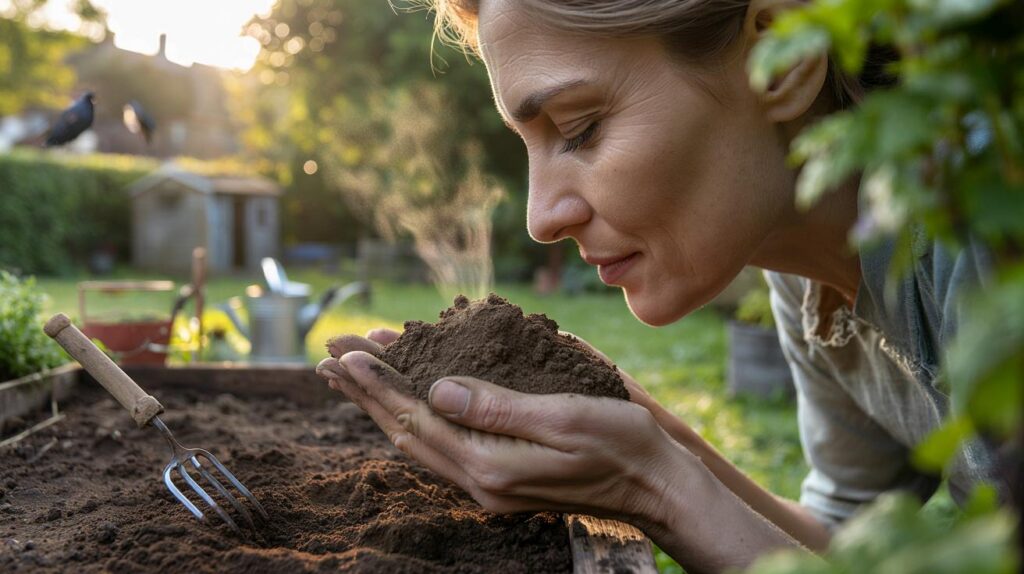
The scent that rises when you turn the first fork of soil is oddly specific — sweet, earthy, familiar. Many people feel their shoulders drop as soon as that smell hits. Why does a simple garden ritual quiet a racing mind as reliably as a cup of tea?
Sunday, 7am, the allotment is half-awake. A blackbird scuffs in the hedge, kettles rattle in nearby sheds, and the ground holds the night’s cool like a secret. I press a spade in, lean, and the turf parts with a soft sigh. From the cut rises that unmistakable perfume — rain without rain, countryside without the drive. I pause with the handle against my hip, breathing in like a sommelier with a glass of claret. I swear the air changed. The news on my phone feels far away; emails, unruly. Even my stride slows as if someone turned down a dial. It wasn’t the roses.
The science beneath your boots
That fragrance has a name: petrichor when it follows rain, and **the star molecule is geosmin**. It’s made by soil-dwelling actinobacteria, part of an ancient microbial chorus. Your nose is absurdly sensitive to it — parts per trillion — and when geosmin arrives, it doesn’t just tickle the nostrils. Smell routes straight to the limbic system, where memory and emotion live. No permissions. No committee. A hint can pull you to a place where things are slower and more textured. It’s a scent our ancestors trusted; geosmin often signals water, fresh growth, safety. Your body hears that story long before you’ve had a chance to edit it.
I met an NHS nurse on a London plot who swears by ten minutes with a hand fork after night shifts. She doesn’t plant much, barely weeds. She just breaks the crust and breathes. There’s data behind her ritual. A University of Michigan study found a short spell in nature led to meaningful drops in cortisol, our stress signal, after around twenty minutes. Gardeners often get that dose without planning it. An RHS-supported project in the UK has linked frequent gardening with better wellbeing and lower stress, especially for people who do it in small, regular bursts. We’ve all had that moment when a scent or a patch of green shoves the day into a friendlier shape.
What else is happening? Soil holds living allies. Exposure to harmless soil microbes like Mycobacterium vaccae has been shown, in early studies, to modulate immune responses and influence mood-related pathways. One line of research found that contact with M. vaccae led to serotonin-related changes in animals that looked a lot like a lift in mood. You’re also moving rhythmically, which nudges your nervous system toward balance. Sunlight gives you a whisper of vitamin D; the mind likes a physical task with a visible end. And **your brain loves a cue**: smell lands hard and fast, tagging an activity as restorative even before you notice the shift.
Turning calm into a practical habit
Try a “soil reset” the next time your mind chatters. Pick a patch no bigger than a doormat. Like a barista with a routine, go step by step. Press the spade or fork in a hand’s breadth, lift and crumble a small clod, and pause a beat with it near your face. Breathe in for three, hold for two, out for four. Let the smalls — the grit, the roots, the cool damp — fill your attention. Repeat for five clods. Smooth the surface with your palm, brush your hands clean on your trousers, and stand up slowly. That’s it. No harvest, no pressure. Light, repeatable, sensory. **Light, regular digging beats intensity.**
Water can wake the scent on dry days. A quick sprinkle, a minute’s patience, then lift and sniff. Gloves are fine if you need them, though a short moment of skin-to-soil contact adds an honest note. People often overdo it, chasing the “perfect bed” with heavy tilling that leaves soil and back both tired. Keep it gentle. If you’re pollen-sensitive or immunocompromised, stick to moist soil, avoid windy spells, and rinse hands after. Let’s be honest: nobody actually does this every day. Your mind doesn’t need perfect; it needs a cue it can trust.
One soil microbiologist put it to me like this: our noses learned to read geology and microbes long before we learned to read screens. The smell is a flag from an old world, and your nervous system salutes it. Treat that as a tool, not a miracle. Pair the scent with a rhythm you can repeat, and your body will do the rest over time.
“Geosmin is a bacterial calling card that the human brain treats like a weather report. It hints at water, growth, and low threat — signals your stress system takes seriously.”
- Pick a 1×1 metre patch and return to it, same time of day.
- Spritz dry soil lightly; wait a minute to wake the aroma.
- Use 3-2-4 breathing with each lifted clod.
- End with a quick tidy gesture your brain can bookmark — rake, pat, or brush.
- Keep sessions under 10 minutes to make them stick.
What this smell says about us
The garden isn’t a spa. It’s messy, sometimes muddy, often ordinary. That’s the point. The scent of fresh soil is ordinary, too — microbes making a living, roots threading a path. When you meet that smell, you meet something beautifully stable. It tells a different story from the one your phone tells. Ritual plus scent plus a task with edges: that’s a recipe minds can recognise and rest inside. Share it, if you like. Bring a child to turn a small patch. Invite a neighbour to tuck in a herb. Compare notes with the person on the next plot about how the air “feels” after rain. The science gives us clues. The practice gives us a life we can sense. Not perfect, not curated, just grounded. And isn’t that what calm is, in the end — a place where things touch and hold, and where the day smells like it belongs to you?
| Key points | Details | Interest for reader |
|---|---|---|
| Geosmin and petrichor | Bacteria in soil release geosmin; rain and fresh digging amplify it | Explains why the smell feels ancient and reassuring |
| Microbes and mood | Exposure to friendly soil microbes can influence stress and mood pathways | Gives a biological reason your mind settles in the garden |
| Simple “soil reset” routine | Five clods, slow breath, brief tidy to close the loop | Offers a quick, repeatable method to feel calmer fast |
FAQ :
- Why does soil smell stronger after rain?Raindrops trap and launch tiny bubbles from the ground, spraying geosmin-rich aerosols into the air. Your nose is incredibly sensitive to that molecule, so the scent blooms.
- Is it safe to inhale the smell up close?For most people, yes. Stick to undisturbed, clean garden beds, avoid compost dust and windy days, and wash hands after. If you have allergies or a lung condition, keep it gentle and brief.
- Do I need a big garden to get the effect?No. A window box with fresh potting mix, a grow bag, or a shared community bed works. The key is a small, repeated ritual your senses recognise.
- Can houseplants deliver the same calm?They can help. You won’t get the full earth aroma unless you moisten and lightly disturb the compost, but the care routine and greenery still soothe.
- What if I don’t like getting my hands dirty?Use a hand fork and thin gloves. Bring the soil close for a sniff after watering. You can keep it tidy and still catch the calming signal.



I tried the 3-2-4 breathing with five clods—worked shockingly well. The part about geosmin hitting the limbic system definately explains why my shoulders drop in 2 seconds. Bookmarking this for post‑Zoom resets.
Cool story, but isn’t this just confirmation bias? The University of Michigan study looked at general nature exposure, not specifically digging. Any RCTs on M. vaccae in humans, or are we extrapolating from mice again?