
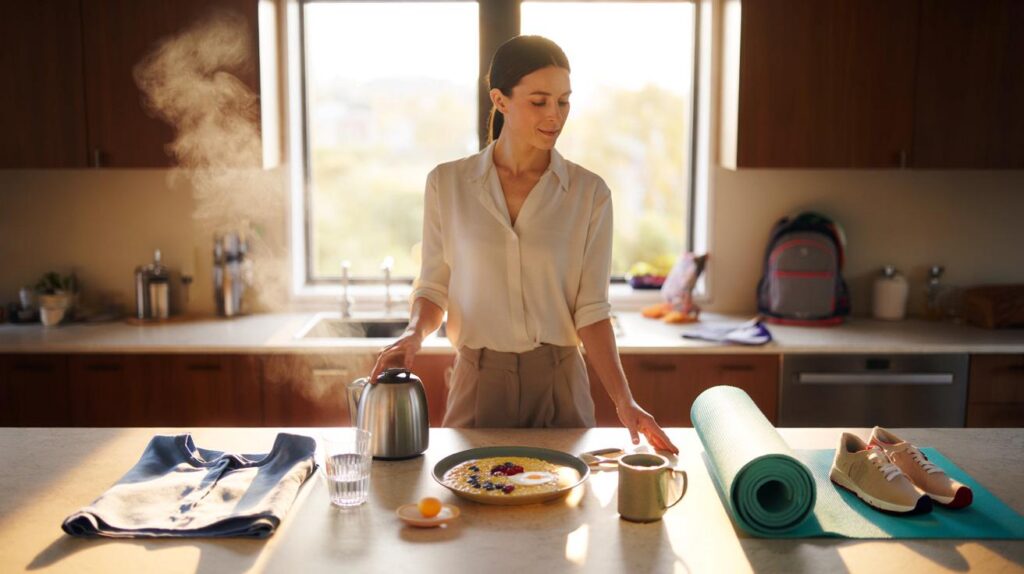
There’s a reason mornings feel like a maze: too many choices before coffee, not enough fuel to make them. Open wardrobe, pick a top, change it. Check the weather, pack a bag, remember the PE kit, forget the charger. For many women, the invisible work starts long before the commute. A small, slightly scrappy idea keeps popping up in group chats and kitchen notes — a way to cut through the noise and keep the day intact.
The kettle clicks on at 6.42am, and Jess watches her toast brown as a flurry of notifications blinks awake. Her daughter can’t find a sock. A courier is at the door. Teams hums already. Jess reaches for a biro and writes three words on a Post-it stuck to the fridge: Wear. Fuel. Move. She won’t do everything. She will do these.
Only three.
The “three-thing rule”: a tiny structure for noisy mornings
The **three-thing rule** is simple: pick three non‑negotiables that shape your morning, and let everything else be optional, delayed, or defaulted. It’s not a manifesto. It’s a filter. What counts are things you can complete in under 15 minutes each, that lower friction for the rest of the day. Three anchors, not thirty hacks.
Here’s how it looks in real life. A nurse in Manchester chose “uniform laid out, porridge overnight, five sun salutations.” She said her shift still started at 7am, but her mind no longer did. Surveys across OECD countries show women shoulder far more unpaid care and admin at home — often close to double men’s time. The rule doesn’t erase the **mental load**, yet it trims the morning’s sharp edges.
Why it works: limited decisions multiply focus. Every micro-choice drains attention and willpower, a phenomenon many people call **decision fatigue**. Our brains love constraints; they narrow the field so momentum can build. Three items set a frame wide enough for life, but tight enough that you finish them. Finishing is a feedback loop, and that loop propels the rest of the day.
Make it yours without turning it into homework
Start with three verbs you can do on autopilot: Wear, Fuel, Move. Pre-decide a weekday uniform, rotate two breakfasts, and attach a ten-minute stretch to the kettle boiling. Set a two-minute timer to pack the bag the night before. Keep it messy-friendly; the point is completing three stabilisers, not performing a perfect routine.
Common pitfalls: picking goals that belong to someone else’s life, or picking six. When the list feels like homework, shrink it. We’ve all had that moment when a tiny slip nukes the whole morning. Swap punishment for adjustments. Let one item be a “micro” version (apple instead of eggs, leggings instead of a run) and call it done. Let’s be honest: nobody does this every day.
Listen to how you talk to yourself when the plan wobbles. Names matter, tones matter, and small wins count twice on tired days. Try writing the three on a scrap of paper where you make your first cup, and stick to the same set for a week before tweaking. Then pause and ask: which one genuinely made the day lighter?
“I stopped trying to ‘win’ mornings. I just pick three things that future me will thank me for, even if the sink is a mess.”
- Three easy anchors: Wear (uniform outfit), Fuel (one default breakfast), Move (10-minute stretch or walk).
- Make it visible: Post-it on the fridge, lockscreen note, or a magnet board by the kettle.
- Keep a “micro” version ready for rough days so the streak survives without heroics.
Why this tiny rule feels bigger than it looks
Three small promises free up headspace you can spend on the real work of your day — the ideas, the care, the conversations that actually move life forward. There’s also something gentler here: mornings stop being a test and start being a handover. *A quiet exhale, right before the rush.* You don’t become a different person; you become the same person with fewer traps in her path.
Women have been told to optimise endlessly, and that pressure can feel like a second shift. The three-thing rule isn’t about squeezing more productivity from tired bones. It’s a boundary, and boundaries shape peace. Keep it personal. For some, the three might be “meds, protein, sunlight.” For others, “pack, coffee, calendar.” It’s small by design, so it fits on the days that don’t.
Try it for five mornings. Write your three, keep them short, and let them be boring. If it sticks, you’ll feel it not as a triumph but as an absence — fewer decisions, fewer spirals, fewer late‑morning crashes. And if life blows it apart at 7.03am, you can still do one, maybe two, and carry on. That’s the quiet power tucked inside three tiny things.
| Point clé | Détail | Intérêt pour le lecteur |
|---|---|---|
| Three anchors, not a routine | Choose Wear, Fuel, Move (or your own trio) you can complete fast | Less overwhelm, more follow‑through on busy mornings |
| Defaults beat willpower | Pre-decide a weekday outfit, two breakfast rotations, a 10‑minute move | Saves energy for decisions that matter later |
| Micro versions keep the streak alive | On rough days, shrink tasks: apple, stretch, pack one item | Progress without perfection, fewer all‑or‑nothing crashes |
FAQ :
- Is the three-thing rule only for women?Anyone can use it, though many women find it helpful because mornings often carry extra admin and caregiving. The rule targets overload, not identity.
- What if my mornings are unpredictable with kids or shift work?Pick flexible anchors that travel: meds, protein, sunlight; or water, pack, stretch. Keep micro versions so you can adapt without scrapping the day.
- How do I choose my three?Ask, “What makes 11am easier?” Then pick actions that directly support that. Test for a week, review on Sunday, and keep the ones that genuinely lighten the load.
- Won’t I get bored wearing the same thing and eating the same breakfast?Boredom is a feature, not a bug. Defaults save brainpower for creative work later. You can rotate on weekends if you miss variety.
- Can I add more once I’m in the groove?Keep the core at three. Add optional extras only after they’re done, so the anchors stay protected when mornings get loud.



Tried the “Wear, Fuel, Move” trio this week and it cut my morning dithering in half. I laid out a black tee and jeans, soaked oats overnight, and did 8 minutes of stretches. Not perfect, but I arrived at 9am with brainspace left. Surprisingly calming.
Honest question: isnt this just habit-stacking with a new label? Also, the mental load piece isn’t solved—women still do the invisible admin. Helpful, sure, but we need partners/systems to share it. Otherwise it risks being another thing women must “optimize”. Feels a bit… band‑aid‑y.