
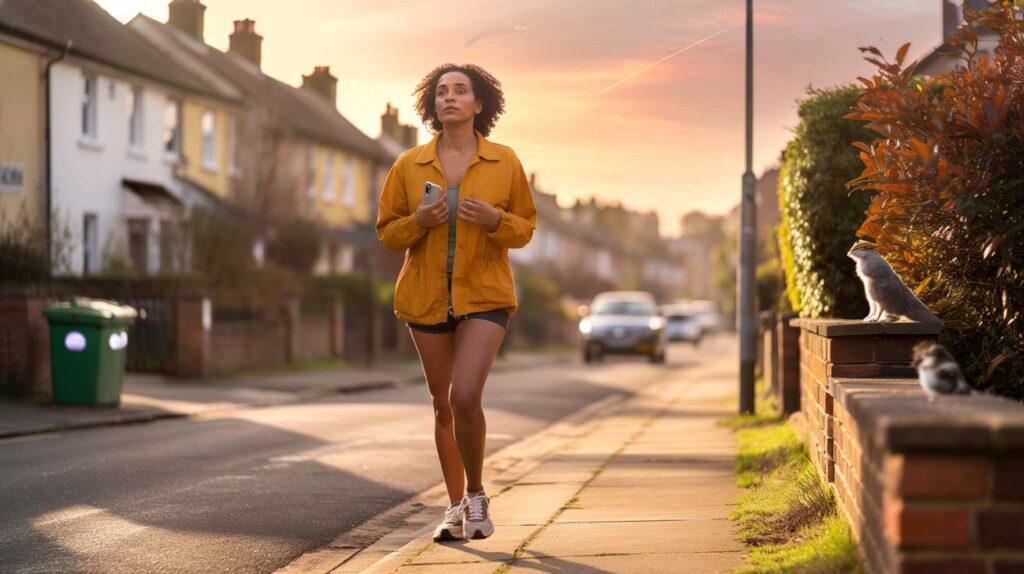
Work, messages, kids, partners, errands, noise — the day rushes past until your head rings. Many women are never alone in clean silence unless they’re brushing their teeth. A solo walk carves out a pocket of quiet where nobody needs anything from you. Thirty minutes. Your pace. Your breath. That’s the whole brief.
It starts with laces and a door. You slip out while the dishwasher hums, or right after a meeting, or once the baby finally naps. The street holds the remains of someone else’s day: a takeaway cup on a wall, a cat on patrol, a smear of pink sky over terraced roofs.
Walk long enough and your jaw loosens. The mind starts to tidy itself, slow and stubborn as the tide. A robin calls from the hedge and, almost rudely, you remember you have a body.
The phone stays in your pocket. You cross at the lights, pass the same tired knocker on number 27, and feel the rhythm take over your thoughts. A little relief creeps in.
Then something odd happens.
A room of one’s own — on foot
There’s a kind of quiet you can only find in motion. A **solo walk** isn’t a workout disguised as punishment, it’s a moving boundary line. You step outside and the world does not immediately reclaim you.
The path doesn’t ask for a reply. The pavement doesn’t ping. You get to look out at ordinary things — buses, bins, plane tracks — until your inner noise dials down. That’s the power hidden in plain sight.
Take Maya, 34, in Leeds. Her lunch breaks had shrunk to emails over a salad, so she started a 30‑minute loop around her block. By week two, she noticed she was snapping less at 5 p.m. and sleeping deeper by 11.
She didn’t buy new trainers or join a challenge. She put on a coat and went. Research often links regular walking with lower anxiety and better mood, and you don’t need studies to feel your shoulders drop after ten minutes outside. It’s the simplest kind of upgrade.
Here’s the unglamorous truth behind it. Rhythmic movement calms the stress system, daylight tunes your body clock, and your gaze finally widens beyond one glowing rectangle. When your eyes scan the horizon, your brain exits emergency mode.
That open focus lets thoughts file themselves. No app required. The result is less rumination and more oxygen reaching the parts of your day that feel starved.
How to make thirty minutes of quiet actually happen
Use the out‑and‑back rule. Walk out for 15 minutes, turn around, come home. No faff, no route planning. Keep a “go kit” by the door — coat, hat, keys, comfy shoes — and leave at the same time you’d doomscroll.
Treat it like a meeting with yourself: non‑negotiable, on the calendar, invite declined to everyone else. If time is tight, pair it with a fixed anchor like school drop‑off, lunch, or the end of your working day. Make it boringly easy.
Beware perfection traps. You don’t need a picturesque trail or a 10,000‑step tally. Busy pavement is fine. Short loops round the block are fine. Rain is fine with a hood and a grin.
Pick routes that feel safe and familiar, favour daylight or well‑lit streets, and tell someone your plan if that settles your mind. Walk with your phone on low volume and one ear free to stay present. **Let it be simple.**
Let’s be honest: nobody does this every single day. Aim for most days and let missed ones go. Start with 12 minutes if 30 sounds ridiculous. Build up. The point is the pattern, not the medal.
“I don’t walk to be fit. I walk to hear my own thoughts before the world gets a vote,” says Nadine, 39, from Brighton.
- Micro‑routes: 5 minutes out, 5 back, three times a day.
- Safety comfort: familiar loop, bright jacket, share location with a friend.
- Mind prompts: name five things you can see, four you can hear, three you can feel.
- Weather ready: lightweight waterproof by the door, dry socks waiting.
- Phone etiquette: pocket‑only rule, music if you like, one ear open.
What this shifts, quietly
Walking alone resets your relationship with time. You stop spending every spare minute on someone else’s plan. After a fortnight, small irritations shrink faster. You spot the tree that’s turning copper week by week. You notice the bakery opens early, the neighbour’s new puppy, your own breath holding then softening.
We’ve all had that moment when you realise the day ran you, not the other way around. A **solo walk** is the smallest rebellion that doesn’t require a speech. It’s also a signal to people around you: this half‑hour is mine, and I come back better for it. The people who love you can handle that.
There’s something else. Girls learn what freedom looks like by watching women take it. Thirty minutes of quiet shows that care exists alongside boundaries. You return with pink cheeks and steadier eyes. You tolerate less nonsense because your nervous system isn’t already at a simmer.
*The world keeps asking; you’re allowed to step outside and answer later.*
Make it feel good, not like a chore
Start with pleasure. Choose a loop with one thing you genuinely enjoy — a view over the park railings, a row of lime trees, the muddy canal path with nosy swans. Dress for ten minutes colder than it is, and stick a spare hair tie in your pocket.
Layer a tiny ritual on top: the first 90 seconds for three deep breaths, the last 90 to list what felt good today. Bookend your mind. If you like sound, go for birdsong or a favourite playlist, then switch it off for the last stretch and let quiet do its work.
Common stumbles? Waiting for motivation. It rarely arrives on time. Routine is kinder than willpower. Another: turning it into a productivity hack. This isn’t about crushing steps or “optimising” your morning.
There’s also the fear of being seen alone. People take one look and get on with their lives. You’re walking. That’s all. If a street feels off, reroute without drama. **Your safety and ease come first.**
One more stumble: thinking it doesn’t count if it’s short or slow. It counts. Brisk is brilliant for heart and mood. Slow is perfect for headspace. Both are walking, both are yours.
“The first five minutes are the hardest. Then the pavement starts doing the thinking,” says Priya, 42, Manchester.
- Anchor it: after coffee, before emails, post‑bedtime routine.
- Keep it visible: shoes by the door, coat on a hook you can’t miss.
- Make it social, lightly: text a friend “Going for my 30”, no reply needed.
- Play with pace: gentle out, brisk back, or the reverse.
- Finish line: a glass of water and two stretches when you return.
The underrated reset you can claim today
Imagine your next week with a thin silver line of quiet running through it. The day stops feeling like a wave you must out‑swim and starts to feel like a path you choose, one lamppost at a time. You don’t need permission, a subscription or a new identity. You need a door, ten fingers to knot your laces, and a promise you keep in small weather. If someone texts, they can wait twenty‑nine minutes. If the sky looks moody, you’ll take the umbrella and call it drama. You come back carrying fewer thoughts and more air. That tends to change what happens next.
| Point clé | Détail | Intérêt pour le lecteur |
|---|---|---|
| Claim 30 minutes daily | Out‑and‑back rule, calendar block, go‑kit by the door | Makes a consistent habit realistic in busy lives |
| Walking calms the system | Movement, daylight, wider gaze reduce mental noise | Explains why you feel better fast without extra effort |
| Keep it simple and safe | Familiar routes, one ear open, share location if helpful | Removes common barriers so you actually go |
FAQ :
- When’s the best time to walk if my day is packed?Pick a fixed anchor you already do — after breakfast, post‑school run, or straight after your final meeting — and slip out for 30. Anchors beat “sometime later”.
- Is walking alone safe?Choose familiar, well‑lit routes, favour daylight where possible, keep one ear free, and tell someone your plan if that settles you. Carry what helps you feel confident.
- What if it’s raining or cold?Layer up, hood up, and shorten the loop if needed. The air still does its job. Hot shower and dry socks after make it oddly satisfying.
- Should I listen to music or a podcast?If it lifts you, yes — then switch off for the last five minutes and let silence land. That contrast is where a lot of the calm sneaks in.
- Does a 10–15 minute walk still help?Absolutely. Ten minutes can change your mood and reset your focus. Stack short loops through the day and you’ve built **real rest** into real life.



I started the 15-out/15-back last week and it was shockingly doable. By day three my 5 p.m. snappyness eased and I slept like a log. Definately keeping the coat-by-the-door trick.
Genuine question: for women in areas where walking alone feels unsafe after daylight, any tips beyond ‘well-lit routes’? Shift-work makes timing tricky.