
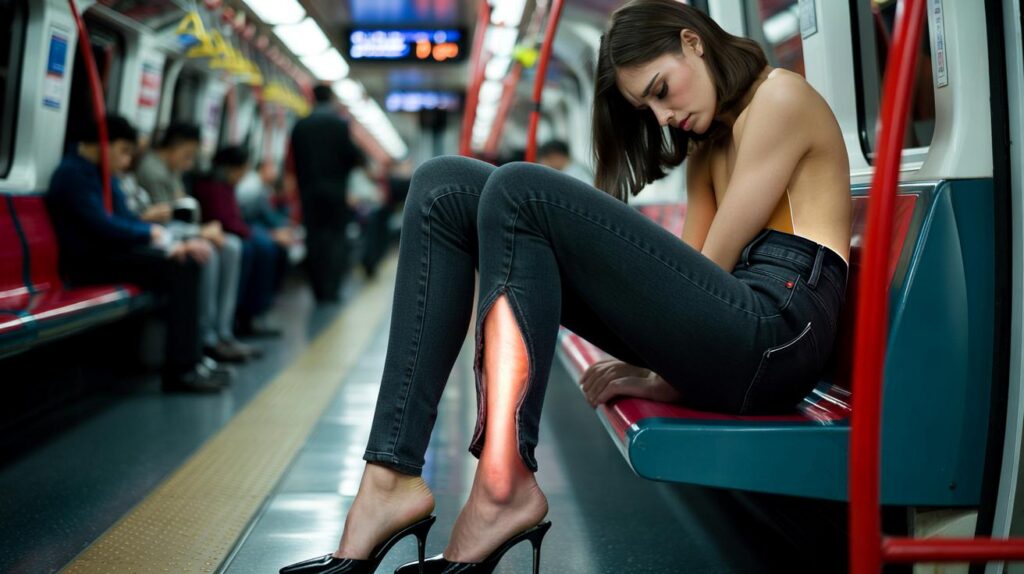
They promise a smoother silhouette, a firmer line, a kind of everyday airbrushing. Shaping jeans do what the label says: they sculpt. Yet that grip doesn’t let go when you sit on a train, cross a leg in a meeting, or stand behind a café counter for hours. Little by little, the squeeze migrates from “snug” to “stifling”. What starts as style can become a quiet pressure on your blood flow. You don’t always notice until your legs tell you.
The carriage shuddered and she shifted in her seat. Black sculpting jeans, fresh out of the wash, clung like second skin as the tube rocked from Brixton to Oxford Circus. Phone in one hand, the other rubbed at her thigh, chasing a fizz that had started near the pocket and was now darting down to her knee. It felt like a carbonated line of ants. By Green Park, a numb patch had settled on the outer thigh. She stood, the waistband dug in, and a tiny wave of relief moved with her steps. Something else was tightening.
The stylish squeeze hiding in your wardrobe
Shaping denim works by compressing. Clever panels lift the bum, hold the tummy, and streamline where fabric once folded. That pressure doesn’t just sculpt; it can press on veins that move blood back to the heart, especially the low-pressure network in your calves and thighs. When you sit, the backs of your knees crease against a tight seam, slowing venous return like a kink in a hose. Stand still too long and the squeeze can pool blood in the lower legs, setting the stage for swelling and that telltale pins and needles tingle.
There’s a real-world name for it. Years ago, doctors dubbed it “tight pants syndrome” after seeing cases of meralgia paraesthetica, where the lateral femoral cutaneous nerve gets compressed under the waistband. A famous case report in a neurology journal described a woman whose skinny jeans contributed to nerve and muscle trouble after a day of squatting to move house. Most people won’t end up in hospital from denim, of course. Yet the pattern is familiar: a high, rigid waistband, a rigid seat, a day spent sitting or stooping—and by evening, numbness and tingling stake out territory along the outer thigh.
Here’s what’s happening under the fabric. Veins rely on muscle contractions and small one-way valves to shuttle blood upwards, against gravity. A firm band across the groin can press on the path where those vessels and lymph channels pass, just as the seam at the knee can hamper flow when your leg is bent. Add heat, dehydration, or hours at a desk, and viscosity creeps up while movement drops. Nerves don’t love pressure either; the outer thigh nerve is finicky, and when it’s squeezed you get burning, tingling, or a numb strip. If you’re prone to varicose veins, the squeeze can intensify heaviness. It’s not drama. It’s physics.
How to wear denim that loves your legs
Start with fit checks, not wishful thinking. Slide two fingers comfortably between waistband and skin when standing and sitting; if they get stuck, size up or switch cut. Do a 20-minute home test: wear the jeans while you make tea, walk a hallway, squat to tie your shoes, sit and then climb stairs. If the fabric saws at the knee crease, or your thigh tingles by minute fifteen, that’s your answer. Look for 1–2% elastane for stretch without vice-like grip, and a rise that doesn’t carve into the hip crease. Structured, not strangled.
Small habits protect circulation. On commute or at your desk, uncross legs, plant both feet, and roll ankles ten times each hour. Take 60-second “calf pump” breaks—rise onto your toes and lower down, twenty repetitions. We’ve all had that moment when we peel off jeans and trace the grooves they’ve left behind; those grooves are clues. If you wear a belt, keep it one notch looser when travelling. High heels plus tight jeans tilt your pelvis, intensifying pressure along the front of the hips. Swap stiletto days for trainers or a block heel to ease the chain.
Think of pressure like a dose: how much, how long, and where. Rotate your silhouettes—straight, wide-leg, relaxed taper—so the same seams don’t press the same paths day after day. If you love the smoothing effect, compare it to medical compression: stockings use measured, graduated pressure in millimetres of mercury, designed to help veins. Shaping jeans exert patchy, unpredictable force. As one physio told me, the goal isn’t to abandon denim; it’s to be kind to your circulation.
“Fashion should hug, not choke,” says London physiotherapist Maya B. “If your jeans leave burning, numbness, or swelling beyond a short red line that fades in minutes, your body’s asking for space.”
- Quick check: walk three minutes. Any numbness, tingling, or burning?
- Look down: deep red marks that linger = too much pressure.
- Swap days: alternate tight cuts with looser ones to give nerves a rest.
- Move hourly: ankle circles, calf raises, short walks reset flow.
- On flights: pick softer waistbands and do seated leg pumps.
Not a scare story, a body check-in
We change posture dozens of times a day. Clothes that move with us—rather than against us—fade into the background and let the body do its quiet work. Shaping jeans don’t have to be villains. They simply need boundaries: the right size, kinder seams, an exit plan after long sitting, and a rotation that respects circulation. Let’s be honest: nobody actually does that every day. But this is one of those tweaks that can ripple through energy, comfort, and even mood. Test your favourites. Notice the small signals. The best style is the one you forget you’re wearing.
| Point clé | Détail | Intérêt pour le lecteur |
|---|---|---|
| Fit test that works | Two-finger waist check plus 20-minute wear-and-move routine | Simple way to spot hidden pressure before you buy |
| Know the pressure points | Waistband at groin, knee crease, outer thigh nerve pathway | Helps you choose cuts that don’t pinch blood flow |
| Rotation beats strain | Alternate silhouettes and add hourly micro-movements | Reduces risk of tingling, swelling, and heavy legs |
FAQ :
- Can skinny or shaping jeans really affect circulation?Yes, tight waistbands and seams can slow venous return and compress nerves, especially at the groin and behind the knees. Most effects are mild and reversible when you remove the pressure.
- What are early warning signs my jeans are too tight?Tingling, numb strips on the outer thigh, burning patches, swelling around the ankles, and marks that linger more than a few minutes after you change.
- How should shaping jeans fit to be safer?Comfortably snug, not restrictive. You should slide two fingers under the waistband when sitting, and you shouldn’t feel buzzing or pinching as you walk, squat, or climb stairs.
- Are compression leggings better for blood flow than shaping denim?Medical compression uses measured, graduated pressure to assist veins. Fashion denim applies uneven pressure; supportive leggings with mild, even compression are typically gentler than rigid shaping jeans.
- Who should be extra cautious with tight jeans?People with varicose veins, nerve sensitivity, diabetes, or those travelling long-haul. Choose softer waistbands, looser cuts, and move frequently.



On dramatisse un peu, non ? Vraiment la ciruclation est impactée au quotidien ? Des millions portent des skinny sans finir chez le médecin. Où sont les chiffres, pas juste des anecdotes ?