
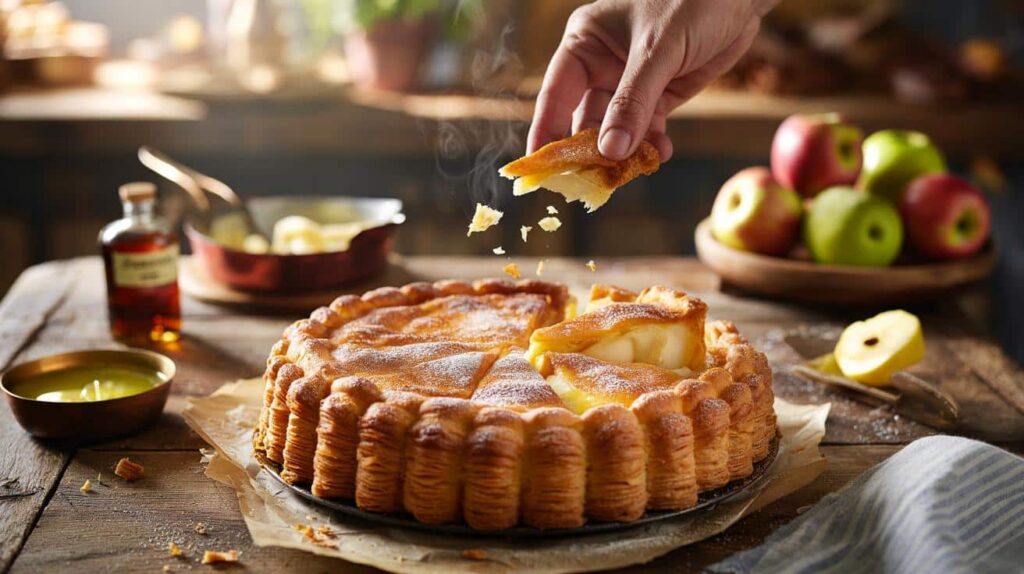
In homes that swore by apple pie, a new ritual is taking root: stretch, brush, fold, bake, shatter. **The sound is half the pleasure.**
The first time I saw a croustade gasconne made properly, it was a late Sunday in a warm Bordeaux kitchen. A cotton sheet covered the table. A ball of dough waited, relaxed, like it knew what was coming. A grandmother slid her hands beneath and began to pull, patient as a sunrise, until the dough went paper-thin and the wood grain showed through. Apples, tossed with lemon, sugar, and a whisper of Armagnac, rested nearby. Butter hissed in a small pan.
She brushed, folded, brushed again, scattering sugar like a light snowfall. The oven door swallowed the tray with a quiet thud. Minutes later, the house smelled like orchard and toast. The croustade broke under the knife with a dry, irresistible crack. *We looked at each other and grinned like we’d gotten away with something.* The sound lingered in the room.
The crackle is the hook.
Meet the Gascon croustade, the crispy marvel winning over France
In the Southwest, they call it croustade gasconne, tourtière landaise, sometimes pastis gascon. Names change by village, but the idea stays the same. Paper-thin pastry, brushed with melted butter and sugar, layered and ruffled around soft fruit. Apples carry the flag, though pears or prunes sometimes step in. It bakes to a golden lacquer, edges freckled and flaky, a kind of culinary origami that shatters and melts all at once.
Apple pie is beloved. The croustade is a surprise. It plays a different chord: crackling top, tender core, aromas of Armagnac and browned butter. In a country where texture matters as much as flavor, that counts. You don’t just taste croustade. You hear it.
Ask families from Lille to Marseille and you’ll hear similar stories. A Toulouse cousin brought one to a birthday, and now every party wants the “crunchy one.” A Lyon bakery began offering “croustade minute” on Fridays and found queues snaking outside by 5 p.m. Online, short clips of bakers stretching dough like silk rack up views and comments. At fall school fairs, the apple tart table suddenly has competition. The croustade sits there with its crumpled ruffles and glossy sugar, and people lean in. They break a shard. They come back with a friend.
Why is it winning? Texture. Ritual. A lighter feel after a heavy meal. No dense base. No cloying custard. The croustade reads crisp, airy, almost feathery, so you keep reaching for one more corner. It also invites participation. One person peels apples, one mixes sugar, one stretches the dough. Stretching looks theatrical, and kids love it. It hits the sweet spot between heritage and novelty—rooted in Gascony, but adaptable to any kitchen with a clean table and a bit of patience. **What wins is texture, not sweetness.**
How to get that shattering crunch at home
If you want the real thing, start with a simple dough: flour, a splash of neutral oil, a whole egg, a little water, a pinch of salt, a trickle of white vinegar. Knead until smooth and springy. Then rest it, covered, at least one hour, two if you can. The rest is not a luxury; it’s the door to thinness. Drape a clean sheet or large tea towel over your table, dust with flour, and roll the dough until it’s the size of a plate. Slip your hands underneath, backs of your hands up, and gently pull from the center out. Turn as you go. Aim for translucent. If it tears, patch with a bit of dough and keep going.
Short on time? Use brick or good-quality phyllo. Brush each sheet with melted butter, sprinkle a thin veil of sugar, and layer five to eight sheets. Scatter apples that you’ve tossed with lemon zest, sugar, and a spoon of Armagnac or rum. Fold edges into loose ruffles, brush with more butter, and sugar again. Bake hot—200–210°C—on the lower rack to crisp the base. Rotate once. It should sound brittle when tapped and look like a crumpled sunrise.
Common traps are small and fixable. Overloading fruit turns steam into sogginess, so keep the apple layer modest and leave vents for escape. Pre-cook apples lightly in a pan with butter and let them cool before assembling. Warm fruit will wilt your layers. Go easy on liquor; a spoon is a perfume, not a bath. Bake closer to the bottom of the oven, on a preheated tray or stone if you have one. If the top browns too fast, tent loosely with foil and keep the heat on the underside. **Let’s be honest: nobody really does this every day.** That’s fine. Croustade feels festive even when it’s simple.
You don’t need to be a pastry chef to nail the croustade. You need a clear table, a steady hand, and a sense of fun. A baker in Auch told me,
“We sell classics all week. On weekends, people want a dessert that makes a sound. The croustade sells itself from the first crack.”
- Rest the dough longer than you think. Thinness is rest plus courage.
- Butter is your friend. Brush lightly but often, and sugar between layers.
- Cool the fruit. Steam is the enemy of crisp.
- Bake hot and low in the oven, finish with 2 minutes of top heat if needed.
- Re-crisp leftovers in a warm oven for 5 minutes, never the microwave.
Beyond nostalgia: why a Gascon classic feels new nationwide
There’s a quiet shift happening at French tables. Desserts with bite are coming back. Pavlovas, crackly meringue roulades, caramel-laced flans with a glassy top. The croustade fits right in, but brings its own rural elegance. It looks handmade even when made by a pro. It travels well. It slices neatly and invites fingers to steal edges. In a time of mindful eating, it delivers intensity without heaviness. Two forkfuls feel like enough, and yet the tray keeps shrinking.
We’ve all had that moment when a dessert disappoints after a big meal. The croustade sidesteps that slump. It arrives whisper-light, it breaks with a tiny thunder, and it perfumes the room with apples and butter. Price matters too. The ingredient list is humble, the technique mostly time and touch. Even with good butter and a splash of Armagnac, it’s accessible. Bakers like it because it has theater. Home cooks like it because it’s pure kitchen pleasure.
Maybe that’s why it’s edging out apple pie in family votes. Apple pie is comfort. Croustade is conversation. One says, “I am tradition.” The other says, “Watch this.” It meshes with the French love for regional pride—Gascony on a plate, Landes in the ruffles, Gers in the glow. It also plays well with seasons: apricots in June, pears in November, prunes when the wind bites. Once you hear that first shatter, you understand. **Once you hear that crack, you remember it.**
The part that stays with you
There’s a scene that repeats in kitchens across the country. A tray lands on the table. Sugar glints like frost. Someone hovers with a knife, then stops and uses their fingers. The room goes quiet for a heartbeat as the top breaks. It feels like opening a present. Then the murmurs start. Who made this? What is it called? How is it so light? That’s the gift of the croustade. It turns dessert into a tiny event, without stress or pomp.
Your version might be phyllo with a wink of rum. Or it might be the full Gascon rite with a sheet and the backs of your hands. It might be apples today, plums in late summer. What matters is the feeling. A family gathered, a tray that asks to be shared, a sound you can almost count on. Share a corner with a neighbor. Swap tips, change fruits, try a new fold. The recipe is old. The joy is new each time.
| Point clé | Détail | Intérêt pour le lecteur |
|---|---|---|
| Croustade vs apple pie | Feather-light layers, shattering top, perfumed apples | Offers a fresh, less heavy alternative for weekends |
| Home technique | Rested dough stretched thin or phyllo shortcut, hot bake | Clear, doable method for guaranteed crunch |
| All-season flexibility | Apples, pears, apricots, prunes, a hint of Armagnac | Adapts to pantry and budget, stays exciting year-round |
FAQ :
- Is croustade the same as pastis landais?Not quite. Pastis landais is a brioche-style cake from the Landes, soft and airy. Croustade—also called tourtière landaise or pastis gascon—is a crispy, layered pastry with fruit, closer in spirit to strudel.
- Can I skip Armagnac?Yes. Use rum, Calvados, or simply lemon zest and vanilla. The liquor is a lift, not a rule.
- What apples work best?Go for a mix: one tart, one sweet. Granny Smith with Golden or Pink Lady brings balance, so the filling stays bright and doesn’t collapse.
- How do I prevent sogginess?Pre-cook apples lightly, cool completely, and keep the layer thin. Bake on a hot tray, lower rack, and let the croustade rest 10 minutes before slicing.
- Can I make it ahead?Assemble and chill for up to 2 hours, then bake just before serving. Re-crisp leftovers in a warm oven for 5 minutes. Microwave is the enemy of crunch.


