
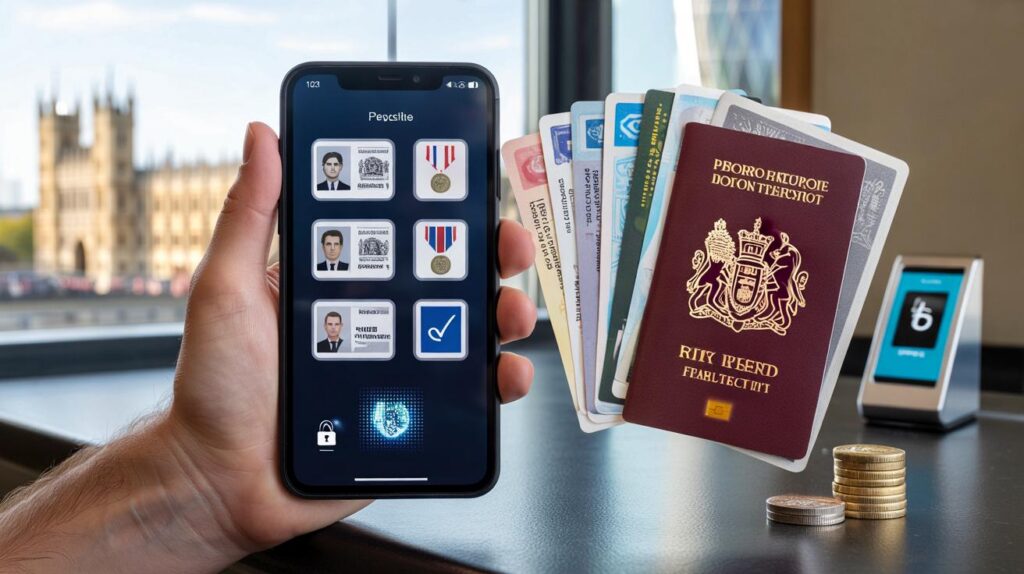
A silent shift starts on your screen, promising faster queues and fewer forms, while raising fresh questions about privacy and power.
From today, the government’s first digital credential goes live for veterans, a small but symbolic step toward putting everyday proof of identity in your phone. Ministers say the aim is convenience; critics warn of creeping control. Most people will notice little at first, yet the direction is clear: by 2027, your smartphone could stand in for most official documents.
What changes today
Digital veteran cards are now available to former members of the armed services. The rollout was unveiled at the Tower of London, where new digital credentials were shown working on standard smartphones. Attendees joked about discounts; a few wrestled with patchy connectivity. Overall, the government billed it as a proof-of-concept that ordinary people can use without fuss.
Ian Murray MP, the minister overseeing the programme, framed it as a quality-of-life upgrade. You sign in once, verify once, and reuse the credential to access support, services and concessions in seconds rather than minutes.
By the end of 2027, ministers want most government-issued ID to sit in a secure wallet on your phone.
How the app works
The digital wallet is designed to mirror how you store payment cards on your phone. The Government Digital Service, inside the Department for Science, Innovation and Technology, is building the system in-house.
- You add a credential, such as a veteran card, into a secure wallet on your device.
- Your phone’s own security—face scan, fingerprint or PIN—protects access.
- When you need to prove something, you present only what’s needed (for example, “veteran status” or “over 18”), not your full record.
- Future features could allow a quick tap at a till to prove your age without sharing your name or address.
Where your data sits
Officials stress a “federated” model: no mega-database, no single vault of everyone’s life history. Your source data stays with the agency that created it.
| Document | Data held by | Typical uses |
|---|---|---|
| Veteran card | Ministry of Defence | Housing support, mental health services, retail and museum concessions |
| Driving licence | DVLA | Driving entitlement, identity checks, car rental |
| Passport | HM Passport Office | Border control, identity verification |
| National insurance | Department for Work and Pensions | Employment, benefits, tax records |
When you verify on your phone, the credential confirms the fact—such as “is a veteran”—without exposing underlying records each time.
Mandatory checks and a political row
The most sensitive piece is employment. Number 10 has vowed to make digital “right to work” checks compulsory, part of a wider effort to tighten immigration enforcement. That shift triggered a backlash on civil liberties and data security grounds, including warnings from senior Conservatives who fear a slippery slope to universal ID demands.
Ministers say only “right to work” checks will be mandatory, because proving you can work is already a legal requirement.
Officials argue that digital credentials reduce admin for employers, cut fraud, and show which firms skip checks—no more photocopying passports or chasing old bills. They also hint that once an employee is confirmed, the digital proof could be deleted from the device. Opponents counter that once the infrastructure exists, a future government could widen compulsory use by regulation, not debate.
Security, risk and trust
The architecture leans on the security used by Apple and Google wallets, plus device-level biometrics. A federated approach limits “blast radius” if one system is compromised. Yet some experts worry about chokepoints, from sign-in services to verification hubs. Ransomware groups and hostile states target precisely these strategic nodes. The state’s response is layered security, audit trails, and minimal data sharing. The public’s question is simpler: will this make me safer and my day easier?
What this means for you
For now, only veterans see a direct benefit. Over the next two years, more documents should appear in the wallet, with optional take-up in most situations and compulsion for employment checks. The everyday experience could feel familiar if you already pay with your phone: a quick unlock, a tap, and a green tick.
- If you lose your phone: your credential should stay locked behind biometrics. You’ll need to revoke it from a new device and re-verify.
- If you have no smartphone: physical documents remain valid, and paper routes are expected to continue.
- If you’re offline: some checks may work locally on device; others will need a connection. Expect fallback routes at critical points.
- If a shop asks for age: a future tap-to-verify could confirm “over 18” without revealing your name or address.
Potential gains and risks
- Time saved: house purchases, bank onboarding and some border checks move faster when forms and photocopies disappear.
- Less data shared: verifiers see only what they need, not your entire life story.
- Fewer fakes: cryptographic credentials are harder to forge than paper.
- Concentration of risk: single sign-in systems attract attackers and can fail at scale during outages.
- Mission creep: once built, the temptation grows to expand use cases. Guardrails, sunset clauses and parliamentary scrutiny matter.
How a verification might work in practice
Imagine you’re starting a new job. Instead of emailing scans, you open the wallet, select “right to work,” unlock with your face or fingerprint, and present a QR code. The employer’s system checks the cryptographic proof against the issuing department. It stores a compliance record without copying your passport. After onboarding, you choose whether to retain the credential on your device for future use or remove it.
Or think about age checks at a supermarket. You receive a prompt to share only an “over 18” attest, verified by your device. The cashier sees a yes/no, not your date of birth. Done correctly, that trims delays and limits data exposure.
What to watch next
The rollout will widen step by step: more credentials, more verifiers, and more places where digital proofs are accepted. Trials of contactless age verification are being discussed. Expect tighter integration with border and travel systems, and a push to digitise legacy paper processes in property and finance. The big test will be public trust, especially if the employment mandate lands before most people see everyday benefits elsewhere.
The promise: less paper, fewer forms, faster checks. The test: strong safeguards, real choice, and visible wins for users.
A few pointers if you’re weighing it up. Check your device’s security settings and turn on screen lock and biometrics. Keep physical documents safe as a fallback. Before sharing a credential, confirm who is asking and what exact attribute they need. If you’re an employer, plan to integrate digital checks but maintain a manual route for those who cannot use the wallet. If you support older relatives or veterans, offer to help them install and test the new credential on a secure device.
Two ideas worth watching next year: attribute-based sharing, where you present only a single fact rather than full identity, and portable revocation, allowing you to disable a credential the moment you switch phones. Both reduce exposure and build confidence. If the government wants people to opt in, the fastest way is simple: deliver speed, guard privacy by design, and make every digital encounter obviously better than the paper version.



Finally, less paper and fewer queues—make it work at the pub for age checks and I’m sold 🙂
Right to work today, right to rent tomorrow, then who knows? This feels like a creeping mandate. Where are the hard guardrails, sunset clauses, and actual parliamentary scrutiny, not just guidance from the goverment?