
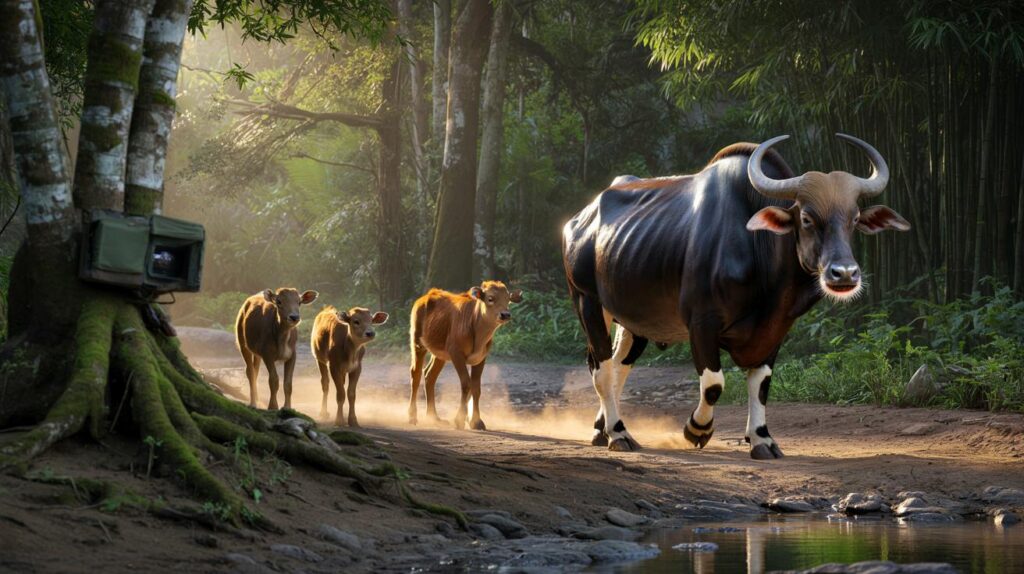
In a remote Thai forest, a motion-sensing lens captured a brief, gentle procession that sent field teams back to their maps smiling.
The short clip shows a female gaur guiding three calves along a shaded track in Huai Kha Khaeng Wildlife Sanctuary, a UNESCO World Heritage site. Conservationists hail the scene as hard evidence that years of protection are rebuilding a living, breathing landscape where large mammals can raise young in peace.
A quiet scene with big implications
Gaur, the world’s largest wild bovine, once ranged widely across South and Southeast Asia. Numbers fell as hunting, habitat loss and fragmentation took hold. Today, many countries hold only scattered pockets. Thailand stands out. Despite its limited land compared with India, it has safeguarded substantial tracts of forest that still support breeding herds.
One adult female and three calves on a single trail tell a larger story: food, space and safety exist in the right measure.
The footage, released by Thailand’s Department of National Parks, Wildlife and Plant Conservation, came from a network of trail cameras designed to watch without disturbing. Such images show that young animals are not only being born; they are surviving long enough to roam, browse and learn the forest.
Why one clip matters beyond the forest
A healthy gaur population signals a functioning ecosystem. Large herbivores shape vegetation, open paths other wildlife use and distribute seeds. Their presence tracks the condition of rivers, soils and plant communities that also sustain people.
- Clean water: intact forests feed streams and reduce costly sediment in reservoirs.
- Stable soils: deep-rooted plants and ground cover prevent landslides and erosion.
- Food security: resilient ecosystems support pollinators, wild foods and sustainable farming at the forest edge.
- Local livelihoods: wildlife tourism and ranger jobs add steady income to rural economies.
Protecting big animals is not a luxury. It is a practical way to keep water flowing, crops viable and communities safer.
Trail cameras prove their worth
Camera traps have transformed fieldwork. They log species, track behaviour and capture births and survival rates without a convoy of researchers moving through sensitive areas. Each frame becomes a datapoint for managers deciding where to patrol, where to connect habitats and where to restore grassland.
How they work, and why that matters
Units sit just off trails and trigger when movement crosses an infrared beam. Time stamps build a picture of activity patterns. Night images reveal who moves where while people sleep. Over months, researchers can estimate population trends and identify hotspots of animal traffic or human disturbance.
These tools also deliver surprises. Similar networks in Vietnam helped document the reappearance of the tiny mouse deer after decades without confirmed sightings. Proof changes budgets, plans and the urgency of on-the-ground action.
Thailand’s sanctuary strategy is bearing fruit
Huai Kha Khaeng, part of a 1.4 million-acre protected complex, links with neighbouring forests to give wildlife room to move. Elephants, tigers and many smaller species share the terrain. Rangers work to remove snares, deter poaching and reduce illegal clearing. The gaur family on camera points to more than luck; it reflects steady, long-term investment.
| Site | Designation | Size | Notable residents |
|---|---|---|---|
| Huai Kha Khaeng | UNESCO World Heritage | 1.4 million acres | Gaur, elephants, tigers, hornbills |
The gaur’s status on the IUCN Red List is Vulnerable. That label reflects ongoing risks: poaching for meat, disease spillover from cattle and shrinking habitat. Thailand’s success suggests that strong law enforcement, corridor planning and community partnerships can bend the curve upwards, even for large, space-demanding animals.
What experts look for in clips like this
Researchers read more than faces and horns. They study gait, body condition, group spacing and calf size to gauge health and breeding timing. Vegetation along the trail hints at food quality. Time of day indicates how animals adapt to heat and human presence.
- Calf count: three young with one adult female suggests successful recent breeding in nearby habitat.
- Calm movement: no signs of flight response imply low disturbance on that route.
- Forage clues: browsed shrubs and intact grasses suggest sufficient food and rest sites.
- Repeat visits: multiple sightings at the same camera help map core areas for protection.
Risks that could unravel the gains
Progress remains fragile. Wire snares set for bushmeat can maim large herbivores. Road expansion can split herds and block genetic exchange. Unmanaged livestock can carry diseases such as foot-and-mouth, which leap to wildlife. Drought intensifies competition for water and raises conflict at the forest edge.
Connectivity, clean boundaries and steady patrols decide whether a herd grows, stalls or disappears.
Managers now push for wildlife corridors that link protected blocks, strict controls on cattle inside buffer zones and rapid snare removal. Each measure reduces mortality and keeps herds breeding.
What this means for you
You may never meet a gaur, but you depend on the same services its forest provides. Watersheds power cities. Healthy soils support harvests. Biodiversity underpins everything from medicines to flood control. When a sanctuary works well enough to raise calves, it is also working for downstream towns and farms.
Simple actions that help from home
- Support field equipment drives: one reliable camera trap can generate thousands of data points a year.
- Choose products with zero deforestation claims to reduce pressure on Southeast Asian forests.
- Back insurance schemes for livestock vaccinations near protected areas to limit disease spillover.
- Visit protected areas responsibly and pay conservation fees that fund ranger patrols.
The bigger conservation picture
Wins like this often arrive in small frames: a brief clip, a single trail, four animals in step. Yet they tie into broader strategies that also benefit pollinators in farmlands and oyster reefs along coasts. Different ecosystems, same principle: restore structure, reduce pressure, give species time and space.
If you work in schools or local councils, this story fits into practical lessons on cameras, data handling and ecology. Students can set up inexpensive motion cameras in school grounds to record hedgehogs or foxes, then test hypotheses on activity peaks. The method mirrors professional projects and teaches how evidence shapes decisions.
For land managers, the gaur scene underscores the value of mixed habitats. Maintaining mosaics of grassland and forest edge supports grazers and browsers, which in turn disperse seeds. Where budgets are tight, rotating patrols to camera-verified hotspots offers a measurable return, cutting illegal activity while protecting core breeding areas.



Heartening to see protection paying off. A mother gaur with three calves in Huai Kha Khaeng means corridors, patrols, and community work are clicking—real ecosystem services for people downstream. Thank you, rangers.