
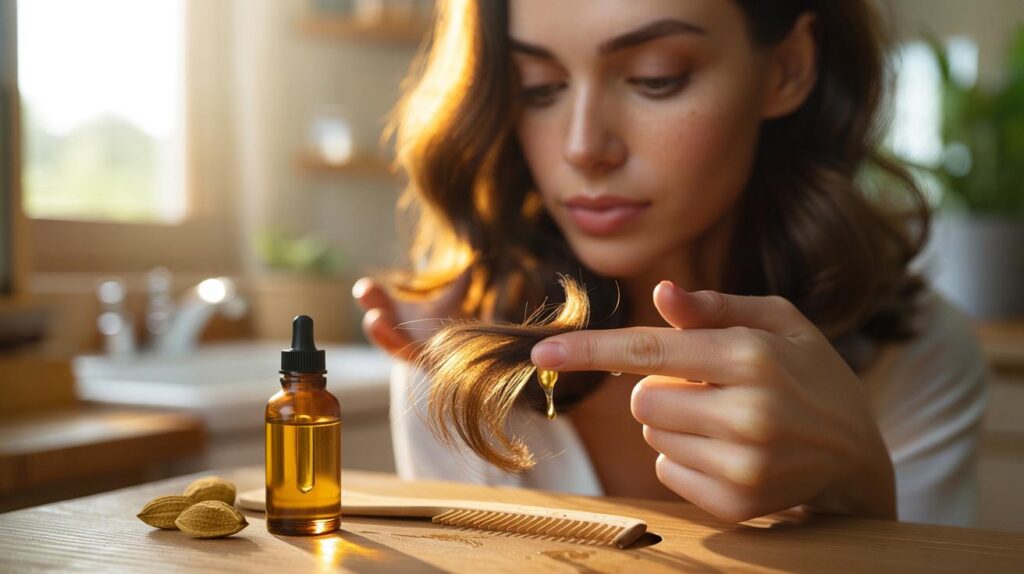
Dry ends don’t just look dull; they feel stubborn. Treating them with almond oil can bring back smooth shine and softer hair without a complicated routine or pricey salon fix.
The tube carriage was a cloud of scarves and static when I clocked it: a woman running her fingers over the last two inches of her hair, the way you do when they feel like straw. She wasn’t alone. Later that morning a friend arrived at my flat, tugged at her ponytail, and sighed, “It looks fine from far away… then the ends give me away.” I handed her a tiny bottle from my kitchen shelf. She frowned, then smiled at the scent that’s barely there, sweeter than plain. We rubbed two drops between our palms until the warmth made it silkier, and pressed it into her frayed tips. The change wasn’t dramatic like a dye job. It was honest. You could see the light bounce again. In ten minutes, her ends looked less like a warning and more like a promise. What if the fix was a nut?
Why almond oil is the small, steady answer to parched ends
Ends are the oldest part of your hair’s story. They’ve seen heat, brushes, sun, and winter radiators, and they leak moisture faster than the roots can feed them. Almond oil is a quiet counter. It’s lightweight, slightly silky, and slips along the cuticle like a friendly varnish, not a blanket. When it kisses dry ends, frizz smooths down, light reflects more cleanly, and the texture softens under your fingers. **Dry ends steal shine faster than any bad haircut.** This oil gives it back without the heavy slick.
Think of Maya, who keeps a cropped bob that sits right on the jaw. She told me her ends always puff out by 3pm, like the hair equivalent of a yawn. One afternoon in a Hackney salon, her stylist tapped two drops of sweet almond oil into his palms and pressed it through the last centimetre. No hairdryer tricks. No gloss spray. On her way out, the cut looked crisper because the ends were calm. She texted later: “Did nothing else today. Still smooth.” It wasn’t theatre. It was tidy, soft, believable.
There’s logic behind the softness. Almond oil is rich in oleic and linoleic fatty acids that help “seal” the cuticle, slowing water loss without smothering the hair. A touch of natural vitamin E plays the quiet bodyguard role against everyday stress like UV and central heating. The oil’s weight is on the lighter side, so it doesn’t swamp fine strands the way some heavier oils can. It sits on the outside, filling micro-gaps and letting light travel straighter along the fibre. That’s why the shine looks real, not glassy or greasy. It’s not magic. It’s physics and a little patience.
How to use almond oil on dry ends for smooth shine
Start with clean or just-refreshed hair. Put one to three drops of sweet almond oil in your palms, rub to warm, and tap most of it onto your fingertips. Pinch and glide over the very ends first, then feather up no higher than the last third of your hair. On damp hair, do the same, then scrunch to help curl or wave patterns perk up. If you love a night routine, braid loosely and press a drop along the braid tail before sleep. In the morning, rinsing isn’t needed; just brush or shake out and go.
Common trip-ups: using way too much, starting too high up the shaft, or rubbing aggressively. Go feather-light. If your hair is very fine, mix a drop with your leave-in conditioner to dilute the feel. Curly and coily textures can take more, but layer it—oil after a water-based cream keeps softness without crunch. Let’s be honest: nobody really does that every day. Aim for consistency over perfection: after every wash, and then a touch-up on day two if your ends ask for it. If your skin reacts to nuts, skip it and patch-test products carefully.
The best endorsement often comes from the chair.
“I treat ends like silk hems,” says London stylist Rhea James. “You don’t overload them. You mend the edge, you don’t soak the dress.”
Use this as your pocket checklist:
- Choose sweet almond oil, cold-pressed if you can, for a cleaner slip and softer scent.
- Warm the oil first in your hands so it spreads thin and even.
- Apply on the last 2–5 cm only; keep it off the roots for swing and lift.
- Layer after a water-based hydrator on curls and coils to lock in moisture.
- If heat-styling, apply a tiny amount after styling for polish, not before.
The feeling of softness you don’t have to fake
There’s a moment when your ends stop catching on your jumper and start gliding over it, and it’s oddly satisfying. *We’ve all had that moment when a photo surprises us—in a good way—because the hair looks like it belongs to someone rested.* Almond oil won’t pretend away split ends that need a trim, yet it makes the time between cuts feel kinder. It’s the sort of fix you can do half-asleep on a Tuesday, and still see the payoff in the bathroom mirror at work. **Start with less than you think.** Build a habit your hair can rely on, like hand cream for your ends.
Almond oil also plays nicely with most routines. If you’re growing your hair, it helps you keep length by protecting the fragile perimeter from snagging and friction. If you colour, apply it on the days when your hair looks matte from dye lifting the cuticle; it brings back a softer reflection without skewing tone. If you heat-style, make it the last step for polish. Don’t over-intellectualise it. You’re just giving your ends a small coat that feels like care. **Shine is a habit, not a filter.**
| Key points | Details | Interest for reader |
|---|---|---|
| Almond oil smooths and softens dry ends | Lightweight fatty acids and vitamin E create a thin seal that reduces frizz and boosts reflection | Instant polish without heaviness or salon visits |
| Use tiny amounts, applied low | 1–3 drops warmed in palms, pinched onto the last 2–5 cm, on damp or dry hair | Prevents greasy feel and keeps movement |
| Works across textures and routines | Layer after water-based products for curls; finish after heat-styling; avoid if nut-sensitive | Makes it easy to personalise and stay consistent |
FAQ :
- Can almond oil repair split ends?It can’t fuse a split back together. What it does is smooth and “glue down” the frayed edge so it looks neater and feels softer until your next trim.
- Sweet almond or bitter almond—what should I buy?Choose sweet almond oil for hair care. Look for cold-pressed, unrefined if you like a softer slip and minimal processing, or refined if you prefer very little scent.
- Will it weigh down fine hair?Not if you keep to a drop or two and stay only on the ends. Mix a drop with your leave-in or apply on freshly washed, damp hair for the lightest feel.
- How often should I use it?After each wash on the ends is a good rhythm, with a micro-top-up on non-wash days if your tips feel rough. Think of it like lip balm for hair ends.
- What about allergies and scalp use?If you have a nut allergy or sensitive skin, skip almond oil and consult a professional for alternatives. It’s best for lengths and ends, not the scalp.



Tried two drops on my crispy ends tonight—instant soft shine, no grease. Thank you for the ‘less is more’ tip! 😊