
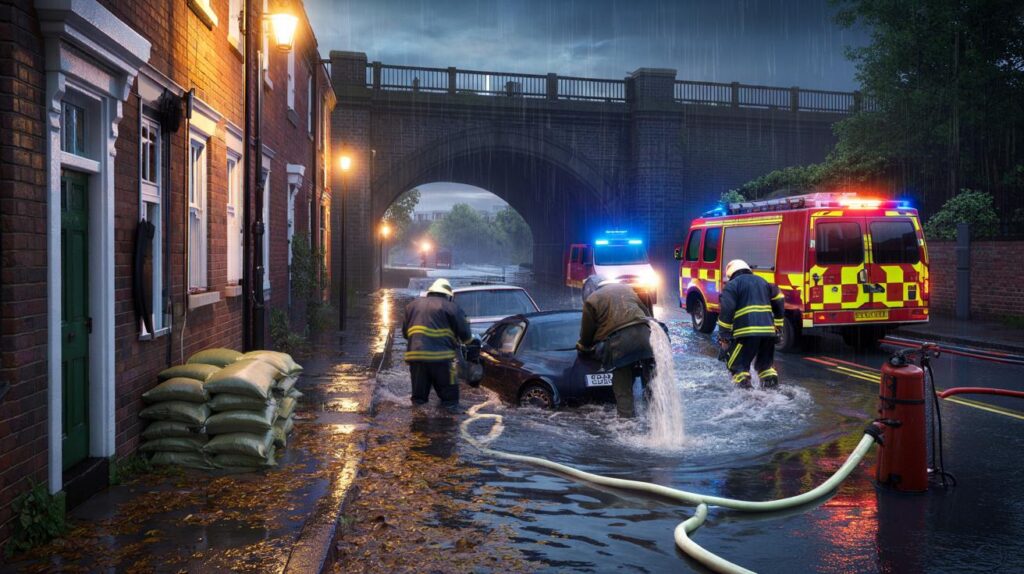
Before dawn, the phones rang, sandbags stacked up and pumps grumbled into life. By lunchtime, the water retreated, leaving questions.
Across the north west, residents woke to submerged kerbs, shuddering engines and the clatter of flood boards after more than 20 hours of persistent, wind-driven rain. As road spray cleared and river levels eased, the clean-up began, bringing a mix of relief and a renewed focus on what failed, what worked and what to do next time.
Overnight deluge swamps roads
Continuous downpours pushed drains and brooks to their limits from Saturday morning into the early hours of Sunday. Several streets in Greater Manchester, Cheshire, Merseyside and Lancashire were swamped as surface water gathered faster than it could be carried away. In Altrincham and Salford, stranded vehicles became early signs of trouble. A major standby incident was declared in Warrington as crews moved equipment and residents stacked defences. The declaration was later downgraded when water began to fall.
28 flood warnings were triggered across the north west as rainfall persisted for more than 20 hours.
In Swinton, Salford, three men were helped from a car just after 04:00 BST when rising water cut off their route. The incident underscored how quickly conditions deteriorated at pinch points where cambered roads dip and gullies clog.
Greater Manchester: cars stranded before dawn
Warnings were issued for Trafford, Stockport and areas of south Manchester, and emergency calls picked up through the night as water pooled under railway bridges and on low-lying roundabouts. The rapid response from Greater Manchester Fire and Rescue Service prevented further casualties, but crews reported multiple stalled cars and impassable side streets.
Warrington and Sankey Brook: drains tested, pumps deployed
Penketh, to the west of Warrington, experienced repeat flooding on a sloped stretch where storm drains regularly choke on leaf fall and road debris. Residents described anxiety as water crept over driveways and towards door steps, prompting a locally arranged pump to clear standing water. Around 08:00 BST, the level at Sankey Brook near Causey Bridge came within 10cm of spilling before it eased back. Sandbags were distributed door to door, and people were asked to keep clear of floodwater for safety and hygiene.
Sankey Brook edged within 10cm of overtopping at Causey Bridge before levels subsided.
Where the warnings hit hardest
The Environment Agency rolled out targeted warnings across the region as river flows and surface runoff converged. By late Sunday morning, all warnings had been withdrawn as levels dropped and the immediate hazard reduced.
| Area | Specific locations | Situation reported | Status by Sunday late morning |
|---|---|---|---|
| Greater Manchester | Trafford, Stockport, south Manchester; Swinton, Salford | Cars abandoned; 04:00 rescue of three men; numerous waterlogged streets | Warnings removed; roads reopening as standing water cleared |
| Cheshire | Warrington, Penketh; Sankey Brook at Causey Bridge | Standby incident; sandbags delivered; brook close to spilling | Incident downgraded; pumps reduced street flooding |
| Merseyside | Liverpool, Wirral | Handful of alerts; surface water on commuter routes | Alerts lifted as drains caught up |
| Lancashire | River Darwen in Ewood; Waterfall in Blackburn | River and surface water alerts; localised road closures | Levels receded; watchfulness advised |
What the agencies said and when the risk eased
A yellow warning for heavy rain was in force from 09:00 BST on Saturday until 06:00 BST on Sunday. That window saw the most sustained rainfall, with embedded heavier bursts tipping drainage networks over the edge in short, sharp intervals. The Environment Agency advised residents and businesses in at-risk zones to move valuables off the floor, prepare flood plans and avoid driving through pooled water. By late morning, river gauges across the region fell back below risk thresholds and the formal warnings were withdrawn.
All flood warnings were cleared by late Sunday morning as river and surface water levels fell.
Why drainage struggled and what it means
The worst-hit streets share familiar traits: they sit at slope bottoms, near small culverted brooks, or at junctions with ageing road gullies. During long spells of rain, silt and natural debris move into pipes, reducing capacity. If high tide or saturated ground slows discharge, water backs up onto the surface. The compounded effect is most visible at underpasses, crownless carriageways and drive entrances where thresholds are already low.
Urbanisation amplifies this pattern. New hard surfaces shed water quickly, while older sewers were never designed for prolonged, high-intensity rainfall. Penketh residents described that cycle clearly: a few hours of heavy rain can build a temporary “lake” unless pumps intervene. Similar scenes in Altrincham and parts of Salford point to a need for targeted gullies maintenance, more kerbside rain gardens and expanded attenuation basins that can hold back peak flows.
How close did rivers come to trouble?
River Darwen catchments responded rapidly, which explains alerts at Ewood and Waterfall in Blackburn. These are flashy systems with short travel times from hillside to channel. Sankey Brook’s near-overspill at Causey Bridge highlights how small changes in flow can push a gauge from caution to action. That risk dropped quickly once the heaviest bursts moved through and upstream inflows eased.
The numbers at a glance
- 28 flood warnings across north-west England during the event window.
- 20+ hours of steady to heavy rain between Saturday morning and early Sunday.
- 3 men helped from a stranded car at around 04:00 BST in Swinton, Salford.
- 10cm of headroom at Sankey Brook, Causey Bridge, before levels fell back.
- 1 regional standby incident declared in Warrington, later downgraded.
What you can do if your street floods
People living on known trouble spots can take practical steps now. Check air bricks and fit temporary covers before rain arrives. Keep a small stock of sandbags or modern water-inflating alternatives. Store key documents and chargers upstairs. Park cars on higher ground if safe to do so, and avoid driving through water where you cannot see the road surface; 30cm can float a car, and much less can stall a modern engine.
For businesses, raise stock off the floor and move electronics above skirting level. Photograph your premises before and during an incident if safe; that record can speed insurance claims. Keep a written call-out list for staff and contractors and test it once a year. Local volunteer groups increasingly share pumps and flood kits; coordinating early can shave precious minutes off a response.
Preparing for the next spell
Met Office guidance suggests more frequent, slow-moving rain bands can coincide with autumn leaf fall, a bad combination for gullies. Residents can log blocked drains with councils as soon as water starts to pond. On streets like those in Penketh, small interventions help: clearing grates, sweeping leaves before a forecast and using mesh guards to trap debris. Community flood plans can assign these jobs ahead of time rather than during a downpour.
Engineers point to a menu of upgrades that reduce risk: retrofitting porous paving on driveways, adding roadside swales, and installing check valves where sewers meet brooks. While large schemes take years, the modest measures can blunt the worst of a two-hour burst within a long, wet spell. They will not prevent every flood, but they lower the height and shorten the duration of street-level water.
Context for the north west
The region’s mix of steep catchments, dense suburbs and older drainage creates familiar pressure points from Liverpool’s terraces to Manchester’s ring roads. Saturday’s yellow warning captured that pattern neatly: long rain, brief heavier pulses and quick river responses. With warnings now lifted, attention shifts to maintenance backlogs, targeted investment and the readiness of residents who know their vulnerable patches better than any map.
Street resilience grows when small fixes, clear warnings and quick community action meet at the right moment.



Thanks to the crews for the 04:00 rescue in Swinton. Are the three men OK, and were there any other rescues across Trafford/Stockport overnight?
Twenty hours of rain and my street still thinks it’s Venice—do we get gondolas next time? 🙂 Maybe start clearing the leaf-choked grates before the yellow warning hits, yeah?