
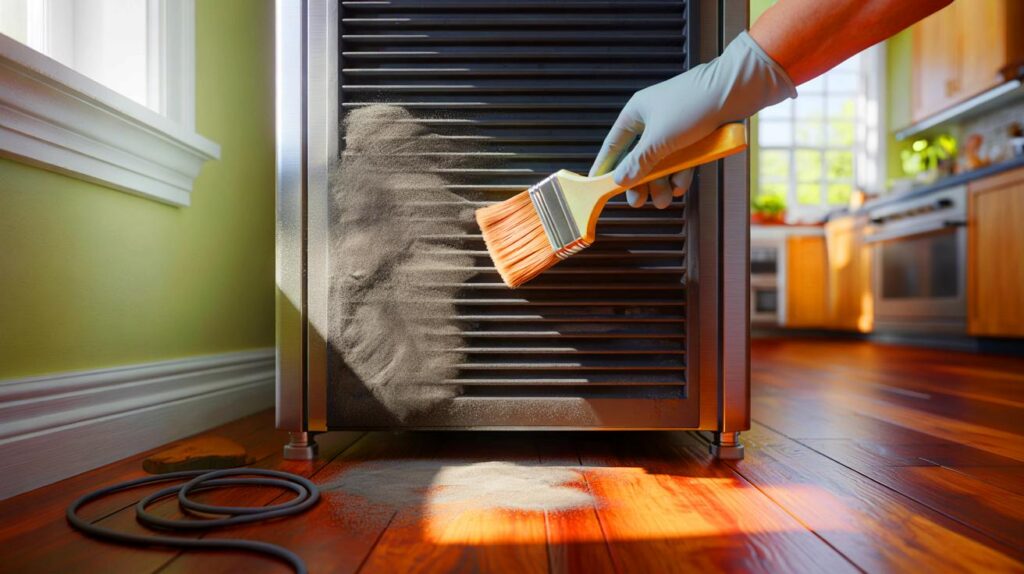
Households battling higher bills may be skipping a tiny job that steadies temperatures and quietens the kitchen hum.
Hidden at the back of most fridges is a dust magnet that quietly undermines cooling. Tackle it for two minutes and you can lower energy use, stabilise food temperatures, and reduce wear on a hard‑working appliance.
What sits behind your fridge
The metal grille on the rear, or the dark coil behind a kick panel, is the condenser. Its job is to dump heat into the room so the cabinet can stay cold. When dust, pet hair and kitchen grease carpet that surface, heat can’t escape easily. The compressor and fan run longer to compensate, the cabinet warms between cycles, and your bill creeps up.
Tests show a clogged condenser can raise electricity use by as much as 30%, while making the fridge run hotter and noisier.
Good airflow makes all the difference. Shorter run times mean steadier temperatures, fewer icy patches, and less stress on the compressor. You hear less rattle, and the sides feel less warm to the touch.
Two-minute clean: step-by-step
Safety first
- Switch off and unplug the fridge. Pull it forward gently to reach the back.
- Find the condenser: a black grille or coil at the rear, or behind a removable toe-kick at the front on some models.
- Use a soft brush or a clean paintbrush to loosen dust from the grille and around the fan. Work from top to bottom.
- Vacuum the fluff from the floor and from around the feet. Clear the wall and skirting too.
- If there’s a small cooling fan near the condenser, hold the blades and brush them clean. Spin by hand to check it moves freely.
- Avoid water or aerosol cleaners. Don’t bend the fins. Refit any panel securely.
- Plug back in. Listen for a smoother, shorter cycle. Many units run more quietly after this clean.
How often to do it
Give the condenser a quick brush one to two times a year. Homes with pets, open-plan kitchens, or nearby tumble dryers may need a monthly once-over. A calendar reminder helps.
What you stand to save
Fridge-freezers commonly use 120–250 kWh a year. A dust-choked heat exchanger that forces 20–30% extra run time can add 24–75 kWh. At a typical unit rate of 25–30 p per kWh, that’s roughly £6–£22 a year wasted on fluff. The job costs nothing but a brush and two minutes.
| Typical annual use | Extra use if clogged (up to) | Cash at 28p/kWh |
|---|---|---|
| 120 kWh | +36 kWh | About £10 |
| 180 kWh | +54 kWh | About £15 |
| 240 kWh | +72 kWh | About £20 |
Savings rise in warm weather and in compact kitchens with poor ventilation. The benefit isn’t only money. Colder, more even cabinet temperatures help food last longer and reduce ice build-up around the evaporator.
Airflow, spacing and temperature
Heat needs a clear path out of the back and underneath. Brands advise leaving a gap of at least 5 cm from the wall. Many recommend more if the sides feel hot to the touch during a cycle. Keep the top free of stacked boxes that trap warm air. Avoid placing the unit next to a cooker, radiator or sun‑drenched window.
Leave at least 5 cm around the condenser, set the fridge to 4–6°C, and check the door seals with a paper test.
- Let cooked food cool before shelving it. Steaming dishes force long compressor runs.
- Defrost a manual freezer section before ice exceeds 5 mm. Thick frost chokes evaporator airflow.
- Set the fridge between 4 and 6°C. Use a fridge thermometer on the middle shelf to verify.
- Check the seal: close a sheet of paper in the door and tug. If it slips out easily, the gasket may need cleaning or replacement.
- Open the door less often and for shorter periods. Plan what you need before you reach in.
When something is wrong
Some signs point to a deeper fault rather than a dust problem. Act early to avoid food loss and bigger repair bills.
- Constant running with warm shelves: clean the condenser, then listen for the fan. If the fan doesn’t spin, book a service.
- Hot sides and weak chill after cleaning: check spacing, then inspect the door gasket for gaps and tears.
- Water under crispers: clear the defrost drain with a pipe cleaner and warm water. Don’t poke metal into plastic channels.
- Burning smells or a rattling compressor: switch off and seek a qualified technician.
Why this tiny task matters
Refrigeration moves heat from inside to outside. Dust adds an insulating coat to the very surface designed to shed that heat. The compressor must work harder to lift temperatures across a bigger gradient. Clean metal gives heat a fast exit route, so the system reaches its setpoint sooner and rests more between cycles. The net effect is lower energy use and cooler, more stable storage.
Practical add-ons you can try next
Track the change with a smart plug that logs energy. A week of data before and after cleaning will show shorter daily run time. If you see no improvement, the fan or thermostat may be struggling. A cheap digital thermometer in the door shelf helps you keep the sweet spot around 5°C without guessing.
If you shop for a new unit, compare quoted kWh per year, not just letter labels. Modern, well‑sized models can sit under 150 kWh annually. Yet the greenest fridge is the one you already own, kept in good shape. A brush, a gap behind, and calmer habits in front of the door do most of the heavy lifting.



Wow, never knew the condenser grid mattered. Gave mine a brush, compressor noise dropped instantly. Bill impact TBD, but the kitchen hum is way lower. Thx!
30% seems… optimistic. Do you have a link to the tests you cite, or at least the conditions (ambient temp, baseline kWh, duty cycle)? I want to replicate.