
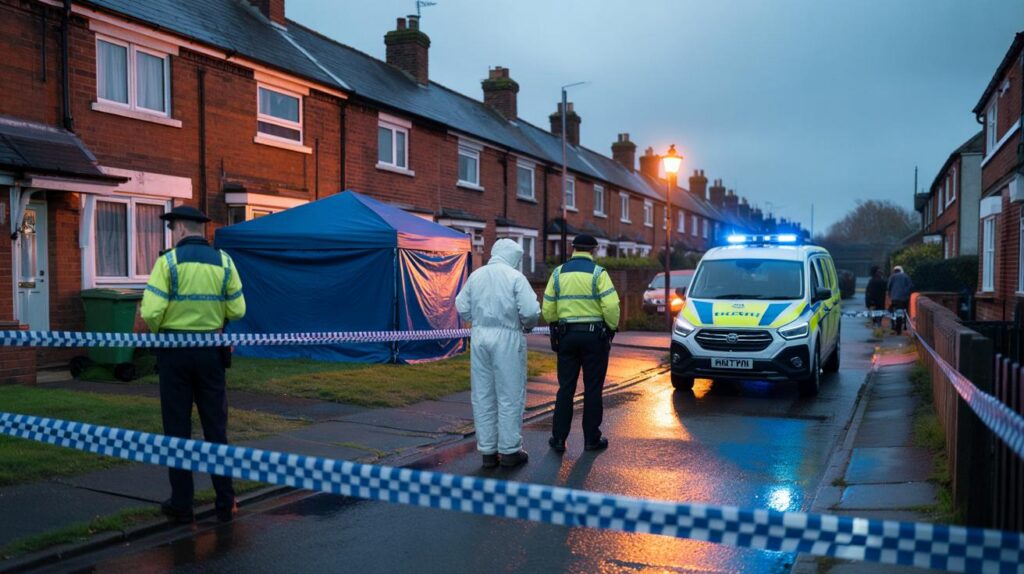
Two women have been found dead in a quiet UK town. Police have launched an investigation, a cordon has gone up, and word travels faster than the cold wind slicing down the high street. Shock sits on doorsteps like a forgotten parcel.
The morning started out like any other: bins rattled, a kettle clicked, the paperboy ghosted past terraced windows. Then blue lights swept the brickwork, and everything stopped. Neighbours stepped out in socks, pulled coats over pyjamas, and stood in the drizzle with questions they couldn’t voice.
Two women. One address. No easy narrative to hold onto. A police tent went up, the kind you only ever see on the news, and shop shutters paused halfway down as if thinking twice. And yet the birds kept singing, thin and persistent above the tape. Something felt out of place.
Officers moved with the rehearsed rhythm of people who’ve been here before. Locals watched without speaking, phones tucked away but always near. The road, so ordinary yesterday, was suddenly part of a story none of them chose. Nobody knew what to call it yet.
A town jolted awake
Late on Saturday, police confirmed that two women were discovered dead at a residential property on a quiet street. They didn’t release names, ages, or a cause. That will come later, once next of kin are informed and post-mortems speak more clearly.
What they did say was simple: the area is sealed off, a team is in place, and the investigation is “moving at pace.” In UK policing, that phrase means the basics are solid—scene secured, evidence logged, witnesses noted. Lights stayed on through the night in the incident van parked under the sodium glow.
For a town that prides itself on being uneventful, the contrast cuts deep. The school run passes the cordon. The bus to the retail park has to detour. You can feel routines buckling slightly, like a door swollen by rain. People lean into the familiar tricks—tea, gossip, small jokes that don’t quite land.
What we know so far
Officers were called to reports of concern at a mid-terrace home, a few minutes’ walk from the post office and the park. The call came from someone local, not a passer-by, which usually means the timeline will be tight. Paramedics attended and, after a few tense minutes, left quietly.
No arrests were announced as of Sunday morning. That detail matters and doesn’t. It tells you the focus is still on understanding the scene, not rushing to blame. It also leaves space for speculation to grow, which is the part that stings.
Britain records relatively few homicides compared with larger nations, yet each one lands like a shockwave. Small towns feel the impact closer to the skin. Streets are shorter, faces are familiar, and absence echoes along brick and hedgerow. Grief doesn’t have far to travel.
How the investigation will move
Over the next 48 hours, specialists will comb the property from floorboards to loft hatch. Scenes-of-crime officers work in layers, like caretakers of invisible threads. They’ll photograph, swab, bag, and label in a choreography designed to keep the story intact.
CCTV will be a big piece. Doorbell cameras, shop systems, bus feeds—this is the quiet tech that carries a town’s memories. Officers will map sightlines and times, looking for patterns: a car that looped twice, a porch light flicking on at 2.13am, a shape moving where no shape should be.
Then there’s the online picture. Timelines, messages, search histories—digital traces that tell you how a day unfolded. The aim isn’t to pry; it’s to listen to data the way officers listen to voices. When put together, these fragments can speak.
Ways you can help without losing yourself
If you live nearby and have a doorbell camera or a dashcam, check the window between midnight and sunrise. Note the exact time, even if you think it’s nothing. Save the footage to a separate file, label it clearly, and keep a copy before it loops or overwrites.
Write down anything odd you remember from the last day or two. A noise you can’t place. A delivery left at the wrong door. A car idling longer than usual. Memory smudges quickly when you discuss it in a group chat, so jot it down first, then call it in on 101. If it feels urgent or current, ring 999.
Share what you know with police, not the rumour mill. Let the professionals hold the centre while the rest of us steady the edges. We’ve all had that moment when the street looks the same, but your gut says it isn’t.
“We are keeping an open mind, and we will be here as long as it takes. You’ll see extra patrols in the area—come and talk to us,” a senior officer told locals.
- Contact police via 101, quoting the incident reference on the cordon signs.
- Submit footage through the force’s online portal if available.
- Prefer to stay anonymous? Call Crimestoppers on 0800 555 111.
- If you’re struggling, talk to your GP or a local support charity.
Common mistakes people make when they mean well
Posting theories on Facebook feels helpful in the moment, but it blurs the view for people doing the careful work. Screenshots travel, bump into each other, and get treated as facts by tired eyes at 2am. Take a breath before you hit share.
Don’t knock on the door of the house next to the cordon. Don’t film kids walking past the tape. Don’t corner the one neighbour who talks to everyone and ask them to talk for everyone. Let’s be honest: nobody does that every day.
Check on the people who’d never ask—older neighbours, the person living alone at the end of the terrace, the shop worker who cycles home after dark. Keep routines where you can, because routines hold a town together when headlines pull it apart. **Small kindnesses travel faster than fear.**
What to expect in the days ahead
Police will likely hold the scene until forensic work is complete. Post-mortems will take place, and family members will be supported away from public view. The next official update might come by press release or a brief statement on the pavement.
You might see flowers appear along the railings. Cards taped to the lamppost. A pause in conversation outside the bakery that lasts a second longer than normal. Grief in a small place wears a human face, and it doesn’t need a stage to be real.
As the picture sharpens, questions may narrow rather than fade. People will try to shape sense from fragments, because that’s what people do. **The truth doesn’t rush, but it does arrive.**
Quiet places, big questions
The phrase “quiet UK town” hides as much as it reveals. These places are rarely sleepy; they’re layered with the soft friction of daily life. Work, school, buses, cups of tea, and the rhythm of pavements scrubbed clean on Saturday mornings.
When something devastating happens, it doesn’t change a town’s character overnight. It exposes the threads that were always there: care, habit, neighbourliness, and the awkward, stubborn dignity of letting facts lead. **No one here wanted their street on the map for this.**
Maybe that’s why people step toward each other, not away, when the sirens fade. They gather near the cordon and talk quietly about normal things, because normal things are a kind of promise. The promise that life won’t be defined by the worst day it’s asked to carry.
Where the story goes from here
There will be more detail. Names, lives, a clearer timeline, and a picture that isn’t just tape and tents. It will arrive in pieces—an update from the force, a coroner’s note, a court date if charges follow. Not all of it will be easy to read.
What matters in the meantime isn’t passive waiting. It’s the practical acts that keep a place humane: holding back from guesswork, sharing what you know with the right people, offering company to those who need it but won’t ask. Stories spread; care should, too.
None of us owns the truth of what happened in that house. The most honest thing we can do is make space for it. When it comes, let it land with the dignity it deserves.
A wider look at safety without panic
Safety isn’t a headline; it’s a practice stitched into days that look uneventful. Keep front doors and side gates locked, lights on timers if you’re out, curtains closed at night if your room is street-facing. These are quiet habits, not fear.
Talk with your kids about routes home, who they’d call, where they’d wait if a lift runs late. Share numbers with neighbours you trust, not because you expect the worst, but because the ordinary is easier with company. It’s not about fortifying; it’s about knowing who’s on your side.
If the news leaves you raw, turn it off for an hour and step outside. Walk to the park, pick up milk, wave at the bus driver who always nods back. New information will be there when you return. Your nervous system will thank you.
What this says about small towns today
Two women found dead in a quiet UK town is the kind of line that lands heavy on a screen, then sits with you all day. It asks how a place that felt ordinary yesterday can feel tender to the touch now. The truth is, both can be true at once.
Small towns are not naive. They know about grief in practical terms, and about solidarity that doesn’t need a poster. The best answers come slowly and clearly, from people whose job is to be patient on our behalf. That patience is a quiet kind of courage.
When people share space—streets, buses, chip shops—they also share responsibility. Not to police each other, but to keep a shape to the day while the hard work happens out of sight. If that sounds unglamorous, that’s because it is. It’s also how the centre holds.
| Key points | Details | Interest for reader |
|---|---|---|
| Two women found dead | Police confirmed discovery at a residential property; next of kin being informed | Sets the reality and gravity of the situation |
| Investigation launched | Scene secured, forensics working, CCTV and witness appeals underway | Explains what’s happening now and what to expect |
| How to help | Provide footage, note details, report via 101 or Crimestoppers; avoid rumours | Gives readers concrete steps and boundaries |
FAQ :
- Are police looking for anyone?Officers say they are keeping an open mind. If a suspect is identified as outstanding, they will issue a public alert.
- Is the area safe to walk through?Police have cordoned off a specific zone. Outside that perimeter, life continues with extra patrols and visibility.
- How long will the cordon stay up?For as long as forensic work requires. That can range from hours to several days, depending on complexity.
- What should I do if I have CCTV?Save a copy for the relevant window, label it with the exact time, and submit it via the force portal or call 101.
- How can I talk to my kids about this?Keep it simple and honest, focus on what adults are doing to keep people safe, and invite questions without guessing at answers.



Heartbreaking news—thinking of the families and everyone on that street. Please don’t feed the rumour mill; what feels like “help” can really hurt. If you’ve got cam footage, save it properly and send it in, not to WhatsApp. Small kindnesses matter: check on older neigbours, bring milk, keep routines. This occured in their home; they deserve dignity.
Have police given an exact timeframe yet (midnight to sunrise, or narrower)? I’ve got a doorbell cam but the timestamps drift; is there guidance on syncing time so footage is actually useful? Also, is there an incident reference number we should quote beyond what’s on the cordon signs?