
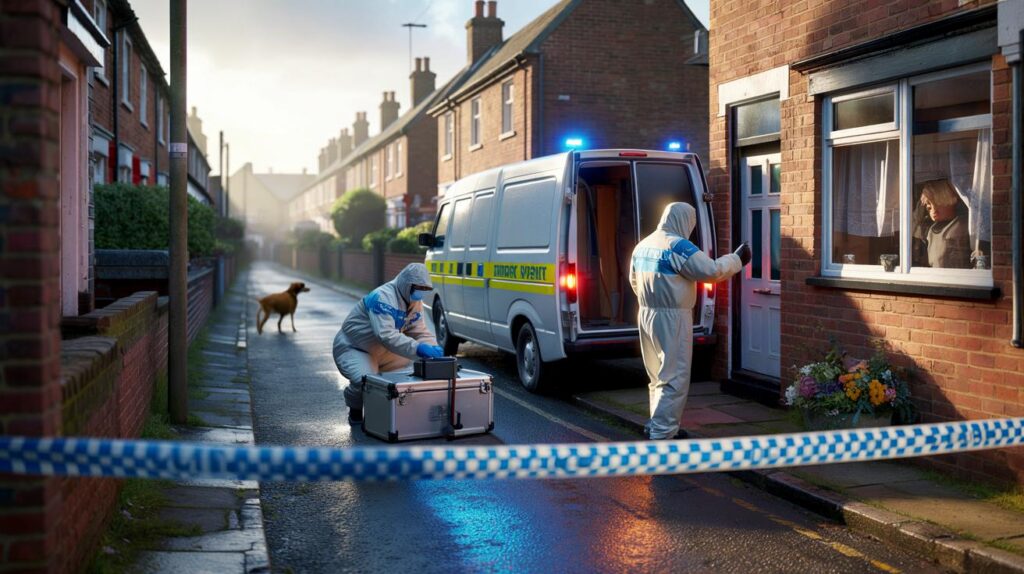
A quiet commuter town woke to blue lights and questions after two women were found dead, prompting a major police investigation and a community searching for calm in the churn of uncertainty.
It starts with a hush. Morning light on redbrick terraces, the clink of milk bottles, a dog sniffing at a low garden wall. Then the blue tape appears across a side street and everything narrows to the sound of radios and footsteps.
A forensics van rolls to a stop. Officers lift silver cases as neighbours peer through curtains they never usually touch. A kettle steams in one window, forgotten mid-boil. People speak softly, as if the street itself might overhear. The air feels thinner, like the road is holding its breath.
Somebody leaves flowers by a lamppost. Another checks their phone, then checks it again. We’ve all had that moment when a familiar place suddenly feels different. Then the silence breaks.
A small town jolted
The facts are stark. Two women have been found dead in a quiet UK town, and police have launched an investigation that now defines the day’s rhythm. A street that’s usually about school runs and parcel drops has a cordon at its centre.
Officers in white suits move with practised calm, photographing doorways, knocking politely, taking names. This is a community in shock. It’s visible in the way conversations stop when an officer passes, in the way people look down at their shoes when the news crews arrive.
At 7am, commuters were redirected around the cordon. A postie rerouted her round, letters shuffled to tomorrow. A dog walker paused at the tape and took the long way home. The corner shop kept the radio low, as if turning the volume down might slow the news.
There are no names here, not yet. Just a cluster of addresses and a timeline taking shape. Police tend to move through a careful sequence: preserve the scene, speak to immediate neighbours, gather CCTV and dashcam, start door-to-door enquiries. Post-mortems will follow, then the grim, painstaking work of matching fragments to fact.
People ask if there’s a broader risk. That’s a fair question when ordinary life starts feeling fragile. For now, investigators keep their language measured: they’re keeping an open mind, they’re piecing together movements, they’re asking witnesses to come forward. It’s the quiet grind that actually brings answers.
What we know, what we don’t—and what helps
In the first 24 hours, information tends to arrive like rain on windscreen glass: scattered, streaked, hard to read. One practical move is to focus on verified sources. Your local police force’s feed, its newsroom page, the council’s channels, trusted regional reporters on the ground.
Hold off on the urge to share that uncaptioned clip or the blurry screenshot from a friend of a friend. Misinformation never sleeps, and it’s relentless when fear is involved. Take a breath, ask what’s confirmed, and remember that every post has a ripple. Facts travel slower than rumours, but they travel better.
There’s also what not to do. Speculating about names, posting unblurred house numbers, copying images of people who haven’t been arrested—these are lines best not crossed. Let’s be honest: nobody does that every day. So it helps to name it, out loud, and choose care.
“Early information is rarely the whole story.”
- Follow official updates from the local police force and council channels.
- Share appeals for witnesses or footage, not hearsay.
- If you have dashcam or doorbell video from nearby streets, note the time window and contact police directly.
- Support neighbours quietly—tea, lifts, a check-in—without prying.
- Call 101 with information, or contact Crimestoppers anonymously if you prefer.
It’s worth stepping back from the swirl to glimpse the broader picture. ONS data shows most homicide victims know the suspect, and women are more often harmed in a domestic context than in a random street attack. That doesn’t settle this case. It does suggest caution with narratives that sprint ahead of evidence.
Police will test house-to-house accounts against CCTV timestamps, phone data, and forensics. Witness memories drift; cameras don’t. Each bit of footage is a thread. Pulled together, they make a map—who walked past, who didn’t, which car lingered, which didn’t exist at all outside a rumour.
People remember the night differently. A slamming door becomes a bang. A siren two streets over becomes proof of something it never touched. What helps most is detail: time, place, sound, weather. Small things are big in an investigation like this. So write it down before it blurs.
The days ahead
The first day is shock. The second is questions. Then the days widen, and the story settles into something harder: patience. There will be post-mortem results and appeals, perhaps a vigil, certainly many cups of tea. Grief sits in ordinary things—school shoes on a mat, a bus stop left quiet.
On the edges of the cordon, normal life keeps nudging forward. Bins go out. A cat stares from a windowsill, bored of the uniforms. People still need milk, lifts, a joke about the weather. The investigation is active and ongoing. All the while, officers work in long, quiet loops, speaking to the same people twice, testing the same assumptions three times.
Criminal investigations are slow because they have to bear weight. A charge needs more than a feeling; it needs a chain of proof. That’s cold comfort on a warm afternoon. Still, this is how a shaken town finds its way back to itself—through care, restraint and the stubborn, unflashy work of getting things right. It’s not fast. It is steady.
| Key points | Details | Interest for reader |
|---|---|---|
| Two women found dead | Police have launched an investigation and secured a cordon | Understand why the area is sealed and what happens next |
| What helps now | Follow official updates, share appeals, send verified footage | Practical steps to support the investigation without harm |
| What to avoid | Speculation, naming, sharing unverified images or addresses | Protects victims, community, and the integrity of evidence |
FAQ :
- Are police treating the deaths as suspicious?Officers have opened an investigation and are keeping an open mind while post-mortems and forensic results come in. Language tends to stay cautious until evidence sets a clear direction.
- Is there a wider risk to the public?That assessment is made by detectives on the basis of evidence, not rumour. If police see a broader threat, they will say so and change patrols, advice and alerts accordingly.
- How can I share information safely?Call 101 with the time, place and what you saw or heard. If you have dashcam or doorbell footage, note the time window and location. You can also contact Crimestoppers anonymously.
- What actually happens at a forensic scene?Scenes are photographed, mapped and logged. Specialists collect trace evidence, bag and label it, then maintain a chain of custody so that anything used in court is solid and challenge-proof.
- What can I do for neighbours who are upset?Simple things matter: a text, a brew, a lift to the shops. Keep questions gentle and private. Facts will matter more than rumours. Give people room to talk—or not talk at all.



Any update on risk to the public?
Can we plese stop the guesswork? Sharing blurry screenshots and “a mate said” DMs does more harm than good. Stick to police updates, not hearsay. Let the team gather CCTV, forensics and statements—facts before fear.