
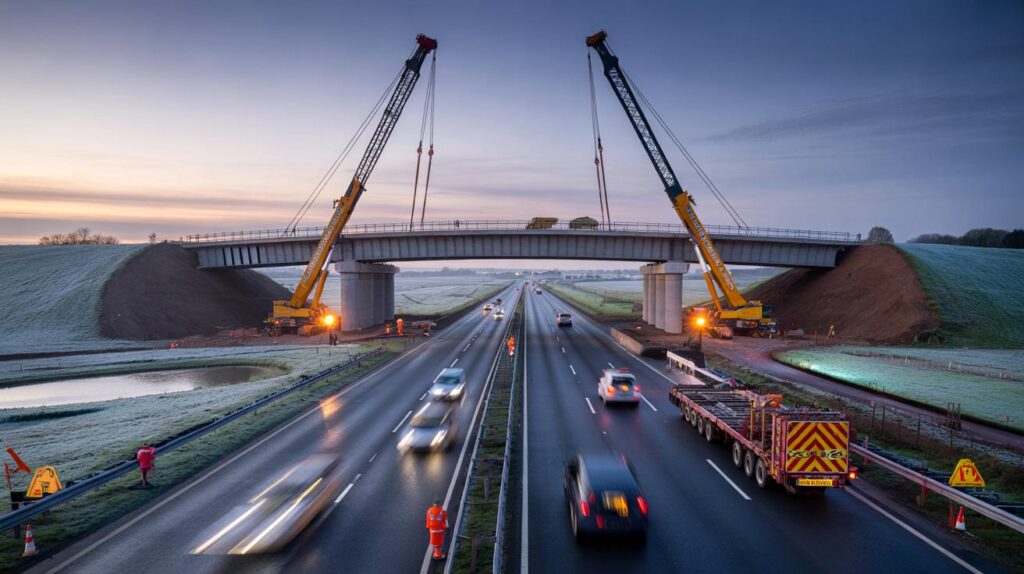
The UK’s £1bn A428 Black Cat to Caxton Gibbet upgrade just hit a scene-stealing moment: the first giant bridge beams now span the A1. It’s the kind of milestone that flips a project from drawings to reality. The question on thousands of drivers’ minds is simple and human — what changes now, and when will everyday journeys finally get easier?
I was standing on the verge just before dawn, breath ghosting in the cold as two cranes squared their shoulders against the sky. A steel beam eased into place, inch by careful inch, while a small crowd of orange hi-vis jackets watched like parents at a school play. *You could feel the thud drum through the ground when the pins locked home.*
Someone behind me whispered that this span will carry a piece of the new junction where the A1 and A421 knot will finally be untangled. Cars hissed past in the half-light, drivers curious, a few filming through windscreens. The night crew stepped back, and the shape of the future was suddenly, undeniably there. A short, clean line of progress.
What just changed — and why it matters
The A428 scheme has often felt like an abstract promise. Today it looks like a road. **The £1bn project has crossed a landmark: the first bridge beams are now up at the Black Cat junction.** This is the structural heartbeat of the upgrade, the point where decades of congestion between Bedford and Cambridge start to loosen.
For years, the stretch between the A1 and the A14 has been a patience test — single carriageway bottlenecks, spillback at peak times, every breakdown causing a chain reaction. Crews have been moving earth, shifting utilities, pouring foundations for months. Now, with beams in, we’re into the visible bit: decks, ramps, the elegant sweep of slip roads carving through what used to be flat fields.
Here’s what that actually means. The project’s three new junctions — Black Cat, Cambridge Road, and Caxton Gibbet — need 18 bridges and structures to knit the new dual carriageway into the network. Beams are the turning point where ground works hand the baton to span works and surfacing. From this point, overnight closures will bring more lifts, and then the first traffic switches as lanes move onto temporary alignments. That’s when everyday life starts to feel the change.
What drivers can do next — and what’s coming on site
Start treating the corridor like a living site map. Map apps are useful, but the most reliable prompts will be the big yellow signs at approach roads and the project’s weekly traffic updates. Note the overnight windows for beam lifts and surfacing runs, then aim to travel either before 9pm or after 5am when feasible. A simple shift of 20 minutes can avoid the queue tail.
Let’s be honest: no one actually reads every traffic bulletin. Pick one source and stick with it — the project’s email alerts or a single live-traffic app. If your commute crosses the A1 near Black Cat, bank a fallback route now and test it once, not on the day you’re late for a shift. We’ve all had that moment when the sat-nav reroutes you onto a farm track and your heart sinks.
On site, crews will move fast now that the first spans are in. Expect more pre-cast beams arriving at night, followed by deck pours, parapets and waterproofing.
“This is the phase people notice,” a site manager told me, helmet tilted back against the glare. “You’ll see bridges grow week by week. Then we switch traffic, build the new lanes, and the journey time savings start to land.”
Here’s the near-term rhythm they’re working to:
- Night beam lifts and short, sharp closures around junction works
- Progressive traffic switches to free space for building the new carriageway
- Surfacing, drainage, and safety barrier installations through spring and summer
- Landscaping and noise bunds toward the end, when the heavy lifting eases
The bigger picture — time, trees, and the pay-off
Stand on the footpath near Roxton and you can trace the line of the future dual carriageway by the way the land slopes are sculpted. In traffic terms, the prize is straightforward: fewer tailbacks and a cleaner run between the A1, the A421 and the A14. Early modelling suggests peak journeys could drop by minutes that feel bigger than they sound, because they come off the most stressful parts of the day.
There’s a quieter layer to this too. Crews are threading new drainage ponds and wildlife crossings into the blueprint, along with thousands of native trees to wrap the road as it settles into the landscape. Noise barriers will soften the edge for nearby villages, and the new alignment means fewer right-turn conflicts and fewer nasty surprises at dusk. It’s the unglamorous safety work that pays off long after the ribbon-cut photos.
There will be friction. Night closures, flashing boards, that odd feeling when you drive an old lane that’s been nudged a few metres to one side. **Next comes the traffic switch that will change your commute.** The advice from engineers is not dramatic: slow the approach, follow the temporary white lines, and trust the marshals wearing head torches at 2am. These months are the last steep climb before the view opens out.
How to get the best from the changes
Use the “two-clock rule.” Check two times each day: first thing in the morning, then again 45 minutes before you set off. That captures any late notice closures or weather shifts. If your workplace is flexible, slide your start window by 30 minutes either side for the next few months. A small tweak beats a long sulk in stationary traffic.
People often overcommit to a single route out of habit. Try an A/B plan: your usual route unless it turns red on live maps for more than 15 minutes, then a pre-tested alternative. If you’re ferrying kids or making a hospital appointment, print the detour in big type and tuck it in the visor. Sounds old-school. Works under pressure.
Keep an eye on the junction names and you’ll feel less lost when the signage shifts.
“We phase changes so drivers face one new thing at a time,” says a traffic lead on the project. “First a closure, then a layout tweak, then the switch. Never three on the same night.”
- Watch for new lane markings near Black Cat — they’ll lead you into the temporary alignment.
- Overnight heavy-lift windows usually run 9pm–5am, midweek rather than weekends.
- Speed limits in works zones sit at 40 or 50 mph for a reason — the road geometry is different.
- If you tow or drive a high-sided vehicle, give yourself a wider margin near beam deliveries.
What this means beyond the next junction
There’s a wider map behind the cranes. The A428 fills a stubborn gap in the corridor between Cambridge, Bedford and on toward Milton Keynes, where tech parks, labs and logistics hubs trade in minutes as much as money. A smoother east–west run frees up the A14, shortens freight trips to the ports, and makes school runs a touch less tense for families in the villages that have been absorbing the overspill.
Not every gain is dramatic. Sometimes it’s just the knowledge that if you leave at 7:40 you’ll actually arrive by 8:10, not 8:35. Reliability has a way of shrinking the day’s edges. When a road finds its rhythm, cafés open earlier by choice, deliveries hit the same bay each time, and local businesses can plan rotas without crossing fingers.
There will be debates — about land take, about how much traffic a new road can attract, about the pace of the green transition. Those conversations have a place. For the people easing through cones at midnight this week, the focus is simpler and very human: get the beams in, pour the decks, line the lanes, and switch the traffic cleanly. The milestone that just happened isn’t the finish line. It’s the moment the project stopped being theoretical and started changing how tomorrow will feel.
| Key points | Details | Interest for reader |
|---|---|---|
| First bridge beams installed | Beams now span the A1 at Black Cat junction | Proof the project is moving into a visible phase |
| What’s next on site | More beam lifts, deck pours, overnight closures, traffic switches | Helps plan commutes and avoid delays |
| Why it matters | Faster, safer east–west trips and less peak-time stress | Everyday journeys get quicker and calmer |
FAQ :
- What is the milestone everyone’s talking about?The first major bridge beams have been lifted into place at the Black Cat junction, marking the start of visible structure-building on the £1bn A428 upgrade.
- When will the new dual carriageway open?Main works are in full swing, with phased traffic switches over the next year and completion targeted from 2026 into 2027 for final touches.
- How much time will this actually save me?Peak journeys between the A1, A428 and A14 are expected to drop by several minutes, with bigger gains in reliability during the school run and evening rush.
- Will there be lots of night closures?Yes, short overnight closures will drop in for beam lifts and surfacing. Most run midweek, roughly 9pm–5am, to keep daytime traffic moving.
- Is this road going to be tolled?No. This is a National Highways upgrade of the strategic road network, not a toll scheme.



Seeing the first beams over the A1 feels like the moment drawings turned into road. Finaly! Do we have a firmer date for the first traffic switch near Black Cat, or still “over the next year”?
£1bn for “several minutes”—is that really the pay‑off? Induced traffic is a thing. How was that modeled, and will you publish post‑opening air/noise data for Roxton etc., not just the glossy brochures? Also, was the carbon caluclated transparently?