
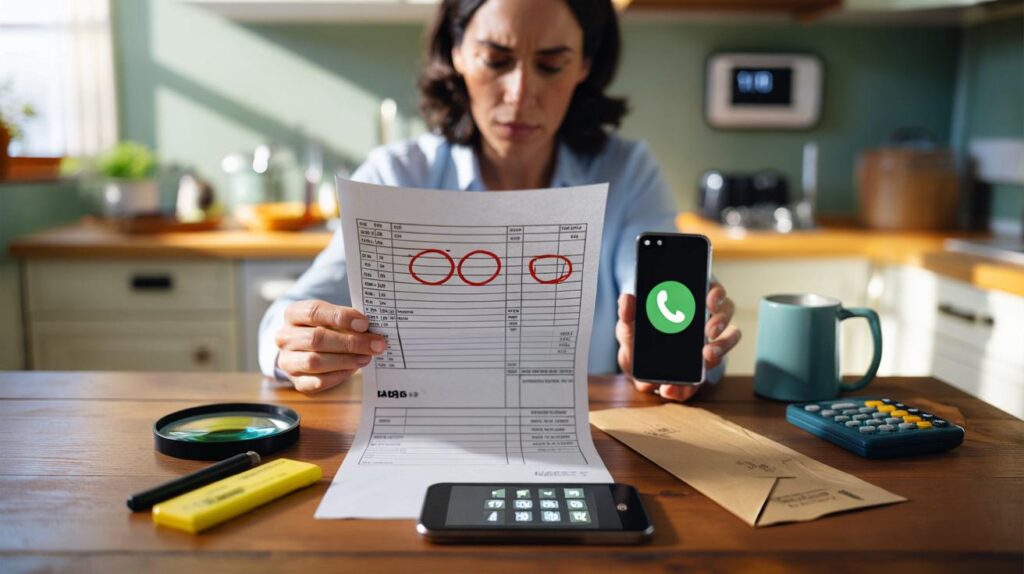
An unexpected utility bill can make the whole week tilt. Numbers you don’t recognise, dates that don’t add up, a total that stings. Before you pay or panic, there’s a calm way to read the statement, spot errors, and challenge it properly.
It starts in a quiet kitchen. Steam rising from a mug, the rip of an envelope, and that cold lift in your chest when the figure blinks back. You replay the month: you were away, the heating was low, the lights were off. The sum still doesn’t make sense.
You call the number on the bill and a recorded voice loops through options. On hold, you notice a tiny line for “estimated”. A code you’ve never seen. A tariff name that sounds unfamiliar. It feels personal, like the numbers are pointing a finger. The kettle clicks, the wait music drones, and a thought lands heavy.
What if the mistake isn’t yours?
Spot the tell‑tale signs on your bill
A bill is a story in columns: dates, reads, unit rates, standing charges, tax, and one‑off credits. Read it like a detective. Circle the period covered, then check whether readings are “A” (actual), “E” (estimated), or “S” (smart). Estimated reads are guesses; they can stack quietly for months.
Next, find the tariff name and unit rates in pence per kWh (or per m³ for water). If your unit rate or standing charge jumped mid‑cycle, note the exact date. **Check the meter serial number on your bill matches the one on your wall.** If they differ, you might be paying for someone else’s usage.
Here’s a very ordinary story. Sarah in Bristol opened a £412 energy bill after a meter swap. Her usage looked like a cliff edge. On the third read, she spotted it: the new meter ID hadn’t been updated, and the supplier had estimated from the old device’s final figures.
She took a photo of the new serial, sent it along with the date of the engineer’s visit, and asked for a full rebill using actual reads. The total halved. Regulators see tens of thousands of complaints like this each year; the pattern is rarely exotic. It’s admin, data, and timing.
Errors creep in through common doors. Estimated reads fill gaps when a smart meter drops to “dumb” mode or when no one submits numbers. Economy 7 and time‑of‑use tariffs can be misbilled if day and night registers are flipped. Gas bills have a conversion step from m³ to kWh; one wrong factor and the total skews.
Billing systems also mis‑prorate when tariffs change mid‑month, or when move‑in dates aren’t aligned with opening reads. Back‑billing rules limit charges older than 12 months in many energy cases, especially if the supplier was at fault. Knowing these levers is half the fix.
Check, record, and build a clean case
Start with evidence. Take clear, timestamped photos of your meter face, including the serial number and each register. If you have a smart meter, grab a screenshot from your in‑home display or app showing daily usage. Then lay your bill beside last month’s and compare unit rates, standing charge, and VAT line by line.
Match the bill’s meter serial to the physical label. Confirm the billing period against when you actually lived there. If you’re on Economy 7, note which register changes overnight by taking two photos 12 hours apart. For water, record start/end meter reads in m³. For broadband, highlight any new add‑ons or mid‑contract price rises you didn’t agree to in writing.
Common pitfalls snare busy people. Folks overlook a tariff that ended quietly, letting you roll onto a pricier standard rate. Standing charges creep up and hide behind a familiar headline rate. Direct debits mask true usage, leaving a deficit that explodes after a review. Let’s be honest: nobody checks their meter every week.
Keep a tiny log: dates you called, names you spoke to, and what was promised. If you’ve been away or your usage was unusually low, keep travel receipts or photos. If you’re vulnerable or on the Priority Services Register, note that upfront; suppliers must factor that into how they handle your case.
You don’t need to be a lawyer to write a strong complaint. Lead with facts, attach your photos, and ask for a specific remedy: a rebill from actual readings, removal of an erroneous fee, or application of back‑billing rules. Below, copy the tone that lands best.
“Please treat this as a formal complaint. The meter serial on my bill (XXXXXXXX) does not match the meter on site (YYYYYYYY). Actual photographs dated [dd/mm] are attached. Please rebill from these reads, freeze the disputed amount, and confirm a revised balance within 10 working days.”
- Attach: meter photos, tariff confirmation, occupancy dates, engineer visit notes.
- Ask for: a complaint reference number and the supplier’s written timeline.
- Request: freeze on the disputed portion and no collections activity while it’s reviewed.
- Escalation path: after 8 weeks or a deadlock letter, take it to the Ombudsman.
- Keep it tight: one page plus evidence beats a rambling essay.
Appeal routes and what fairness can look like
There’s a rhythm to getting this fixed. First, complain in writing to the supplier and ask for a complaint reference. Add your evidence, say what you want changed, and set a polite deadline. If they call, ask them to summarise decisions by email so you have a trail.
Energy cases that stall after eight weeks, or reach a stand‑off, go to the Energy Ombudsman. It’s free, and the supplier must follow any remedy. Water complaints head to CCW for help, and then to the Water Redress Scheme. Broadband and mobile disputes go to an ADR scheme: Ombudsman Services or CISAS, depending on your provider.
Where the maths is wrong, seek a rebill from actual reads. Where the account was on the wrong tariff, ask them to apply the correct rates from the date it went astray. **Back‑billing rules can wipe charges older than 12 months when a supplier failed to bill or made repeated mistakes.** If you’ve paid late fees that stem from their error, ask for those back too.
We’ve all had that moment where the bill lands and your stomach drops. A fair process lets you breathe again. Some wins are straightforward: wrong serial, wrong rate, wrong dates. Others take patience: a meter accuracy test, a smart meter reconnect, a new bill built from scratch.
Share what you learn with a neighbour. Photographs today save arguments tomorrow. If you’ve never looked at your unit rate or standing charge, do it once this week. **Never pay a disputed amount in full if you’re formally challenging it and the supplier has agreed to review.** A small pause can stop a big problem rolling.
Numbers can be cold, but resolution feels human. Your evidence tells a clean story. Their system fixes the sums. Somewhere in the middle, there’s a bill that reflects real life, not a glitch in a database. That’s worth chasing, and it’s more doable than it looks.
| Key points | Details | Interest for reader |
|---|---|---|
| Match the bill to reality | Check actual vs estimated reads, serial numbers, dates, and tariff names | Quick checks that catch the majority of costly mistakes |
| Build a simple evidence pack | Timestamped meter photos, usage screenshots, occupancy proof, call log | Makes your case clear and faster to resolve |
| Know the escalation path | Supplier complaint → 8 weeks/deadlock → Ombudsman or ADR scheme | Free, binding outcomes without needing a solicitor |
FAQ :
- How do I tell if my energy bill is estimated?Look for “E” next to readings or wording like “Estimated read”. “A” means actual and “S” smart. If it’s estimated, submit current photos and ask for a rebill.
- Can I get old charges wiped?In many energy cases, back‑billing rules limit charges older than 12 months when the supplier was at fault. Ask for these rules to be applied and request a corrected bill.
- What if my smart meter stopped sending data?Take manual photos of the registers, note the date, and include an in‑home display screenshot if available. Ask for a smart meter comms check and a rebill from your photos.
- Who do I go to if the supplier won’t fix it?After eight weeks or a deadlock letter, energy goes to the Energy Ombudsman. Water goes via CCW then WATRS. Telecoms go to Ombudsman Services or CISAS, depending on your provider.
- Should I keep paying while I dispute?Pay what you believe you owe based on actual reads, and ask the supplier to freeze the disputed balance while they review. Get that agreement in writing.



Super clear guide—took photos, matched serials, and finally spotted the “E” on my reads. Submitted everything and asked them to freeze the disputed bit. Two days later, they admitted the tariff change was mis‑prorated. Saved me £96. Thank you! 🙂
This sounds straightforward, but my supplier kept “reviewing” for 10 weeks. Ombudsman helped, yet it still dragged. Any hack to force a written timeline sooner? Their “estimated” reads piled up for a year—was that even leagl when the smart meter was sending data half the time?