
Wet towels eating up the radiator. A door that swings, closes, sighs — and never works for you. If your bathroom feels permanently short on space, the answer is often the least glamorous surface in the room: the back of the door. Turn that blind spot into storage, and your mornings start calmer.
Steam ghosted the mirror while the shower ticked down to silence. One towel was looped over the basin, another bunched on the floor, and the radiator looked like a fabric sculpture — hot, crowded, and useless at actually drying anything. I watched my partner do that familiar dance: grab one towel, lose the other, open the door, shuffle, curse, then give up and leave it all where it fell. We’ve all had that moment when domestic chaos wins by a nose. Then I noticed the blank canvas behind the door, tall as me and doing nothing. The answer hangs behind you.
Most UK bathrooms are small, so every square centimetre has to pull weight. The back of the door is vertical real estate that rarely gets used, which is a shame because it’s perfectly positioned near the shower and airflow. A simple over-door rack or a set of slim hooks can turn a dead zone into a tidy, drying station. Make the door work twice.
In a Hackney flat with a bathroom barely two metres by two, a family of three swapped the wobbly radiator pile for a three-bar over-door rack. It took ten minutes. Towels stopped smelling “swim lesson” and started drying between showers. The average British bathroom sits somewhere around 4–5 square metres, which means wall space is often a fight. The door wins because it was never in the ring.
Why does it work so well? Doors move, which creates small gusts that help towels dry faster. They also sit in the natural path of ventilation, drawing air in when you open and close. Space-wise, a door gives you a full-length ladder for stacking bars top to bottom, without robbing a wall needed for shelves or a mirror. It’s storage that doesn’t feel like storage.
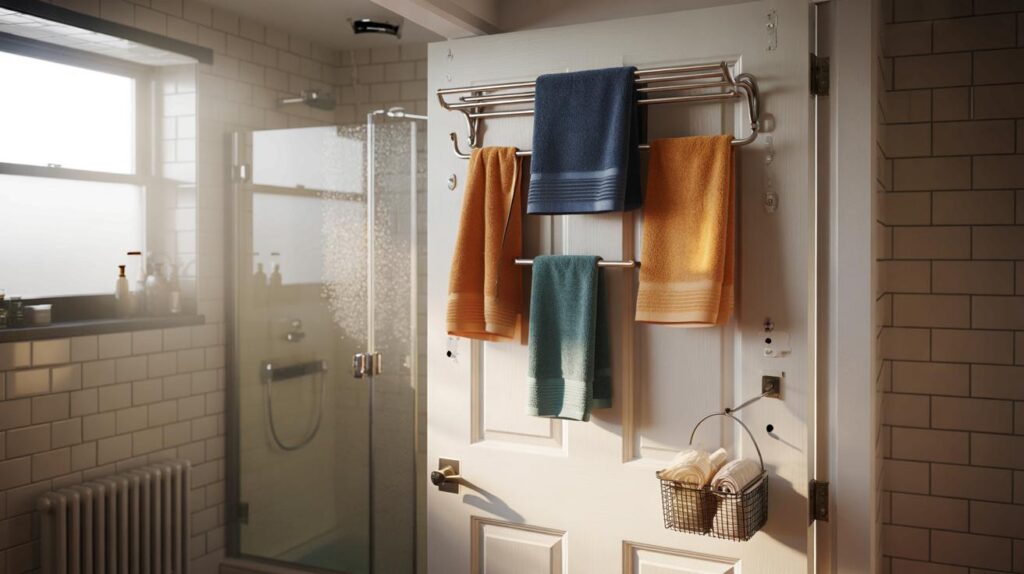
Start simple: an over-door rack with two to four bars or hooks. Measure the top of the door to check the bracket will slide over cleanly, then check the gap so it still closes once loaded. Aim for bar heights that match your household — one around shoulder height for a bath sheet, one mid-height for hand towels, and one low for kids. No drilling, no mess.
Go easy on the crowding. Two towels per hook sounds efficient until they never properly dry. Give each towel its own spot, smooth it out, and leave a finger’s width between bars to let air through. If you must drill, look for a rack that screws into the door’s solid edge, not the hollow core. Let’s be honest: nobody actually does that every day. So choose hardware that forgives a rushed morning.
You want things that survive steam: stainless steel, powder-coated aluminium, or water-loving plastics. Position the rack opposite the hinges if you can, so the weight sits on the stronger side when the door swings. Keep clearance from the toilet by opening the door slowly during setup and watching the towel edges.
“Drying beats storing every time. If the towel dries fast where it hangs, you’ve solved clutter and smell in one move,” says interior organiser Leah Burns.
- Pick over-door first; go adhesive or screw-in only if needed.
- Leave a 5–7 cm gap between bars for airflow.
- Choose wide hooks for less creasing and faster drying.
- Add felt pads where metal meets paint to stop scuffs.
- Colour-code hooks so everyone owns a spot.
The back of the door isn’t a hack; it’s a small shift in how a room works. It turns movement — that open-and-close rhythm — into air that serves you. It frees the radiator, calms the basin, and gives every towel a home that isn’t “wherever it lands.” Sometimes the smallest surfaces feel like a quiet victory.
It also scales. A renter can slide on a rack and take it to the next place. A busy household can stack higher, add a hand-towel loop at shoulder height, then a small basket hook near the handle for flannels. A minimalist can pick a single, elegant rail. The idea doesn’t demand a makeover. It just asks for that blank space to start pulling its weight.
Maybe that’s the charm. A door you never noticed becomes a partner in a smoother morning. You catch a dry towel without thinking, the bathroom clears faster, and the room feels bigger without getting bigger. Keep towels drier, longer.
| Key points | Details | Interest for reader |
|---|---|---|
| Use the door’s height | Stack two to four bars or hooks at varied heights | Fit bath sheets, hand towels, and kids’ towels without fighting wall space |
| Prioritise drying over storage | Leave gaps, smooth towels, position in airflow | Fewer smells, less laundry, faster mornings |
| Choose renter-friendly hardware | Over-door racks, felt pads, rust-proof materials | No drilling, no deposits at risk, quick install and removal |
FAQ :
- Will an over-door rack stop my door from closing?Measure the gap at the top of the door; most modern doors have 2–4 mm clearance. Choose a low-profile bracket and test with the thickest towel you’ll hang.
- What if my door is hollow-core?Skip heavy screw-in rails. Use over-door hardware or adhesive hook strips rated for humid rooms, and keep total load under 5–6 kg.
- How do I prevent mouldy towel smells?Give each towel its own bar or hook, smooth it open, and run the extractor fan for 15–20 minutes after showers. Wash every three to four uses.
- Is there a quiet option that doesn’t rattle?Add thin felt pads where the rack touches the door and a rubber bumper near the handle. Tighten any adjustable brackets to stop play.
- Can I hang more than towels?Yes: a small basket hook can hold flannels or hair tools, and a clip can keep a laundry bag. Keep it light so the door swings cleanly and safely.



Renter gold—no drilling, no drama.
Doesn’t this just mean slamming towels into the wall every time the door swings? My cat will file a compaint.